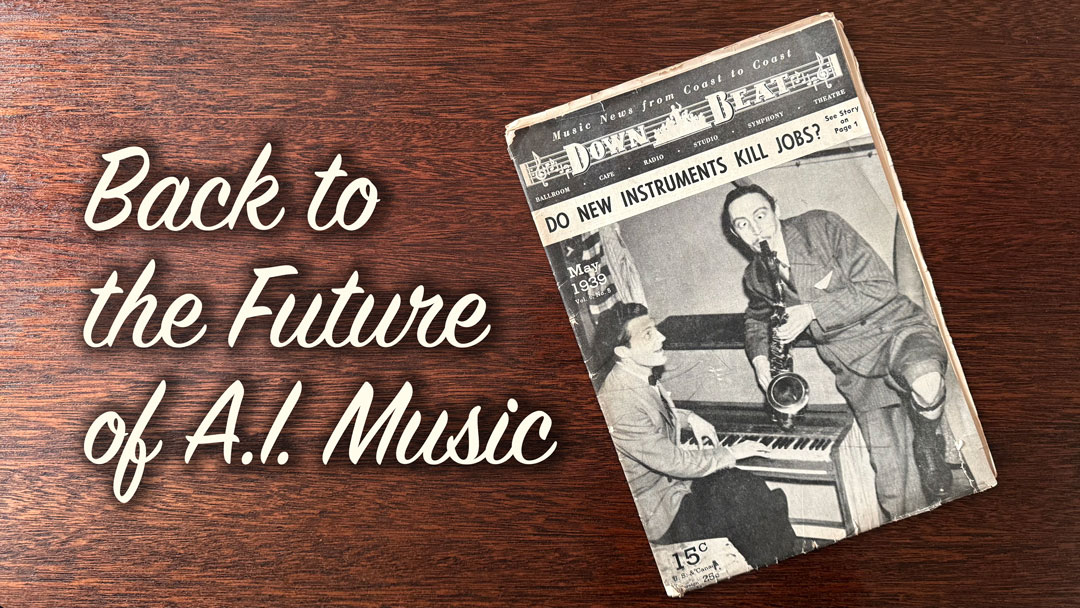
A few times a year, I have to drive through upstate New York, and to break up the eight-hour trek, I always visit a crazy used record shop along the way. It’s a dusty wreck, with vinyl, CDs, 8-tracks, magazines, busted turntables, abandoned instruments, moth-eaten concert shirts and more piled everywhere. You might find what you’re looking for, but you’ll probably leave with something you never even knew existed. That’s what happened to me last time I visited, when I pushed aside a pile of stuff and was assaulted by a magazine with a blaring, confrontational headline:
DO NEW INSTRUMENTS KILL JOBS?
That bold question wasn’t from a recent issue of some techie music mag though; it was splashed across the May 1939 issue of Downbeat, back when the venerable jazz/blues publication was a music industry newspaper covering everything from radio to theater to symphonies. Eighty-six years later, however, that headline still worked—it grabbed my attention, and I had to know: What was that industry-destroying instrument?
I grabbed the issue to read later that night and got back on the road. Of course, I had plenty of time to think, and eventually I guessed that those “new instruments” would probably turn out to be electric guitars, since they were invented in the 1930s.
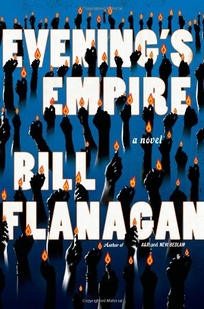 Like most people, I had only ever thought of electric guitars in a musical sense until 15 years ago when I read CBS journalist Bill Flanagan’s epic novel Evening’s Empire. It’s a fun story full of great characters, but it has this one moment where Flanagan basically hits the brakes on the plot for three pages so that he can theorize about the unseen forces behind popular music. He does this, naturally, by having two characters get into an argument at the 1989 NAMM Show. One shouts, “Rock and roll was just jump blues with an electric guitar taking over for the horn section. It was technological and it was economical—suddenly a four-piece band could make as much noise as a big band. It was cheaper, that’s why it caught on.”
That blew my mind when I first read it. I’d never thought of guitar playing as a cost-savings measure, but of course, these days, everything seems to get reduced to ROI, cultural value be damned.
And that brought me back to that 1939 issue of Downbeat: The main reason I bought it was because the headline—86 years old or not—sounded a lot like the ones I see every day, worrying about AI’s impact on music.
For many, AI music is still a novelty, as AI acts like The Velvet Sundown garner more than 1 million streaming subscribers despite not actually, you know, existing. The larger concern for the industry, of course, is that music that isn’t played by real musicians also doesn’t require real engineers, or producers, or studios, or gear…you get the idea.
• Craig Anderton’s Open Channel: AI and the Fingerprint Factor
For now, humanity has its own back: More and more studies are finding the public isn’t interested in AI-generated music, and the latest, conducted by iHeartMedia, discovered that 75 percent of consumers don’t want AI to be used in media or entertainment at all.
That’s good news, but as AI improves, will that pushback last? Maybe, maybe not—and maybe it won’t matter.
Historically, musical evolution usually goes in unexpected directions, regardless of technology wants it to do. Let’s go back to that old issue of Downbeat and answer the burning question: What was that job-killing new instrument?
It was the Novachord—essentially a vacuum tube synthesizer—and it was a big enough concern that the American Federation of Musicians forbade members from playing it in orchestras, said Downbeat, “on the theory that it is capable of imitating so many other instruments and lends such fullness that several musicians can be dispensed with.”
Again, fear of new tech putting music pros out of work sounds eerily like those anxious articles about AI—but the Novachord’s fate may give us some clues as to what we can expect as AI in music continues to evolve.
As you probably figured out, the tube-based synth didn’t kill jobs, because it never caught on; while it could do so much—including cut orchestras’ costs—only 1,000 Novachords were ever made. The idea of a synthesizer was pretty cool, though, and it eventually returned when technology caught up. By the time that fictional Evening’s Empire conversation took place 50 years later in 1989, music was awash in Synclaviers and Yamaha DX7s, jazz orchestras had vanished and rock was starting to fade in the face of hip-hop’s ascent.
None of that happened because of the Novachord, however, nor because of the shortcuts and cost-savings that it offered.
Discover more great stories—get a free Mix SmartBrief subscription!
World-changing developments, whether musical and economical, may be aided by technologies, but they’re driven by humans making choices and the random nature of existence. Musicians in 1939 might have had Novachord nervousness, but as Evening’s Empire pointed out, electric guitars were the next catalyst to shove music in a new direction, not a tube synth terror. And while an amplified six-string might have saved on personnel costs for jump blues bands, whoever made that call purely for economic reasons couldn’t have anticipated that it would lead to a new world-dominating sound, or that the instrument ‘s use would be radically reshaped by the likes of Jimi Hendrix and others.
The same will likely happen with AI: We can’t honestly predict where the technology will go in terms of music or how it will be used in the sounds of tomorrow. AI might well get shoved aside, just like the Novachord did. One thing you can count on, however, is that AI-generated or not, music made 86 years from now will still have to connect with people emotionally to be satisfying. If we could somehow hear that music today, we probably wouldn’t “get it,” but that wouldn’t matter so long as it clicked with the listeners it was made for. As the forward-thinking musicologist Marty McFly once put it, “I guess you guys aren’t ready for that yet—but your kids are gonna love it.”
—Clive Young, Co-Editor.