This article first appeared in the February 1995 issue of Mix
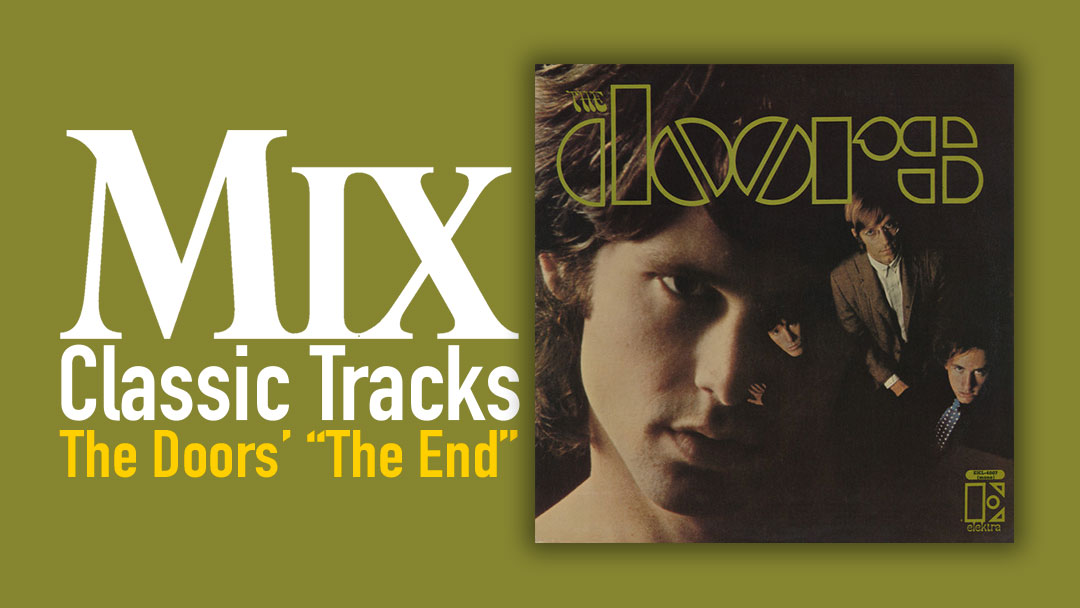
Yeah, yeah, I know: “Light My Fire” is the obvious choice for this column. But as a 14-year-old kid listening over and over to The Doors’ first album when it came out in 1967, it was the moody, 11-minute, open-ended, raga-rock opus “The End” that really sold me on The Doors and immediately made them my favorite group (besides The Beatles, of course) for the next couple of years.
Though I had some problems with the whole Oedipal subtext of “The End”—”Father.” “Yes, son.” “I want to kill you. Mother…I want to..aaauuuuughhh!”—a lot of the imagery in the song bent my mind in strange new directions, and I loved the way the song ebbed and flowed and built to its furious climax, and then resolved back at the main theme in such a sad but beautiful way. The song is an unmistakable artifact of the late ’60s—it was directly inspired by numerous LSD trips Morrison took—but it also has a floating, timeless quality to it that has allowed it to transcend that period.
By the time The Doors signed with Jac Holzman’s Elektra Records label in mid-’66 (after Columbia had signed them briefly but never made a record with them), they had already established themselves as one of the top club bands in Los Angeles, and Jim Morrison was one of the city’s true rising stars.
New York-based Elektra staff producer Paul Rothchild, who’d recommended the label sign the band after seeing several Doors shows at L.A.’s Whisky a Go Go, was assigned to make the group’s debut album, and he said from the outset that his approach was to make an “aural documentary” of the group, capturing the band’s powerful live energy in a studio setting.
The Doors’ classic first album was recorded over a two-week period in the fall of ’66 at Sunset Sound in Hollywood, with a 21-year-old staff engineer named Bruce Botnick manning the 4-track recorder and custom tube console. Shortly before the Doors sessions, Botnick and Rothchild worked with Tim Buckley’s Elektra debut at Sunset, so they had already established a good working rapport.
• Discover more great stories—get a free Mix SmartBrief subscription!
“Up until a year before that, I’d been doing everything 2-track,” Rothchild told me in an extensive interview way back in 1981. “Actually, though, most of the first album is 3-track. We’d put bass and drums on one track, guitar and organ on another, and Jim’s vocals on a third. We used the fourth track for a few overdubbing things. Like on ’20th Century Fox,’ I got the whole band onto a wooden platform and made them march. If you listen to the rhythm sound on the chorus, it sounds like a small German army! I’d just done a flamenco record where I’d used a similar idea…. We also overdubbed Morrison singing harmony to himself on a couple of things. Double-voicing was avant-garde. Overdubbing harmony certainly wasn’t new, but the idea of doubling a voice was still considered radical.”
Rothchild said that “The End” was one of the songs that originally convinced him that The Doors were a great band, and he knew from the outset it would probably be the centerpiece of the first album. “When “The End’ was first performed in the studio, we took almost a whole day to set it up, because it was a very complex piece to record,” Rothchild said.
“I remember exactly how I miked the session,” Bruce Botnick told me recently. “On the drums, we had a Sony C37 on the overhead, there was a C37 underneath the snare, an Altec ‘salt shaker’ on the bass drum and that was it. On the guitar amp was a Telefunken U47—they weren’t Neumanns at the time. The organ was a 47 as well, and then on the piano bass, it was direct. Jim’s vocal was a U47 as well, and I used a UREI 1176 limiter on it. Some of the album was 3-track, but I recall that ‘The End’ was 4-track: The piano, bass and drums were on channel one; Jim was on channel two; Robbie [Krieger, guitarist] and Ray [Manzarek, keyboardist] were separated on the other channels, so we had a little more control.
“There was a room echo chamber that was used on it—except for Jim’s vocal, which was an EMT plate—and they were all delayed using an old Ampex 200 that had been converted over to a 3-track, which had different record EQ and playback EQ settings,” Botnick continues. “So we could set the recording EQ to the AME, which was the Ampex Master Equalization setting, and do the playback at NAB [EQ setting), and that would goose the chambers and get the nice slap that I liked. That drove the two chambers. The room chamber was basically in stereo with two microphones in it: RCA 44s. The console was all-tube, built by a fellow named Allan Emig, who was the original engineer on Dave Brubeck’s ‘Take Five’ and a lot of the famous stuff over at Columbia Records. The 4-track was an Ampex 300; actually a 3-track that I had converted—I got a 4-track head stack made for it.”
Actually, the first attempt to record “The End” had to be abandoned because Morrison was too high on a combination of LSD and alcohol to perform in the studio. “We tried and couldn’t get it,” Rothchild told Crawdaddy magazine in 1967. “Jim couldn’t do it. He wanted desperately to do it. His entire being was screaming, ‘Kill the father, f— the mother!’ He was very emotionally moved. I have tried several times to record artists on acid, and it doesn’t work.”
Studio Magic
The next afternoon was a different story, however. As Rothchild told me, “When we finally got the tape rolling, it was the most awe-inspiring thing I’d ever witnessed in a studio. It’s still one of the top musical events of my life. When they were done, I had goose bumps from head to toe. It was magic. I went into the studio and told them exactly what I told you and then I asked them to do it again. ‘Let’s make sure we’ve got it.’ So they did it again, and it was equally brilliant. Afterward, Ray said, ‘Whew, I don’t think we can do that any better.’ I said, ‘You don’t have to. Between those two takes, we have one of the best masters ever cut.’ It turns out we used the front half of take one and the back half of take two. We did the same thing with ‘Light My Fire.’”
That isn’t the end of the story, however. Ray Manzarek told one writer, “Later that night [after “The End” session], Jim came back and went into the studio and took the fire extinguisher and hosed the whole place down—not the control room, thank God, just the area where the band was. Just to cool it down. That’s what he was doing. I know he was doing that. Just calming the whole thing down. ‘Wait a minute. Too much heat here, man.’ Stoned out of his mind. And the studio people came in the next morning; they didn’t know anything about it. [They] absolutely freaked. Paul Rothchild said, ‘Uh, don’t worry, don’t worry. Elektra will pay for it. No, there’s no reason to call the police. Just some minor vandalism. Don’t worry about it.’ He knew right away who did it. We all knew right away what had happened.”
• Classic Tracks: The Clash’s “London Calling”
The song was given a second life in 1979 when Francis Ford Coppola used “The End” during the brilliant opening sequence, and again during the dramatic denouement, of Apocalypse Now. (The Doors were one of the most popular bands among the troops in Vietnam in the late ’60s.) And the version in the film even emphasized the part that was buried in the original: Morrison rhythmically chanting “Fuck! Fuck! Fuck!” during the furious instrumental build-up near the song’s close. “Flat out, we knew ‘Fuck, fuck, fuck’ wouldn’t get on the radio, so that was censored,” Rothchild recalls of the original sessions. “It’s on the master, but it’s not upfront like it is on the Coppola-[David] Rubinson mix [for Apocalypse]. On the original, it’s there as part of the rhythm track, which was the original intent. It was never supposed to be a lyric.” Producer Rubinson also added some percussion that was not part of The Doors’ performance: “No one in our camp had anything to do with that,” Botnick says.
Botnick, who went on to record all of The Doors’ studio albums, and even produced their final record with Morrison in the lineup, L.A. Woman, personally remixed the original 4-track tapes of “The End” for one particularly spellbinding sequence in Oliver Stone’s overblown film The Doors.