This article first appeared in the May 1995 issue of Mix.
Here’s the thing: It’s never the band’s fault if you’re “sick of” a song or album. Led Zeppelin wasn’t personally responsible for me hearing “Stairway to Heaven” approximately 20,000 times on the radio in 1971 and ’72 alone. FM radio and my college friends conspired against me! I can still recognize that it’s a work of genius on many levels (indeed, I plan to investigate it fully in this column), even though I never need to hear it again.
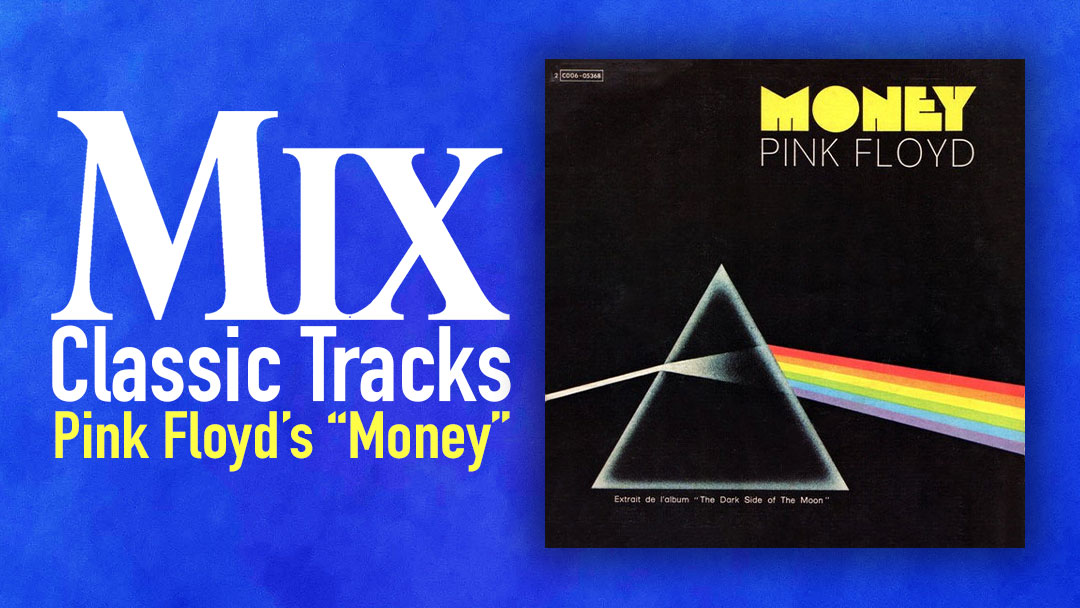
Likewise, I know a lot of people who are burned out on Pink Floyd’s 1973 masterpiece The Dark Side of the Moon simply because they heard it too much 20 years ago and because so much of it has been a staple of album-oriented radio ever since. Not me. Pink Floyd was one of my favorite bands from the first time I heard Ummagumma in 1969, and I saw each of the three U.S. tours the band played between that album and The Dark Side of the Moon—the Atom Heart Mother tour, Meddle tour and the awe-inspiring “Eclipse” tour, the latter featuring nearly all the songs from Dark Side a year before it came out.
Pink Floyd occupied a peculiar place in the pop music cosmos of the early 70s. Their roots were in the British psychedelic movement; indeed, their original leader, Syd Barrett, is widely regarded as one of the first casualties of the psychedelic revolution. He went mad (only in part from the injudicious imbibing of illegal substances, it should be noted), was ousted from the band, but later became a lyric focal point for some of Pink Floyd’s best material, notably songs from The Dark Side of the Moon and the equally brilliant Wish You Were Here.
Because of their sprawling, serious instrumental music, the Floyd were also dubbed “art rock” by some; others lumped them with so-called progressive rockers like (the original) King Crimson, Yes and ELP, though for my money the Floyd didn’t aspire to the sort of lofty, even pretentious, virtuosity that dominated that school. Listen to The Dark Side of the Moon or Wish You Were Here, and it’s clear that this band’s roots are more in blues than anything else, and that remains true to this day.
One thing the Floyd and the prog rockers did share was an interest in meticulous audio, both on their records and in concert. For better or worse, Pink Floyd heartily embraced quad, and to my knowledge they were the first major band to use a quad setup as part of their live show—keyboardist Rick Wright used to have a joystick panner on top of his organ that allowed him to swirl various effects tapes to speakers placed in the rear of a hall or up in the balcony.
• Discover more great stories—get a free Mix SmartBrief subscription!
Like so many bands that came up in the late ’60s, Pink Floyd was heavily influenced by The Beatles and their wide-open approach to both sonics and arrangement. In fact, it was around the time The Beatles were wrapping up their recording career with Abbey Road that Pink Floyd first hooked up with a young engineer who’d worked on that album, Alan Parsons.
Parsons did some assisting work on Ummagumma, he mixed the ambitious, difficult Atom Heart Mother, did some road work with the band as their live engineer and then was asked to stay on and record The Dark Side of the Moon at Abbey Road Studios during the second half of 1972 and January of 1973. Twenty-two years and more than 25 million copies of The Dark Side later, Parsons is quick to admit, “Things would have been very different for me had I not done that album. It did my career an enormous amount of good. I had no financial benefit out of it, but it gave me a great deal of credibility.” And it turned Pink Floyd into one of the most popular bands in the world.
In an era when the term “concept album” was bandied about rather casually, The Dark Side of the Moon truly was that—a multipart musical meditation on how society alienates us and in some cases drives us mad. The album’s songs were all deftly tied together by a mind-bending array of sound effects ranging from thumping heartbeats and ticking clocks to machine noises, odd mutterings and cackling laughter. Of course, it wasn’t just that aural thread that made the album such a great listen. The songs, written by and large by bassist and de facto leader Roger Waters, had memorable hooks and literate hut accessible lyrics. And one song, in particular, seemed to strike a chord in American listeners: the cynical, ascerbic “Money.”
“Money” was written by Waters during a series of pre-tour songwriting sessions in West Hempstead in early 1972. He built the song around an unusual 7/4 meter and, as was his custom, wrote the lyrics after the music (which was always designed to he about money) was already worked out. It was completed in time to be included with a number of other new songs for the big “Eclipse” tour of Europe and America that spring, so by the time recording sessions for the Eclipse album (the title was changed to The Dark Side of the Moon later) began at Abbey Road’s Studio 3 in June, the song had been seriously road-tested, with any kinks worked out.
“It started life on the road with another version of the well-known effects loop,” Parsons says. “It was lightly imperfect and didn’t have such interesting sounds on it.” And what do we hear on the finished version?
“There’s a cash register, a piece of paper being torn, a bag of money being dropped on the floor, a uniselector in a telephone exchange,” Parsons notes. “It was a combination of existing effects tapes in the archives at Abbey Road, and then things like the paper being torn and the money bags being dropped we recorded live. Although many sessions were in #3, we put the loop together in #2. In those days, everything was designed for quadrophonic, so we recorded all the effects on 4-track. The idea was that the money loop would revolve around the speakers, although being a seven-in-a-bar sequence, it came to a dead stop in the third of the fourth on the second time around, but it still sounded good. There was an SQ-encoded quad mix commercially available.”
Because of the sonic excellence of Pink Floyd’s albums and the fact that their productions usually sprawled over a period of many months, the group earned the reputation for being real sticklers in the studio, but, according to Parsons, “That’s been exaggerated, I think. If you were to take almost any band by comparison, the average production today is a whole lot more picky than the Floyd were in those days. They liked to experiment, and that sometimes took a lot of time, but in tern-is of actual performing, they didn’t play for hours on end making sure every note was absolutely perfect. They went more for a band feel a lot of the time.”
Parsons says the basic track for “Money” was cut live with all four players—bass, guitar, drums and Wurlitzer piano. “As I remember, the loop was the first thing to go down, and then we dubbed onto that, so there was only one performance in the end. In other words, we just did it until it was right—we kept erasing over the original performance until it was right. So I’m afraid there aren’t any other takes out there that nobody’s heard.”
• Classic Tracks: The Doors’ “The End”
The only significant instrumental overdubs are two additional David Gilmour guitar lines that snake in and out of the track and a couple of Nick Mason tom fills. “Most of the guitar sounds came from him,” Parsons says. “He had the main processing boxes of the age, like the EMS ‘High Fly,’ phasing pedals and a Binson Echorec, hut there were no real tricks on the miking. The Wurlitzer was probably done direct, maybe through a DI box. Roger’s bass, I think, was also direct, although sometimes I’d use a C-12 on his cabinet.” As far as production went, “Roger and David were obviously the main figures, but they all had things to say. It’s fair to say that Roger was sort of the sergeant-major.”
Asked what other records of the era might have influenced his and the band’s approach to recording The Dark Side of the Moon, Parsons replied, “Well, certainly, The Beatles, records like Abbey Road. Anybody from The Beatles camp was certainly in experimental mode. I think it was a thing that Abbey Road was particularly good for, because we had a large number of rooms and a large number of [tape] machines. You have to remember that everything was generated with tape machines in those days. There were no digital delays, no Harmonizers. Basically, if you wanted an effect, it was usually achieved with a tape machine. Sometimes, particularly on Floyd sessions, we would have machines stolen from other control rooms literally littering the corridors, with wires everywhere. It was quite a sight. There was also a room with four EMT plates in it on the top floor, as well as three live chambers. On the lead vocal of ‘Money,’ as best as I can recall, there’s a fast tape delay probably generated on a Studer A62, running at 15.” (Another simple effect—the long vocal delays on “Us and Them”—was achieved by using a 3M 8-track machine running slow, and using two tracks for each repeat.)
The snippets of different conversations that emerge during the long instrumental fade (and which also crop up on other tracks on the album) are an interesting story in themselves. Toward the end of the recording, the band invited about 20 different people—ranging from hand managers and roadies to Abbey Road staffers and musicians using other rooms at the studio—to sit down in the studio and respond to a series of questions that had been written down on cards: “When did you last thump someone?” “Are you frightened of dying?” “What is the dark side of the moon about?” etc.
Some of the answers were then creatively edited into different parts of the album, adding immeasurably to the texture of the work. Parsons and Paul McCartney were among the interviewees whose responses were not used; the stars of those sessions ended up being the infamous Roger the Hat, who then road-managed another band, another roadie named Pete Watts, and Abbey Road’s colorful doorman/janitor Jerry Driscoll, among others.
As Parsons notes, “Although everybody felt we were probably making the best Pink Floyd album to date, no one could have predicted it would still be on the charts ten years after it came out. I didn’t think of the Floyd as a singles hand, either, so the success of ‘Money’ in the U.S. took everyone by surprise.” Indeed, the song wasn’t released as a single in the UK. In America, “Money” made it as high as Number 13 on the pop charts in May of 1973—the band’s only charting song until “Another Brick in the Wall” hit Number One seven years later. (Many U.S. radio stations bleeped the second half of the word “bullshit” from the last verse.)
Pink Floyd was—and still is—an album band first and foremost. Even at the time, the success of “Money” was a double-edged sword for the group. As David Gilmour said a few years ago, “We were used to these reverent fans who’d come and you could hear a pin drop—we’d try to get really quiet, especially at the beginning of ‘Echoes’ or something that had tinkling notes, trying to create a beautiful atmosphere, and all these kids would be there shouting ‘Money’!” Decades later, that’s still happening.