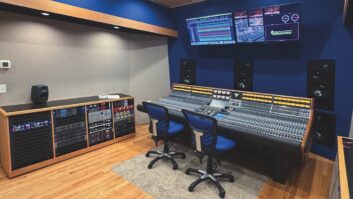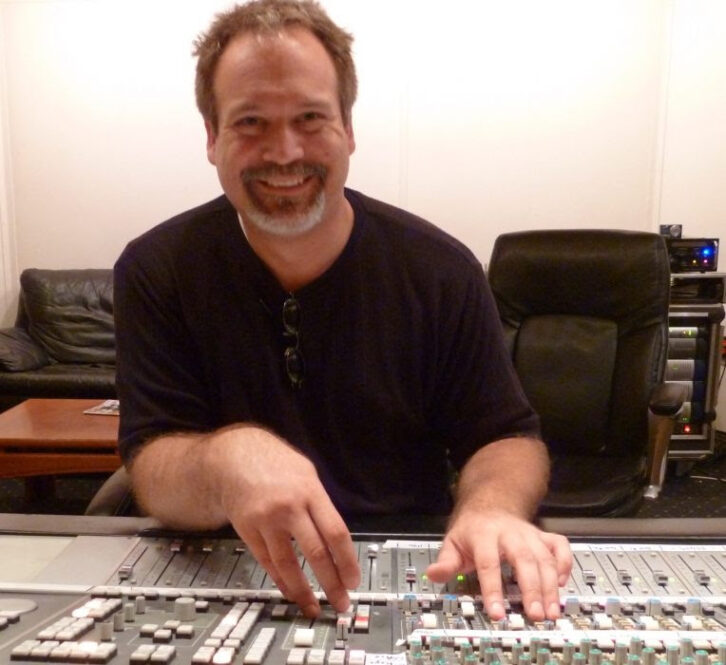
Murfreesboro, Tennessee, December 18, 2025 — Michael Hanson is a music producer, engineer, and educator who has worked with artists including Emmylou Harris, Keith Urban, The Black Crowes, and Ronnie Milsap. He serves as an Associate Professor of music production and recording at Middle Tennessee State University (MTSU). In his graduate-level production course, Hanson recently introduced Immersive Design Labs’ microphone array as part of a class demonstration. He used the system to reinforce core recording fundamentals while giving students an early look at concepts that carry over into immersive audio workflows.

Hanson sees immersive audio as an essential part of the modern audio landscape and believes students should be exposed to it during their studies as part of a well-rounded education. “Looking at the music market today, immersive audio has to be a consideration for everybody,” he says. “If you start talking audio for gaming, film sound, television, broadcast, things of that nature, we are already doing this. And if you look at expanding a curriculum, immersive audio for music needs to be part of the equation.”
As part of an in-class recording demonstration, Hanson used the IDL microphones and array to reinforce the fundamentals of stereo recording while finding natural points to expand the discussion toward immersive techniques. “You have to master and understand what is happening in stereo before you can jump to eleven speakers around you,” he says. “The IDL array lets me dip a toe into immersive so students realize what can change, and it allows me to connect so many dots and inspire other thoughts.”
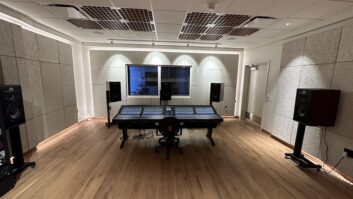
In the same class session, Hanson asked students to evaluate a stereo capture made with the array before hearing the identical performance played back in an immersive room. The comparison helped them understand how spatial information translates across formats. “The students could hear the difference,” he says. “They realized it sounded good in stereo, and then, when we went immersive, they said, ‘I feel like I am standing in the room.’ It made the ideas clear, even for those who have not yet taken immersive audio courses.”
The IDL system also helped reinforce core audio principles that Hanson’s students will rely on throughout their careers. The array gave him a practical way to demonstrate calibration, level matching, and microphone behavior in real space. “Grab a mic and a calibrator, and I can truly calibrate mic levels,” he says. “If we did not calibrate, everything is out of whack and out of skew. It allows me to talk about the inverse square law and what happens as sound moves through space.”
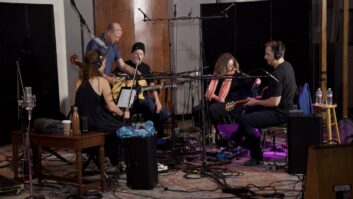
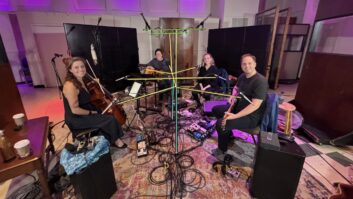
During this classroom recording experiment, Hanson moved musicians around the array so students could hear how distance, separation, and placement affect the capture. This approach helped clarify concepts like the three-to-one rule and ambient pickup without relying on abstractions. “Basic concepts of audio come to life,” he says. “When the sound reaches the other microphones, it is quieter, but it is still clean, and it still works, and now it becomes ambient.”
For Hanson, these exercises echo the earliest days of recording, when engineers mixed by physically positioning musicians around a single horn or microphone. “We just moved the musicians around, and everything worked. Everybody was saying it sounded good,” he says. “It became an easy allowance for me to reinforce fundamentals of audio while helping students realize the interest that immersive can bring to setting a stage and setting a place. It has been great to bring into the classroom.”
To learn more about Immersive Design Labs and its approach to immersive recording, visit www.immersivedesignlabs.com and follow the company on Instagram and YouTube.
About Immersive Design Labs
Immersive Design Labs (IDL) is redefining the future of immersive audio by grounding its products, methodologies, techniques, and research in the core principles of sound physics and human psychoacoustics. The company’s approach merges cutting-edge technology with a deep understanding of how humans perceive sound, creating innovative solutions for the next generation of immersive audio experiences.