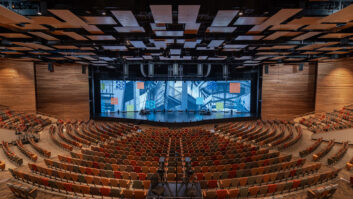
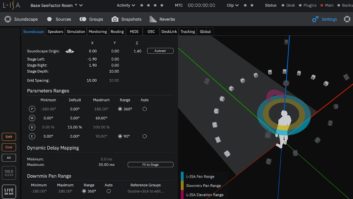
Photo above: L-Acoustics L-ISA allows Asbury Church to quickly transition between different spatial scenes for its contemporary and traditional services with the push of a button
Asbury Church was organized in 1962 with nine members. More than six decades on, it is one of the largest congregations in Oklahoma, drawing some 3,300 worshipers a week to its Tulsa campus, and it asks a great deal of a single room: a choir-and-orchestra service at 9am, a worship band at 11am, and periodic combined services that put as many as 126 inputs on the console at once. The purpose behind all of it is constant. “They’re not there to entertain people,” says DC PRO CEO Daniel Connell. “They’re there to help bring emotion into the worship experience, to draw people in.”
Two things stood in the way of that goal. The sanctuary’s previous system was reaching the end of its service life, and the room itself had dead spots, areas where the high frequencies disappeared, and pockets of power where hangs overlapped, which meant it had never achieved even sound coverage. Asbury’s production team had learned to work around all of it. In early 2025, the church asked Broken Arrow, Oklahoma AV systems integrator DC PRO to find something better.
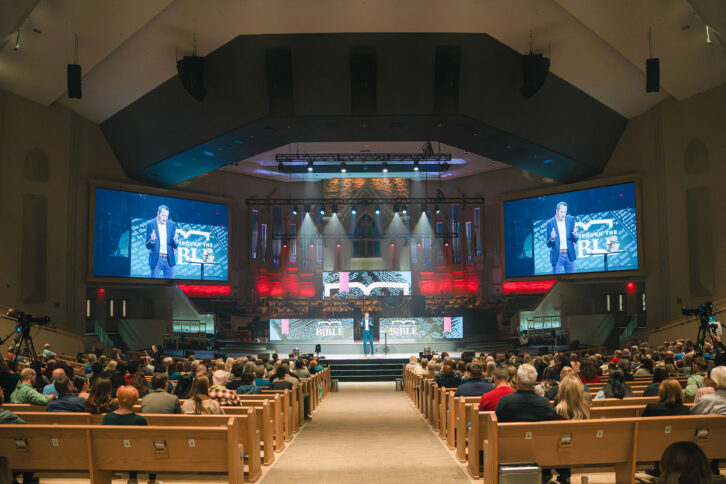
DC PRO Specifies a Full-Surround L-ISA Immersive Hyperreal System
Connell’s team evaluated designs from several manufacturers before specifying L-Acoustics L-ISA in its full Immersive Hyperreal configuration, including frontal arrays for localization, and surrounds to let sound objects move around the room. “No other system offered the creative flexibility required to support two polar-opposite services every Sunday at the level of excellence Asbury expects,” Connell says.
That flexibility matters because the room has to change character on a schedule. The traditional service fields a full orchestra and choir every weekend. Then, within 30 minutes, the stage is reset for amplified guitars and drums. Now, instead of retuning a left-right system twice a Sunday, Asbury recalls a different spatial scene at the push of a button.
The surround layer earns its place on the same argument. With the congregation inside the soundfield rather than in front of it, position does work that level alone cannot. “It gives them the immersiveness and localization that lets the audience really connect with what’s going on onstage,” Connell describes.
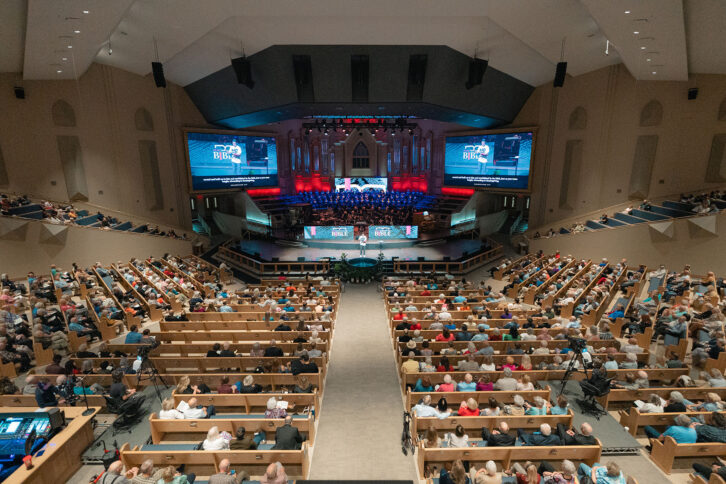
L2D Scene, Kiva II Extensions and KS21i Low End Across the Front
The new frontal system is built on five arrays of L-Acoustics L2D forming the L-ISA Scene. Far left and right Extension arrays of eight Kiva II each widen the image, and two further arrays of eight Kiva IIi sit behind the Scene 1 and 5 hangs to cover house left and right.
Low-frequency reinforcement comes from a dozen KS21i flown directly behind the center Scene array in three adjacent hangs of four, the bottom cabinet of each group reversed for cardioid performance. A dozen low-profile SB10i spread across the face of the stage extend that to the front rows, which are also served by ten X8i along the lip of the deck for spatialized front-fill.
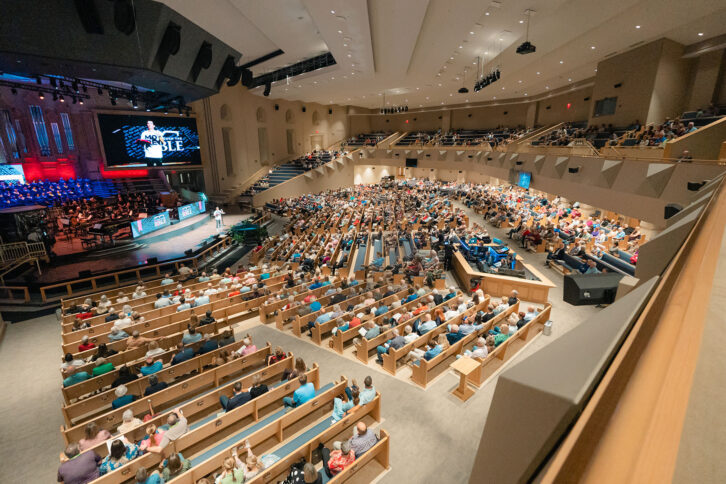
X Series Surrounds Wrap the Room from Balcony Face to Back Wall
Out in the house, six coaxial X15, three per side, run along the upper left and right front sides of the auditorium. Eleven X8i mounted to the face of the balcony fire into the orchestra seating level, and 15 smaller X6i on the back wall of the over-balcony section close the surround field behind the congregation. Under the balcony, 15 more X6i mounted just below the lip provide delay coverage, with a pair of X12, one per side, flown over the far left and right sides of the balcony as supplementary delay fills.
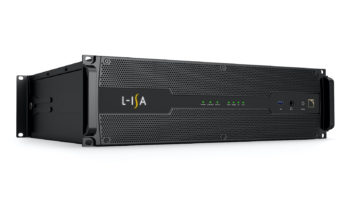
Onstage, six X8 are available as monitor wedges for the worship music team. L-Acoustics LA7.16i amplified controllers drive the main system components, LA1.16i power all of the X8i and X6i, and an L-ISA Processor II renders the auditorium’s object-based immersive mix.
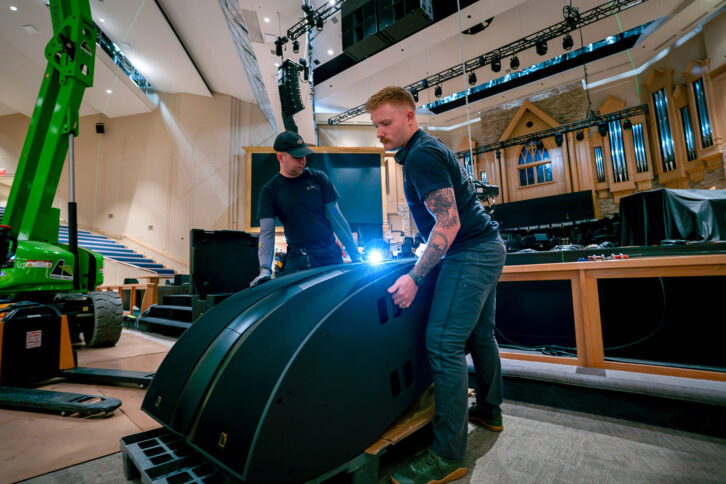
L-ISA Gives Asbury Space in the Mix Without Reaching for EQ
Daniel Yarbrough, Asbury’s Production Director, mixes most of the services himself, and the problem he describes is a crowded one. Across two services and up to 126 inputs he wants transparency—microphones, strings and instruments reproduced without being colored—while still separating one source from another. On a left-right system, that separation has to be bought with EQ and compression.
L-ISA lets him achieve it with position instead. “Not only is the mix coverage just incredibly even across our whole room, but it’s also creating wonderful ways for me to be able to place things spatially to create that space in between objects,” he says. “And we’re finding ourselves being able to hear every instrument with such incredible clarity.”
The working method has changed with it. Yarbrough now keeps his inputs close to full range and separates them by moving them. “All I have to do is move it spatially to create separation and add a little width on something, and we create that separation through spatial balancing,” he says. “I’m not having to work nearly as hard to try to find that spatial balance in the room and glue everything together.”
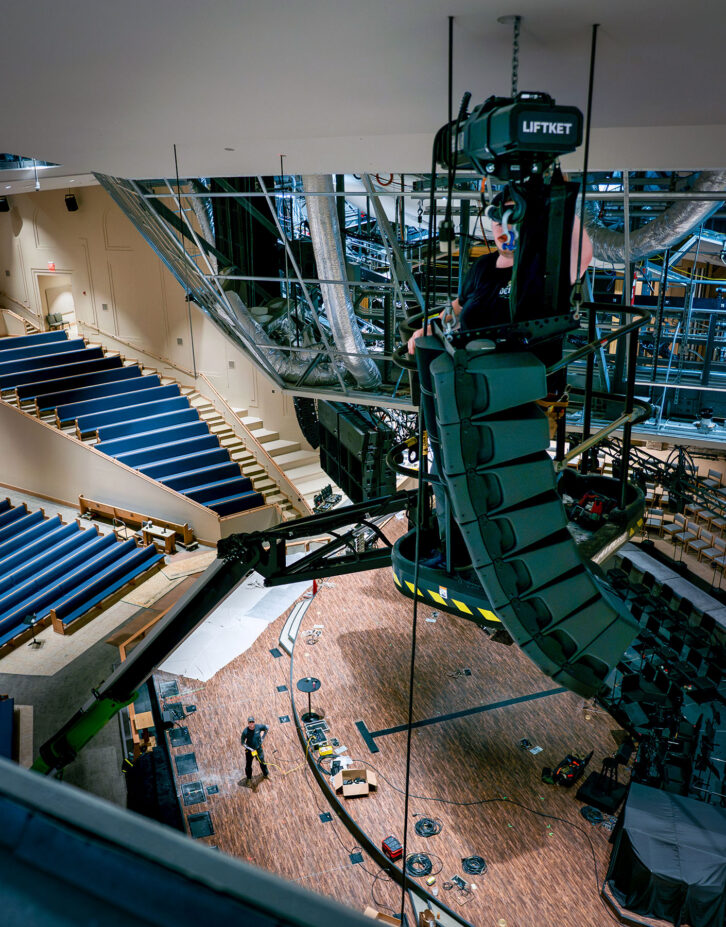
L-ISA Evens Out a Difficult Room
The spatial system has also gone a long way towards answering the acoustical problems the sanctuary had long endured. Where the old PA presented two sources, the new one presents seven across the front, counting the Extensions, and Yarbrough can transfer energy between them rather than driving the room from the same two points.
“I’m not getting these power pockets throughout the room,” he says. “In our old room, there were traditionally dead spots or areas where you’d lose all the high frequency. There was always some kind of compromise needed.”
Connell expects more churches to arrive in the same place. “Part of a worship-service dynamic is that you want to be very engaged, and every little detail matters,” he says. “The L-ISA technology at Asbury Church is a great example of what the future will sound like for a lot of churches.”
For Yarbrough, the measure is simpler. “We have great balance in every seat across the entire room right now, which is just an unbelievable win for us,” he says. “There is no compromise in the mix quality at every seat in the house.”
For more information on Asbury Tulsa, visit www.asburytulsa.org. DC PRO can be found online at www.dcprolva.com.
Please visit L-Acoustics at www.l-acoustics.com.