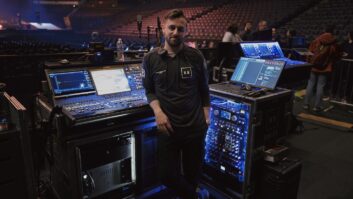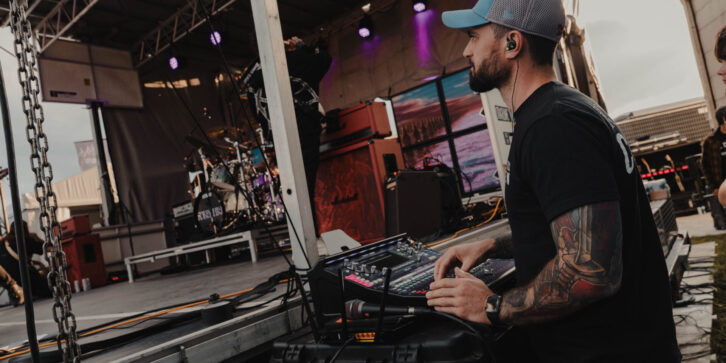
Bloomfield, Conn.—When Keith Loboda started out, he wanted to be a rock star—until he realized he’d rather be working for rock stars. Initially working as a house engineer at a local punk rock venue, he’s now been with progressive rock group Polyphia for seven years and recently invested in a compact Allen & Heath console.
When he started with the band, Loboda would mix Polyphia on each venue’s house console. But as Polyphia’s crowds grew, so did Loboda’s need for consistency. “I started seeing other engineers with these compact fly rigs,” he recalled. “Between the different rackmount mixers and compact surfaces like the [Allen & Heath] dLive CTi1500, those seemed like manageable systems for travelling with.”
The idea of consistently working on the same console at every tour stop was appealing, so Loboda invested in his own Allen & Heath SQ-5. “It was such a wonderful decision to make,” he recalled. “I can take the console and GX4816 stagebox on a plane with me and it’s below 50 pounds.”
Loboda also appreciated the workflow that SQ provided. “It felt like an analog console, but with all the benefits of digital,” he explained. “And it sounded incredible with the 96 kHz processing and plugins. I also love the built-in USB interface for multitracking every show. It had everything I needed in the box.”
In addition to the stock dynamic processing and FX, Allen & Heath offers add-on plug-ins for more advanced tinkering. “The Opto compressor is probably one of my favorites,” he said. “I’m also starting to learn how to use the multiband compressors and dynamic EQs.” Loboda notes that Dynamic EQ is especially useful with Polyphia for taming the low end in their backing tracks. “I try to keep the backing tracks from masking the kick drum and bass guitar. The dynamic EQ can ensure that the kick drum can still pound through without competing.”
Discover more great stories—get a free Mix SmartBrief subscription!
Polyphia’s critical guitar tones are sculpted through Neural Quad Cortex DSPs, which change settings throughout a performance using MIDI commands from the playback computer. Loboda also makes changes at the console to further create separation between them. “Both guitars are in stereo, and I pan one of them a little wider and keep the other more inward,” he explained. “I also use slight EQ changes to keep them from competing in the mix.”