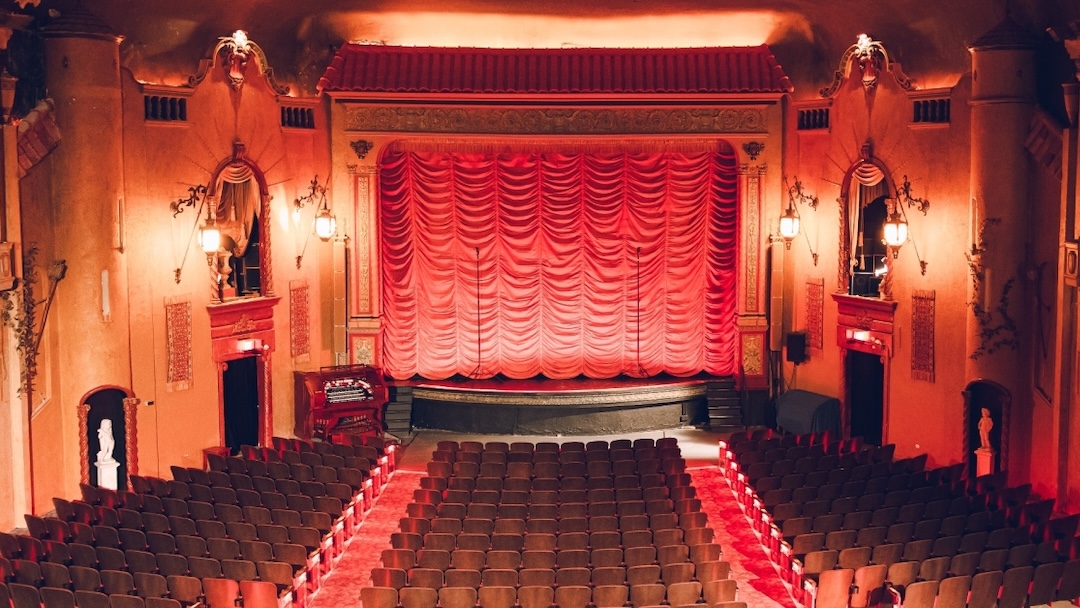
Chicago, IL (August 6, 2026)—Films with sound first appeared in 1927, and Chicago’s Music Box Theatre opened its doors just two years later, making the most of that cutting-edge new technology. Fast-forward nearly 100 years, and the Music Box is still around as a beloved historic cinema presenting art house fare and more. Keeping up with the times, the venue recently undertook a massive audio upgrade that had to meet the expectations of modern audiences while respecting the architectural and acoustic constraints of the historic building.
The new audio system was co-designed by Hollywood’s Post 43’s Bill Steel and cinema specialist dealer and integrator Kinora, which also installed the upgrade.
• Discover more great stories—get a free Mix SmartBrief subscription!
The theatre’s new Alcons Audio system features a front-stage configuration consisting of two CRA24N/90bi and one CRA24W/120bi pro-ribbon screen systems for the center channel, complemented by left and right channel arrays comprising four QR24 line-source columns with a QB242 low-frequency extension each. Low-frequency reproduction is provided by a pair of CB362 high-output double 18” subwoofers, powered and managed by a combination of Sentinel10 and Director6 4 and 8-channel amplified loudspeaker controllers.
To help maintain the visual integrity of the theatre’s interior, all left and right loudspeakers were custom color matched to blend discreetly into the venue’s architecture; meanwhile, the subwoofers and CRA cluster live in a center channel alcove behind the projection screen.
• Les Mis Goes Immersive at Radio City Music Hall
Music Box Theatre technical director Julian Antos noted, “The system reproduces the wide variety of soundtracks we play beautifully and accurately, from sweeping 70mm epics, to blockbusters, to films recorded at the very dawn of sound. We’re particularly thrilled with the system’s handling of older mono optical soundtracks, delivering clear, warm, and intelligible audio. Installing an Alcons system put an end to complaints about dialogue intelligibility and listener fatigue, and was one of the best investments we’ve ever made in our theater.”