This article first appeared in the April 1995 issue of Mix.
By 1972, the classic songwriting formulas that had made Motown Records into an unstoppable commercial giant were tired and no longer guaranteed to rocket songs to the top of the charts. Some of the bands that had dominated what became known as Motown’s “Golden Decade” were beginning to fray around the edges, as well. The Supremes were in disarray following the departure of Diana Ross. The Four Tops, in a skid since the departure of the Holland-Dozier-Holland songwriting team from Motown, left the label themselves in ’72. Smokey Robinson broke away from The Miracles. The Marvellettes were on a downward spiral.
Younger Motown acts like the Jackson 5 and Stevie Wonder took up a lot of the slack, and then there were two acts from the first wave that continued to light up the charts: Marvin Gaye struck gold with a series of politically conscious songs like “What’s Going On” and “Mercy Mercy Me (The Ecology).” Meanwhile, The Temptations, propelled by a spate of great Norman Whitfield-Barrett Strong songs like “Can’t Get Next to You.” “Just My Imagination” and the topical “Ball of Confusion,” managed to weather stylistic shifts by embracing the changes. The Temptations forged a psychedelic soul sound in the late ’60s, and in the early ’70s recorded songs that—like Gaye’s—tapped into the still-burgeoning black pride movement.
In the grand scheme of things, it could be argued that The Temptations’ salad days were behind them in 1972. The group had been together for ten years and put 31 songs on the pop charts (13 in the Top 10), but three of its five voices—David Ruffin, Eddie Kendricks and Paul Williams—had left to pursue solo careers. A little more than a year after “Just My Imagination” hit Number One, The Temps went back into the studio with two new singers, Damon Harris and Richard Street, joining original members Melvin Franklin and Otis Williams, and four-year vet Dennis Edwards. If the old blend of voices was not what it once was, there was still one very important constant for the group: producer/songwriter Norman Whitfield.
• Subscribe to Mix Magazine and our Weekday Newsletter for free!
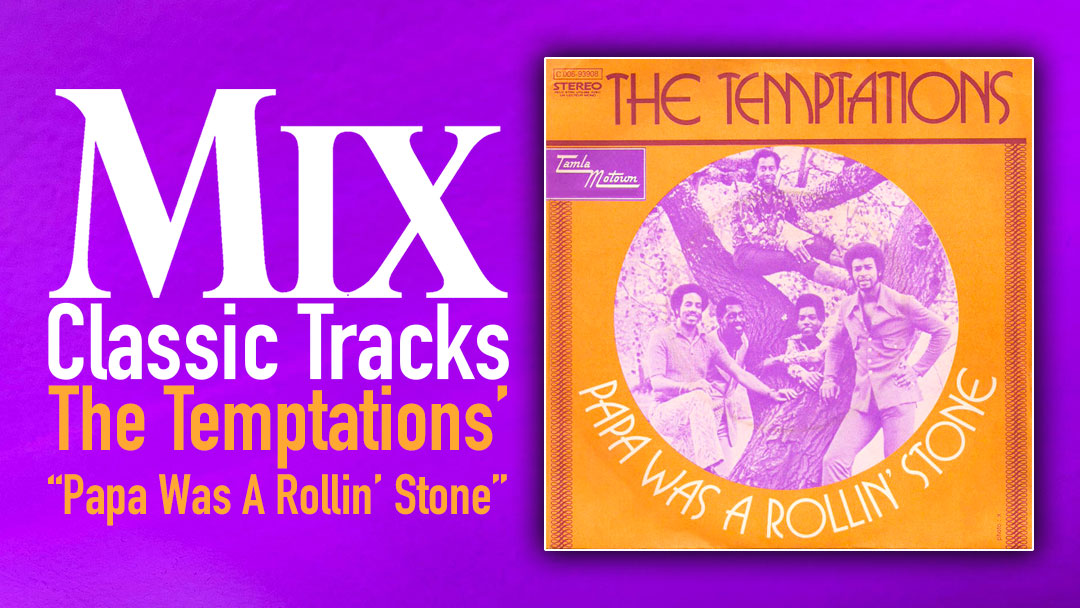
And in the spring of ’72, Whitfield (with his frequent collaborator Barrett Strong) came through for The Temptations one more time, providing the group with what was to be the group’s last Number One song (at least on the pop charts; they continued to score R&B hits through the ’80s). That song was the monumental classic “Papa Was a Rolling Stone.”
Actually, “Papa Was a Rolling Stone” was already something of a known quantity in the R&B community: Whitfield had cut a much different version of the song with the group the Undisputed Truth (“Smiling Faces Sometimes”) earlier in the year, but it didn’t catch on the way Whitfield hoped it would. So when Whitfield brought it to The Temptations, he had an entirely new vision for the song. And although 1972 was to be the year that Motown made its big move to Los Angeles (where the label had already had a large presence for several years), “Papa” was still a Detroit product through and through, recorded at Motown’s studios with a group of both young and veteran session cats and house engineers led by Orson Lewis.
Clocking in at nearly 12 minutes, the song is one of the most ambitious productions to ever come out of Motown. At its heart is a pulse laid down by the late, great bassist James Jamerson, drummer Andrew Smith (who was only 21 at the time), percussionist Jack Ashford, and the ultra-funky and rhythmic guitar duo of Paul Warren (who was just 18) and Melvin Ragin (who more than lives up to his nickname “Wah-Wah”). The late Earl Van Dyke lays down a soft and spacy Fender Rhodes line, and John Trudell, sounding like some weird cross between Miles Davis and Sly & the Family Stone’s Cynthia Robinson, plays piercing Echoplexed trumpet lines that rise and fall in short bursts all through the song. A small string section, masterfully arranged by Paul Riser, makes quick runs around, through and on top of the beat, then slows down here and there to sound almost sweet. Drifting in and out of the ever-shifting arrangement is a lone harp—an angelic voice in what is otherwise a rather dark and ominous track.
After a nearly four-minute instrumental introduction, the verses begin, with each of the singers handling different parts of the narrative, which paints a sad and disturbing portrait of a problem-plagued, absentee father in the ghetto. The chorus, with all the Temps singing, accompanied by cracking, percussive handclaps, is among the best known in contemporary music: “Papa was a rolling stone/Wherever he laid his hat was his home/And when he died, all he left us was alone.” For its time, it was quite a statement about one kind of urban black family, and its power has not been diminished by time.
Whereas tracking in Motown’s early days was almost always done live, by the late ’60s and early ’70s, the standard m.o.—at least for sessions produced by Norman Whitfield—was to stack instruments, building from the rhythm track, and adding vocals and any sweetening later. Most of “Papa Was a Rolling Stone” was recorded at Hitsville Studio A on West Grand Blvd. in Detroit. According to Mike McLean, who was the head tech for Motown’s studios from the early ’60s until April of ’72, “Hitsville is where all the rhythm tracks were done. It was equipped with an Ampex MM1000 16-track tape machine, no Dolby, and it was supported by an assortment of little mixers. It didn’t even have a console. It was mainly just a tracking room. It had very good acoustics because years earlier we had installed some sophisticated sound treatment that was based on the old RCA [Studios] design.
“Then we had another facility,’ McLean adds, “that was known as the Davidson Avenue facility—or Day—which is where string parts and some other things were usually done. This is the facility that was originally developed as Golden World Records. It was a big, big room with acoustics that weren’t nearly as sophisticated [as Hitsville]. We had these huge baffles—giant panels that are usually used to make soundproof rooms for audiometry testing. They were four-inch thick, steel-covered things with custombuilt wheel bases. They were massive panels, but very helpful in that room. They gave the engineers a lot more control. Davidson Avenue also had an MM1000 16-track and a homebrew console with some Neumann EQs and Op-amp Labs stuff.”
Mixes typically occurred at a third site, the Motown Center, which housed two mix rooms, each equipped with $50,000, custom-built Electrodyne consoles and a mastering room. “The Electrodynes were considered quite revolutionary for the time,” McLean says, “because of the VCA design. We had eight subgroups and we could switch the faders for the 16-track mixdown.” Each mix room also contained four Altec 604-E loudspeakers in a quad arrangement. According to McLean, “It sounded pretty impressive when it was panned around those big speakers.”
Drummer Andrew Smith remembers that “working for Norman Whitfield was extremely demanding, to say the least. He always had a very strong idea of what he wanted to hear, and he was always able to get great performances out of us.”
“The way all his sessions started out was he’d have breakfast there for us,” percussionist Jack Ashford recalls. “Then what he’d do was pass out the chord charts, and we’d start running it down. He took total charge of his sessions. If there was an arranger, he’d usually be sitting off in a corner, because Norman might have one idea when he gave the tune to the arranger, but by the time he got to the studio and heard it all hit him at once, it usually altered his original plan. On that particular song, I remember at one point he said, ‘Let’s just leave the two guitars going and the rest of you take a break.’ He sent us all out and then he worked with them for a while. He’d do that sometimes— work on the drums and the bass, let everyone else go. He would lock down the parts that he viewed as the nucleus of the song first. Then, after he got that together, he’d bring everyone else in, he’d kick it off, and it would melt right together. It was tremendous. His personality would make you want to play. He was the dominating force, but at the same time, he didn’t get in the way of what you did.”
• Classic Tracks: The Emotions’ “Best of My Love”
About the “Papa” tracking sessions, Smith adds, “Norman started conducting us one by one, as far as what he wanted. It turned out to be like an ESP situation. It was one of those sessions where if you were a creative player, you had to really tune in with your antennas to his body language, and his humming once in a while, to feel where he was coming from. Basically, he hummed the beat he was after to me, and I got on top of that. What he wanted me to do was establish a heartbeat for the song, so he could work around it. Once we had that heartbeat pumpin’, then he started creepin’ around the room like he was a Svengali or something. It’s true, he would point, one by one sometimes, to the different musicians to give them their cue, and they had to tune in on their ESP levels to make sure they were locked into exactly what he wanted. Little by little, this is how he mixed his potion.”
I ask Smith if it was hard to sustain the same beat for 12 minutes. “Man, 12 minutes is an understatement, because we did a lot of different takes of it,” he answers. “I remember that day when I left the studio, my head was throbbing; my brains were throbbing. That song required all the concentration I had to keep that beat steady. It sounds simple from the outside, but those are sometimes the hardest ones to play. I couldn’t skip a beat or slide—I had to keep that heartbeat goin’ every second.” The musicians had no vocal guide track to work with: “Norman kept it all in his head, and sometimes you’d hear him hum a line or sing a little to himself. He always knew exactly where he was,” Smith says.
The singers usually added their parts to the finished rhythm track in a separate session. In the case of “Papa,” there was also a major overdub session at Davidson Avenue to add guitarist Paul Warren’s colorful, snaky leads. The string session also took place at Davidson Avenue, closer to the mix. In all, there were four cutting sessions: May 15 and June 14, 22 and 28, 1972.
Motown engineers in that era used Neumann mics almost exclusively—head tech McLean says he was particularly fond of the KM86 and once ordered 50 for the studios. “I thought it would be great to have one all-purpose mic,” he says, “but of course the engineers complained that it wasn’t giving them enough flexibility, and I suppose they were right. I was being a little idealistic.” Instruments and amps were generally miked quite close, with plate reverbs and the occasional overhead mic providing track ambience.
Whitfield, who has always eschewed talking to the press and remains a very private person to this day, is best known as a brilliant songwriter, but his later Temptations work—from “Ball of Confusion” to “Papa Was a Rolling Stone”—offers vivid testimony to his production genius as well. These are highly complex arrangements that required serious mixing chops. At Whitfield’s direction, Motown’s engineers managed to make these often-dense songs into colorfully coherent works of art. “Papa,” mixed by Whitfield and Orson Lewis, represents the apex of his studio genius. It’s an airy, atmospheric track loaded with interesting touches that never overwhelm any other element.
When The Temptations’ “Papa Was a Rolling Stone” was released in the fall of 1972, it was an instant smash, hitting Number One in a shortened (seven-minute) mono version, and propelling the album on which it appeared—All Directions—all the way to Number Two on the pop charts, their highest-charting album of new material ever.
“We knew it was special at the time we made it,” Jack Ashford says today. “Even without the vocals, you could tell something was goin’ on. It had a certain vibe to it. But you know, we didn’t really know we were making history because we were too busy living it. It was that way with all the songs. We were just playing music, man.”