Cornelius, NC (December 5, 2025)—The 1990s were hip hop’s golden age, a time when the genre emerged from its underground roots to dominate global culture. On the West Coast, Dr. Dre and Snoop Dogg locked G-funk into the charts. In New York, Wu-Tang Clan and Nas pushed rawer, street-driven sounds. Rap was a dominant cultural force, but as the coasts carved out distinct identities, most artists fell neatly into one camp or the other.
Doug Rasheed wasn’t interested in either lane. A working musician turned producer, he was chasing something bigger, more musical, more cinematic. “The producers that I emulated were Teddy Riley, Jimmy Jam, Terry Lewis, Babyface,” Rasheed explains. “It wasn’t really the hip hop producers, even though I like Dr. Dre and I loved what he was doing. That wasn’t really me. My natural progression was to go to a more musical style because I played in bands.”
Rasheed met manager Paul Stewart while working as a security guard at Sony Pictures Studios, hustling beats and looking for an opening in Los Angeles’ music industry. The two clicked, and in 1994 they made a bold move: leasing a Hollywood Hills mansion owned by jazz great George Duke. “We said, look, man, we need to look big to be big—so we went for it,” he says. “We weren’t really making money at the time, but we dove in, and that’s how it all started.”
Inside, Rasheed set up his Akai MPC 60, Minimoog, Roland JV-1080 and Yamaha BB-5000 bass, and started making music. The space became a clubhouse, a proving ground and a space where artists filtered in and out. “It was competitive and it was fun,” Rasheed says. “If it was whack, they would tell you, ‘No, man, that’s not it.’ You had to have thick skin, but it was a great environment— Coolio, Montell Jordan would come through, Tyrese before he got signed, Ray J. A lot of people who became successful were hanging out there.”
At parties, Rasheed and Stewart would pull records from their collections, competing to see who could find the best samples. One night, Rasheed pulled out his mother’s old copy of Stevie Wonder’s Songs in the Key of Life and landed on “Pastime Paradise.” Its opening loop was hauntingly spare: hand percussion and Yamaha GX-1 synth strings, a riff on Bach’s Prelude No. 2 in C Minor. To Rasheed, the sparseness was an invitation.
“I was looking for something that would be easy to chop up and loop up and something that wasn’t really full; I wanted to add music to it,” he says. “When I heard it, I knew I could lock it in.” What started as a game had just become the spine of one of the defining tracks of the decade.
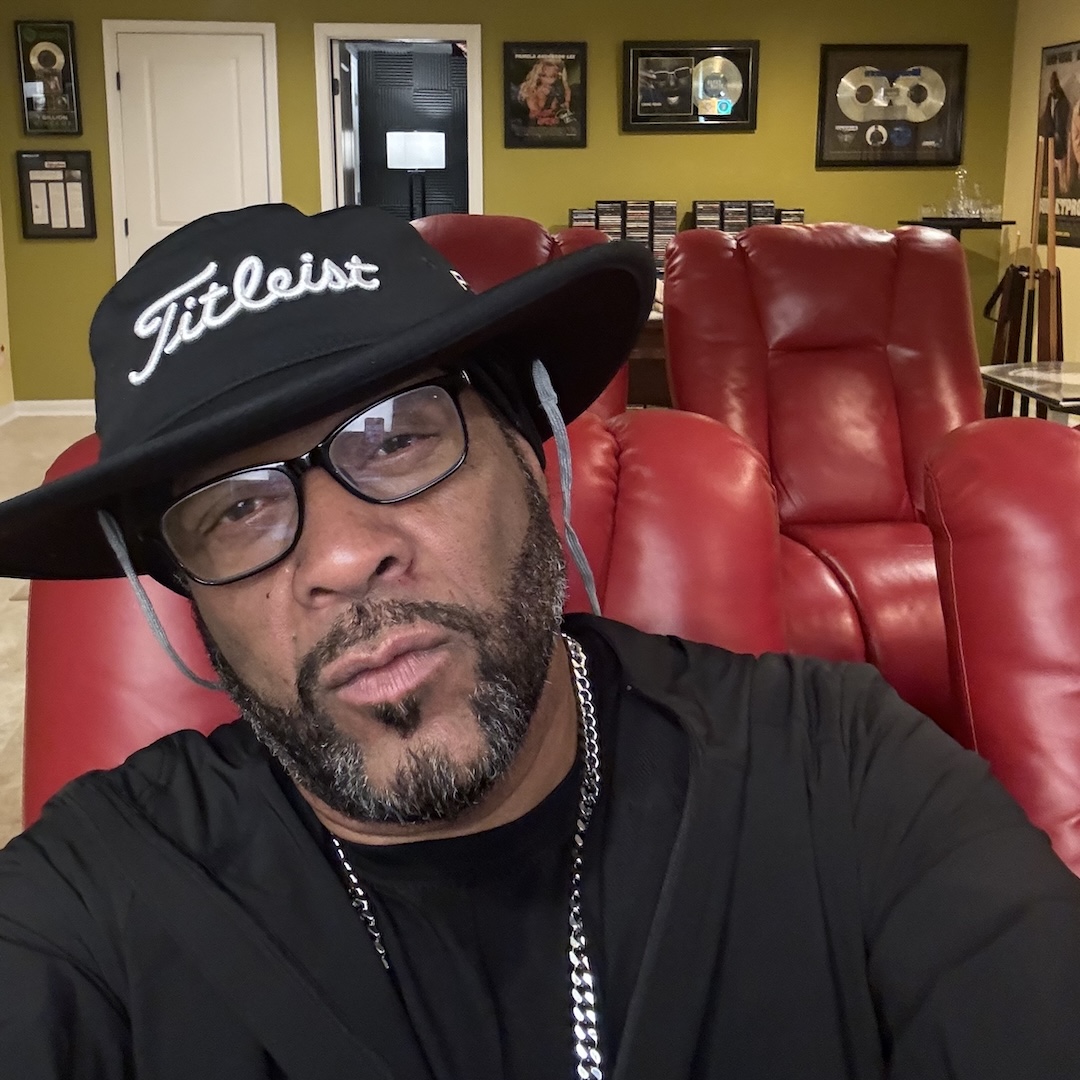
Rasheed chopped, looped and laid down drums, keys and bass: “My Roland JV-1080 back then was on all of my records and I added live instrumentation. I had a Minimoog I used to play; I’d layer my live bass with the Minimoog bass, just give it a little more bottom. I used it on a lot of records, wherever it fit. I used that on the Tupac stuff.”
That foundation set the stage for the layered voices Rasheed envisioned. “I had this idea in my head; I wanted it to sound ethereal, like a choir.” That’s when Larry Sanders—better known as L.V.—walked in. A gospel-trained singer signed to Tommy Boy and already part of Coolio’s circle, L.V. had the kind of resonant, church-honed voice that could carry a line and fill a room.
Rasheed had mapped out the harmonies, but he couldn’t sing them all the way through himself. “I didn’t have the wind,” he admits, “but L.V. did. I had him sing the three-part harmony, and it was hard; you’ve got to take a deep breath to get all the way through.”
When L.V. began singing along with Wonder’s melody, he instinctively reshaped the words, swapping “Pastime Paradise” for “Gangsta’s Paradise.” In that moment, the track went from an experiment to an anthem.
The vocal scratch tracks, plagued with room noise, were meant to be used as demo vocals, but Rasheed ended up blending them with vocal tracks recorded later at Larrabee Studios. “The clean choir at the studio was missing the rawness of what we did at the house,” Rasheed explains. “I had to fly that in underneath the clean vocals, and when we blended the demo vocals with the studio ones, it created overtones. It sounded like a mass choir. It was accidental, but it was magic. Once I did that, it turned into a whole other beast.”
By the time Coolio entered the picture, the track was nearly finished. It had the hook, the choir parts were in place, and the foundation already felt bigger than what most of what was on the radio. Coolio immediately staked his claim. “He comes in, hears it, and says, ‘I need that track,’” Rasheed recalls. “He took it home and two weeks later came back with the verses.”

The verses, opening with a reworking of Psalm 23, were darker than anything Coolio had put on record. Just a year earlier, he’d gone Platinum with It Takes a Thief, powered by the good-time grooves of “Fantastic Voyage,” but this was different—a meditation on struggle, mortality and faith.
“‘As I walk through the valley of the shadow of death/I take a look at my life and I see there’s nothing left’—I freestyled that,” Coolio told Rolling Stone in 2015. “I wrote the whole rest of the song without stopping … I like to believe that it was divine intervention. ‘Gangsta’s Paradise’ wanted to be born; it wanted to come to life, and it chose me as the vessel.”
Where most West Coast rap of the moment was about bravado, “Gangsta’s Paradise” carried the weight of a confession. That gravitas matched Rasheed’s production, making the song bigger, heavier and different from anything else on radio.
By the time they moved to Larrabee the record had a momentum that was hard to ignore. “My dad was there, he’s a musician too, and he’s mouthing across the studio, ‘This is a hit,’” Rasheed says. “I thought, ‘This is really one of those ones, I gotta make sure this is tight.’”
Rasheed wasn’t happy with the first mix. “It was too raw; it didn’t sound good enough,” he says. He booked time at Encore Studios with engineer Kevin Davis (Mariah Carey, Outkast, Usher), who was known for getting records radio-ready.
“Kevin mixed it in like 20 minutes,” Rasheed remembers. “I had booked four hours. We listened to it in the car, and then we played basketball in the parking lot for three and a half hours!”
• Classic Tracks: A Tribe Called Quest’s “Can I Kick It?”
Part of Davis’ method was to broadcast the mix through a short-range antenna so it could be heard on a car radio outside the studio. “It sounded terrible out there,” Rasheed laughs. “Flat, no compression, nothing. But this was his method. Kevin said, ‘That’s it.’ And he was right. When I heard it on the radio, it was incredible.”
For the final mix, Rasheed stripped out the original snare and kick, sampled new drums from his record collection and added big string stabs with the Roland JV-1080. “That’s when it came to life,” he says. “I always wanted my records to sound big, like Phil Spector’s Wall of Sound. Even if it’s just a few instruments, I want it to slap. That’s what Kevin helped me get.”
With Coolio’s verses recorded and the mix locked, one hurdle remained: The song lived and died on a Stevie Wonder sample.
Rasheed and Stewart couldn’t move forward unless Wonder signed off, and that meant meeting stringent conditions. “Stevie didn’t want any profanity or violent references on the track, so we had to take that out,” Rasheed says, “but ultimately I was glad; it didn’t need it.”
Once the demo was finished, Stewart began shopping around for film placements. In the 1990s, movie soundtracks were marketing machines, with labels and studios pouring money into them the way they would for frontline artist releases. When Dangerous Minds, a Disney-backed drama starring Michelle Pfeiffer, won a bidding war, it gave “Gangsta’s Paradise” a platform that extended far beyond hip hop radio.

The partnership went beyond the soundtrack—the Antoine Fuqua–directed video, with Pfeiffer facing off against Coolio, became almost as iconic as the song itself. “When they tied the track to Dangerous Minds, it was free promotion for Tommy Boy and it just blew up,” Rasheed recalls.
Within weeks, “Gangsta’s Paradise” was everywhere: It topped charts in more than a dozen countries, became Billboard’s Number One song of 1995, and earned Coolio a Grammy for Best Rap Solo Performance. The success was staggering—and not without fallout. “Once that happened, everybody kind of went their own way, trying to make their careers,” Rasheed says of the once-tight crew. “I was out on my own.” But the doors it opened were undeniable.
Discover more great stories—get a free Mix SmartBrief subscription!
Rasheed went on to collaborate with some of music’s biggest names, from Whitney Houston to LL Cool J to Tupac to Barry White. Each project pulled something different from his toolkit, but the through-line has been the same: productions built to sound bigger than the sum of their parts.
Today, he’s writing screenplays and set to release his memoir, From Rags to Gangsta’s Paradise, but the song that launched him remains a touchstone. Since Coolio’s passing in 2022, “Gangsta’s Paradise” feels even more monumental, spanning generations as one of hip hop’s most enduring landmarks.