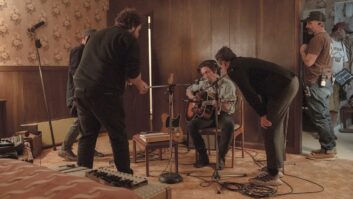
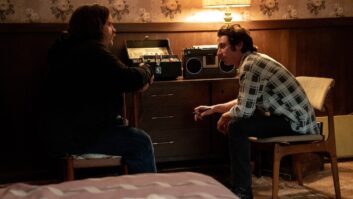
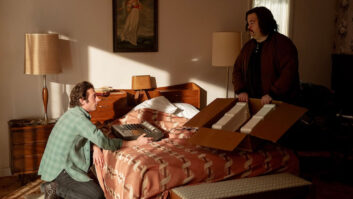
The conclusion of Mix’s unprecedented five-part, 11,000-plus word exploration of how the film Springsteen: Deliver Me From Nowhere painstakingly recreated the sounds of Bruce Springsteen recording at home and in the studio in 1981. Don’t pass up Parts 1, 2, 3 and 4!
THE BAND BEFORE THE CAMERA
There are several scenes in the film, besides the bedroom recording sequences, that required accurate representation of both instruments and audio equipment; for instance, Springsteen and band are seen at Power Station recording a powerful early take of “Born in the U.S.A.” The moment was shot in mid-December 2024, and director Scott Cooper recalls, “Both Bruce and Jon Landau were there that day, and I remember Jon telling me that, on the day of Bruce’s original recording, they had said to themselves, ‘Oh, my God; we caught lightning in a bottle.’ And to have Bruce there, when we were filming that—in the very room where it took place—was fabulous. It was the ghost of that day.”
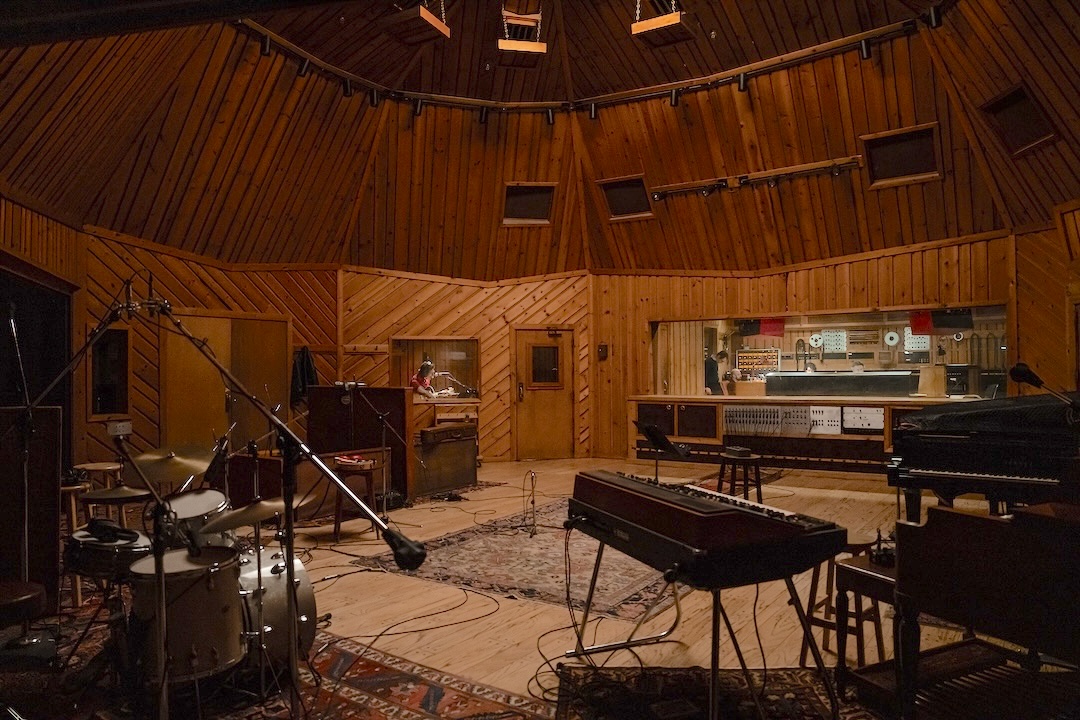
Joshua Lutz was tasked with making sure all the music gear and room setup—as well as the control room gear—was accurate, lest any educated Springsteen fan spot a mistake. Thankfully, he notes, assistant prop master Baha Fitchen had an office plastered with countless reference photos which he referred to. “Just going through all of her wonderful research, we narrowed down exactly what instruments were used that day, and what outboard gear was in the control room,” he states.
Besides Bruce’s Esquire and Stevie Van Zandt’s Strat (on which the guitarist had placed a top hat knob from a Telecaster, so the one on screen did, as well), Lutz sourced a white Music Man StingRay bass, for the Gary Tallent actor to use, though he swapped out the pick guard, which was the wrong color. “[Prop master] David Gulick was very particular about ‘case candy,’” Lutz recalls, meaning items such as guitar straps. “I spent thousands on Ebay,finding the right ones—we used maybe four of them in the movie—just getting ones with the right folk embroidery pattern on them.”
For Bruce’s amps, he found a pair of Fender Twins as Springsteen commonly used in the studio—a black panel and a silver panel—as well as the Yamaha solid state amp Van Zandt was fond of at the time. For bass, there was an Ampeg B15 flip top as well as an Ampeg SVT, which Tallent sometimes preferred.
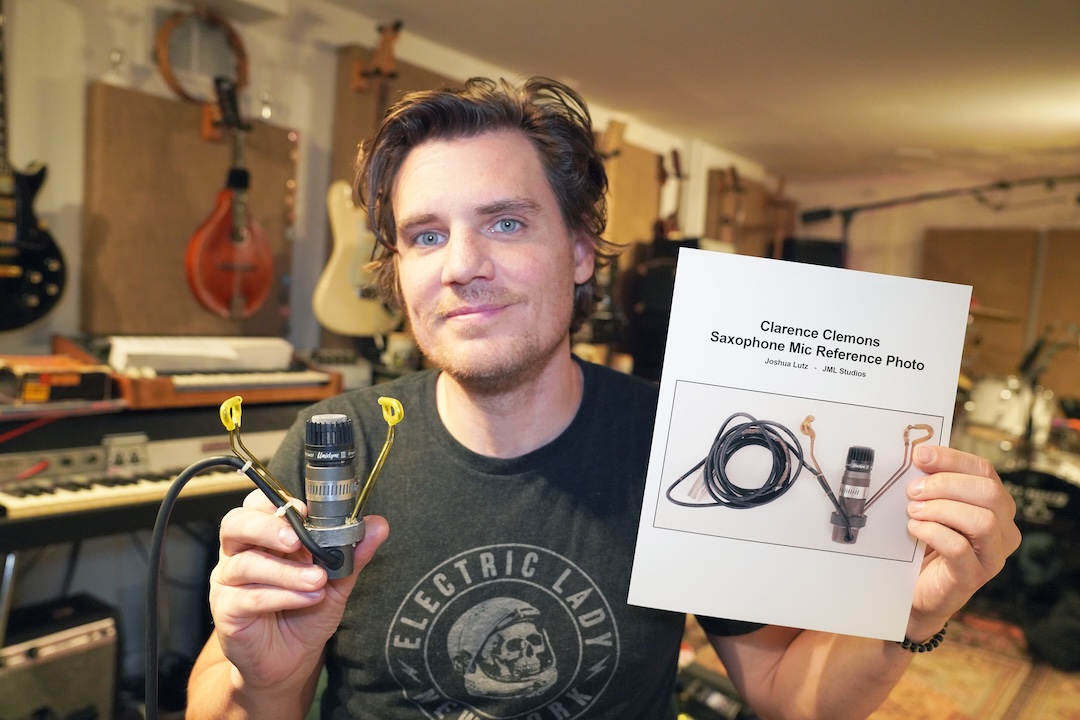
Lutz placed U87s and U67s in front of the amps, which was what Power Station had at the time. For Clarence Clemons’s saxophone, Gulick had Lutz replicate a special clamped-on SM57 that the musician typically used.
“I cut an SM57 in half, took the transformer out, and found a rubber plug that fits perfectly inside, as he did, which formed a kind of a gasket, and then wired it to an old Switchcraft mic cable, and added these two custom clamps, made out of an old hanger, which clamped onto his sax.” Lutz was also keen to make sure classic Shure and Unidyne mic bags were seen around the set, in case a camera caught them.
For drums, Lutz obtained a Slingerland set from Ron Fennick at Fennick Studio Props in New Jersey. “We had to replace the drum stool twice, because the actor playing Max Weinberg, Brian Chase, was an absolute animal. He hit those drums as hard as Max. We had to modify the snare on three different occasions, just to keep up with him. There were lugs flying all over the place, like the finale of a fireworks show!”
While the musician actors were miming to playback, with White singing live for the first several takes, then shifting to miming to his pre-record, Tod Maitland was still keen to give the audience a sense of the room, much as the camera was so that the audience felt it was watching the recording, not simply listening to it.
“It’s always great working in a regular recording studio, acoustically,” Maitland states. As always, he kept his 416 boom mic present, just out of camera’s sight. “I’ll always open up some ambient mics,” he says, “because when you’re in the room with them, you want it to sound more live. You don’t want it to sound like the recording. When someone’s singing directly into a mic, there is no bounce off the room. When you’re there, you’re hearing them, acoustically, in a room—you’re hearing the bounce of their voice off a wall. And that lets you know you’re there with them. I’ll always have one or two ambient mics, about 10 or 20 feet away, just to give Paul, in post, the ability to add in that little bit of delayed bounce, to give it a real-life feeling, like you’re there.”
The vocal, ultimately, was a blend of White and Springsteen. “Jason and Scott went through this with a fine-toothed comb in the cutting room before it got to me,” Massey describes. “Then there would be more suggestions and conversations about it as I was trying to match the two voices, so that we could get a seamless performance—whether to back up two words on Bruce or cut into the middle of a syllable from Jeremy. It was never just Jeremy singing a verse, then Bruce singing a verse. It was very intercut, and very intimate. To be honest, sometimes Jeremy did such an incredible performance, there was no need to even consider going to Bruce.”
Perhaps more visible in the film than the beautiful Power Station Studio A is the control room itself, in which many important scenes take place. It, too, had to appear authentic to 1982.
Lutz recalls, “On one of our initial tours with their staff, we found they had a huge four-foot poster of Springsteen with the E Street Band, in the control room,” he says, “so we had a clear photo of what was in there,” along with other historical documentation, which was plentiful.
More important was the Power Station staff itself. According to director of studio operations Janice Brown, studio manager Hayley Isaacson, chief technician Brett Mayer, technical director Gloria Kaba, engineer Ben Miller and technician Seth Paris helped make sure equipment Lutz identified that he wanted was located and set in place to give the control room its historic appearance.
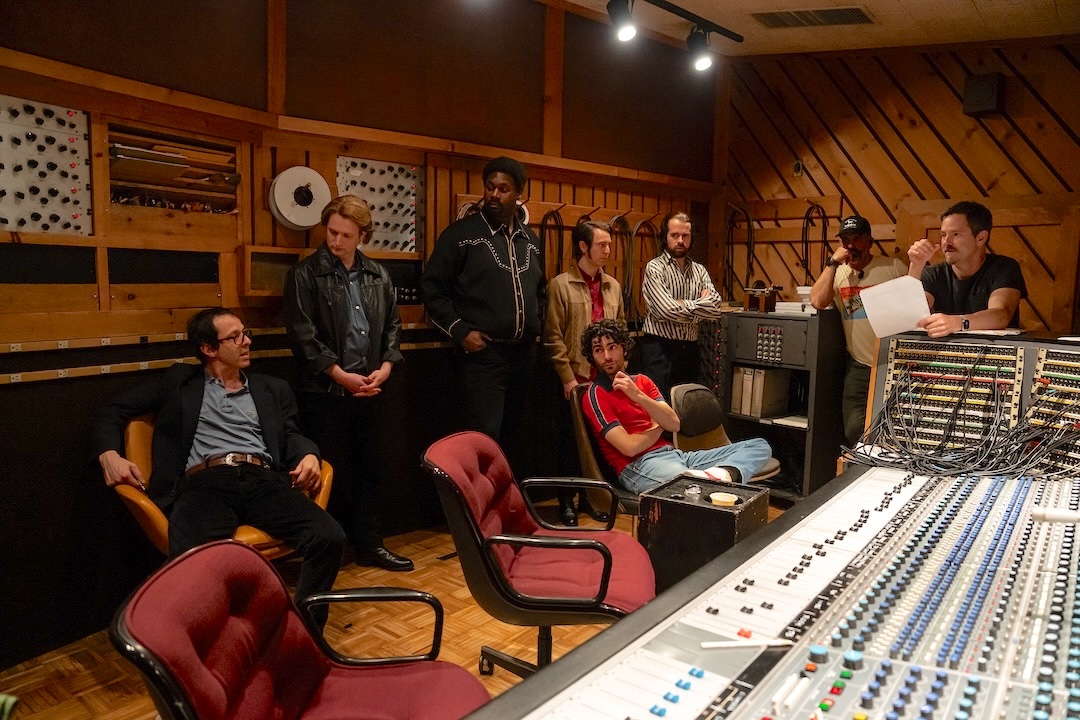
“Hayley gave me a tour of the equipment storage room,” Lutz says, “and there was all this amazing gear down there. Some old, modified Dolby 361s, with the vocal stresser mods on them, which Michael Jackson and Quincy Jones had used. Lexicon 480s, just stacked up, and I’d just say, ‘Okay, that probably would have been in the room. All those old Pultecs, let’s get those in there, too.’ They just did a great job. We showed up the next day, and it was all in the racks, and everything else was pulled out.”
He was, of course, keen to make sure all the connectivity in the patch bay was of the time. “They had some old Bantam cables, so I made sure those were present and prominent—and anything Hosa or Neutrik modern was gone. For the sake of engineers watching, [we made sure] that if you were going into a mult in the patch bay, that you better go into the bottom and come out the top, because no doubt, somebody would catch that and we’d hear about it.”
The original Neve 8088, from that time, was still in place and active, “The original monitors that were there at the time were still in place, so we left them,” reports Lutz, adding that while they covered anachronistic items such as ethernet connections or Dolby Atmos equipment. “They either put up faux boxes over it or would remove it from the walls,” he states. “We worked closely with the Power Station staff to make sure everything we did was reversible, and that we didn’t damage anything. When we got out, there wasn’t a scratch on anything.”
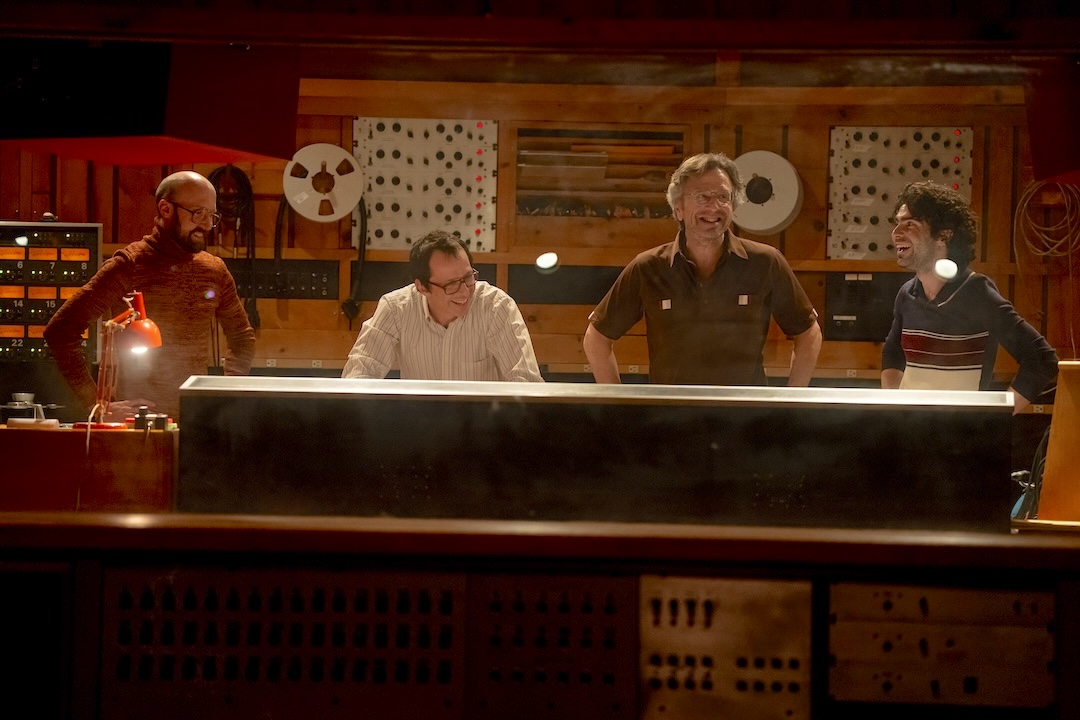
In the film, with Springsteen’s insistence on release of his boom box cassette mixes, engineer Chuck Plotkin (a seasoned engineer portrayed by actor Marc Maron) plays Springsteen and Jon Landau his attempts at improving the sonic quality of the recordings in the Power Station control room. However, they only seem to exacerbate the distortion, as they—and the audience—can plainly hear.
Massey’s first pass at the mix was something likely realistic to what an engineer in Plotkin’s position would do to make such a fix. But, says Ruder, “When we tested the movie, with what an engineer would really do with that sound, we found that the audience, not being filled with audiophiles, were a little confused by the treatment.” So, notes Massey, “I then overemphasized the distortion that was inherent in the recording, to make the point clear to the audience that there was distortion on the tapes, and that Chuck couldn’t do anything to get rid of it.”
MASTERING IN THE MOVIE
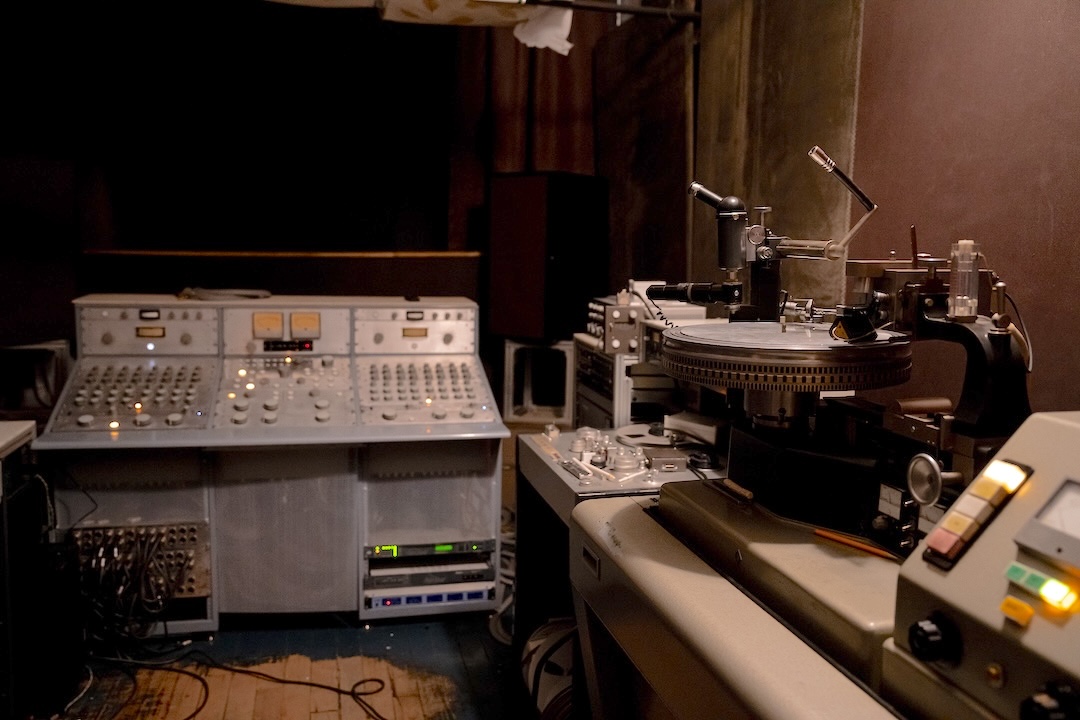
In the film, Plotkin next brings the cassette master to mastering engineer Dennis King (Chris Jaymes) at Atlantic Studios Mastering to see what ideas he might have, when cutting the lacquers on his lathe. Lutz recalls, “They asked me, ‘Can you bring a lathe in?’ And it made me laugh out loud. You don’t move a lathe. Lathes don’t move. You go to the lathe.”
Instead, the production team went to Salt Mastering in Brooklyn, where owner Paul Gold has a Neumann VMS-66 lathe. “In the script,” Gold explains, “it called for two mastering sessions—one mastering on a VMS-66 at L.A. Lacquer in Los Angeles, and then, that being found to sound too high-tech, a second cut is made on a Scully 501 at Atlantic Studios Mastering, which had a more low-tech sound that matched what they were looking for. Scott Cooper took one look at the Neumann and the Scully, and he liked the Scully better.”
So the team filmed the discussion between Plotkin and King at L.A. Lacquer in Salt’s cutting room, with the Atlantic Neumann behind them, and then moved downstairs in the same building, where a small set was put together using a Scully procured by the production, which Gold set up for their use, to shoot the cutting inserts seen in the film. “It was missing a few pieces—the Westrex IIID cutter head and the cutter head suspension box,” he notes. “I made sure it looked and behaved authentically.” Actor Chris Jaymes actually does the cutting in the film, having received some basic cutting lessons from Gold.
REINING IN THE STONE PONY
In the film, Springsteen joins his friends, Cats on a Smooth Surface, at the fabled venue The Stone Pony for a few tunes. Shot at the Pony itself, the band—which included everyone who had played on the pre-records (with the exception of keyboard player Bobby Emmett, who was unavailable, replaced that day by Henry Hay)—mimed to those recordings. Ruder first created edits with Cooper to sort out what would be needed for filming, and those tracks, with singer Jay Buchanan’s vocals mixed out, were provided to Maitland, whose Pro Tools op fed them through a loud P.A. to the room, filled with hundreds of excited extras.
“He had it blasting,” notes Dave Cobb. “It was painfully loud—which is the only way to capture that club feel.” Notes Cooper, “We wanted it to feel like the audience was hanging on for dear life. The aesthetic absolutely resembled what it must have felt like to be there in 1982.” Apparently, that was the case, as Cobb recalls. “Bruce was there, and he was watching, and you’d see his head moving, and he called out, ‘Ah—it was just like that. I feel like I’m back!’”
![Members of the audio team, along with several of the musicians, at The Stone Pony: [L-R]: music editor Jason Ruder, Greta van Fleet bassist Sam Kiszka, music producer Dave Cobb, Greta guitarist Jake Kiszka, session guitarist J.D. Simo and engineer Greg Koller. Photo: Danielle Diego.](https://www.mixonline.com/wp-content/uploads/2025/12/2025-12-19-Springsteen-Day-5-6.jpg)
As at Power Station, Maitland placed ambient mics to assure that Massey had all of the ingredients he would need to make that live feel come through. “When I’m doing big scenes with audiences like this, I have multiple ambient mics all the way around—one, for capturing ambient from the stage, and, two, for capturing the audience.” Adds Massey, “I wanted to really recreate the sound of a band of that era playing very loud in a small club—just a hot, sweaty performance that was really rocking. Because I had all the individual tracks provided by Jason, I was able to split them out and put them all into that space, to make it sound very, very live.”
SETTING SPRINGSTEEN ON STAGE
The other major live scene was the one which opens the film, with Springsteen and the E Streeters closing their “The River” tour at Riverfront Coliseum in Cincinnati, on September 14, 1981. The scene was shot at the former (and closed) Izod Center, located next to Meadowlands Stadium, as Riverfront had been demolished in 2002.
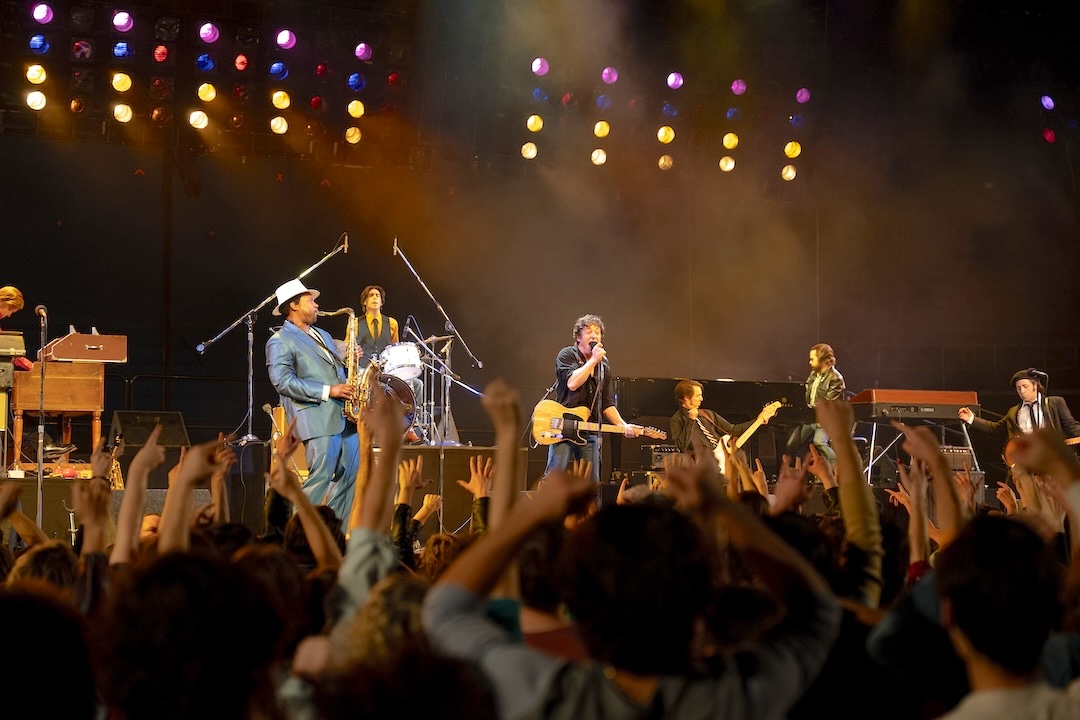
Once again, Lutz assembled an accurate collection of stage equipment, including a pair of Fender Tweeds obtained from SIR Manhattan, stacked as Springsteen would do; Van Zandt’s beloved Yamaha J Series Solid State amp; and Tallent’s Ampeg SVT, which he would also use in the studio. Lutz provided his own 1975 White Cortex Ludwig Maple Classic drum kit for “Max” to play, accompanied by a Ludwig Black Beauty snare, miked with KM84s overhead, MD-421s on the toms and, of course, an SM57 on the snare, for camera.
Toughest to find was a Yamaha CS-80 synth, now considered quite rare. “It’s almost impossible to find a good one,” Lutz notes. “They go for $80,000-90,000, if you can find one that works. Fortunately, I have a friend who’s a synth collector who has one, so we rented it from him and it worked beautifully.
Once again, Maitland played back the Springsteen-provided live backing track through the monitor system on the stage. White sang the first several takes live, then mimed to his Power Station vocal pre-record for the remainder. The final mix is mostly Springsteen, with White interjected, says Massey.
Discover more great stories—get a free Mix SmartBrief subscription!
Interestingly, Maitland, for his dailies mixes, would take whichever vocals used on a particular take, be it White live or his pre-record, and place that on his track, alongside the instrument backing on another, and time code on a third track. “I’ll have those three feeds from Pro Tools, and they can sync that up, so if they’re going to come in and out with the vocals, they know exactly where to come in and out with them,” he explains.
Massey would, again, take advantage of having complete stems available, so that, as he explains, “As the camera moves around, highlighting different instruments—and different parts of the instruments—I could highlight those in the mix, to make it as dynamic and exciting to the theater audience as possible.” Notes Ruder, “There’s so much perspective work in those sequences that you even go from different reverbs on different perspectives. We’re able to work the material to each shot, from an edit and mix perspective, the goal being to make it seamless, where people don’t really know whose voice they’re hearing and find that it doesn’t matter. They just get lost in the sequence.”
And that was ultimately the goal.
“The reason we would do it at all is simple,” says Massey, “We wanted it to come across as a very strong, singular performance. There was no moment where we ever went, ‘This has to be Jeremy’ or ‘This has to be Bruce.’ It was carefully worked out to try and craft the moment to be as effective for the audience as it could be. When people are wondering who they’re hearing, hopefully they simply can’t tell, and we will have achieved what we wanted, on behalf of serving Scott’s story. And if the answer is yes, then we would have achieved what we wanted to achieve.”