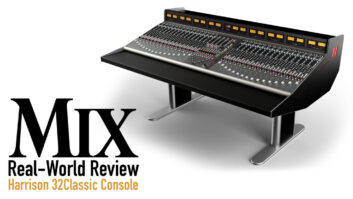
| MIX VERDICT: HARRISON 32CLASSIC CONSOLE |
| THE TAKEAWAY: “The sound is clean and modern, with a bit of a vintage vibe, and its digital integration makes a lot of sense in today’s DAW-centric world.” |
| COMPANY: Harrison • www.harrisonaudio.com PRICE: $105k for 32-channel configuration. PROS: • Ergonomics. • 64 channels of A/D/A conversion. • Quality analog sound. • Up to 96 inputs. CONS: • No compressor. • Not all cue matrix modules have volume pots. |
Don’t pass up Part One!
RECORDING/MIXING MODE
The 32Classic has two main modes of operation: Recording and Mixdown. Recording, in Harrison parlance, is called Monitor Inline Mode. When the Inline button is engaged, a blue LED lights up and the normal top-to-bottom flow of the channel is split up into a Record path and a Monitor path.
For the recording path, the selected input passes through processing and is routed to a DAW’s input (via Dante) and also to the console’s direct analog outputs. For the monitor path, the DAW’s output feeds the channel fader, which in turn is routed to buses 1-8 and/or the main mix channel for monitoring. In this mode, the console looks and acts like most consoles. The signal flows from the top of the channel through phase, inserts, EQ, filters, sends and the fader before it is sent to the buses and/or the main mix.
There are five inputs to each channel: Mic, Playback, Line, Instrument and Return. The Mic input is selected by default but is automatically muted when any of the line inputs—Playback (Dante/Converter DAW output), Line (analog line input) or Instrument (from the in-console microphone/DI)—are selected. The line-level sources can all be summed as a channel input, but they do not have separate gain controls. However, there is an overall line-level trim, though it’s hard for me to imagine when I would ever want to sum these together.
The fifth input is labeled Return. Located at the top of each of the 32 input channels, it provides another line-level input, but it is only assignable to a secondary path that feeds the master mix bus and the cue/matrix modules. In other words, it is not available as an input to console channels. Instead, think of it as a summing mixer that adds 32 inputs to the console.
FADER, BUS, MASTER, MONITOR
The faders on the 32Classic have a very nice feel to them. It’s an audio nerd thing to do, but it’s hard to suppress the “ooh” when you start moving these faders. Most mixers have 10 to 12 mm fader caps, but these are all 15 mm, so there’s a skoosh more to grab. Size does matter.
Every fader has a “0” dB button that disables it and sets the output to, you guessed it, zero. The channel faders feed the main mix and eight sub buses (grouped in stereo pairs), with or without the pan. The buses can be used for combining channels and recording into the DAW (e.g., printing 12 room mics to a stereo pair), or when mixing, they can be used for parallel processing, or for creating submixes or stems, which can then be fed into the Main Mix.
I am a fan of doing all these things, so having eight buses that are easily summed into the main mix is a big plus. I mentioned earlier that each of the 32 input channels has a Return input that doesn’t go anywhere on the individual channels. Where they do go is above bus faders 7&8. From there, they can be gained, soloed, muted and assigned to the main mix. Voilà! Now you have a 64-input mixer. But wait, there’s more.
The Aux Master module is also located above bus 7&8. Here you can control the master gain of the five auxes, and should you want or need to add another 32 inputs to the console, you would do it here by engaging the Main Mix button sitting next to aux 5&6 master volume. This configuration of the console gets a bit complex; suffice to say, the console has the ability to mix a total of 96 inputs.
The Master Mix module, like all the faders, has left and right 20-segment LED peak meters indicating –35 dBu to +14 dBu. It has only three buttons: insert, “0” gain fader bypass, and transformer. The main mix is normally electronically balanced (i.e., no transformer), but when the transformer button is engaged, a Jensen 1:1 transformer is introduced at the main mix output connector. I experimented with this function, and while I preferred the transformer coloration, I imagine that, depending on the source, I might prefer the electronically balanced output. It’s nice to have that option.
The Monitor source module has four stereo input choices—Main Mix (the analog output from the console), Dante (most likely the monitor or main mix output from your DAW), and two stereo external analog inputs—and one surround input, which accepts 12 inputs (think 11.1 or 7.1.4).
That doesn’t mean the 32Classic is configured for immersive mixing. It’s not—but it does have the ability to act as a monitor controller for surround mixes. There are switches with level for an alternate set of stereo speakers, and headphones, and there are switches for left and right mute, mono and dim (which is adjustable between -20 dB to -6 dB). A singular knob (and mute) controls the volume of the main or surround monitors. The alternate speakers have their own volume, but the mute works for them, too.
IT’S A CONSOLE!
A console is a big investment, so there are a few key points I feel the need to mention regarding value. When considering the $105k price tag, don’t forget to factor in the 64 A/D and D/A converters. That’s a lot of high-quality conversion.
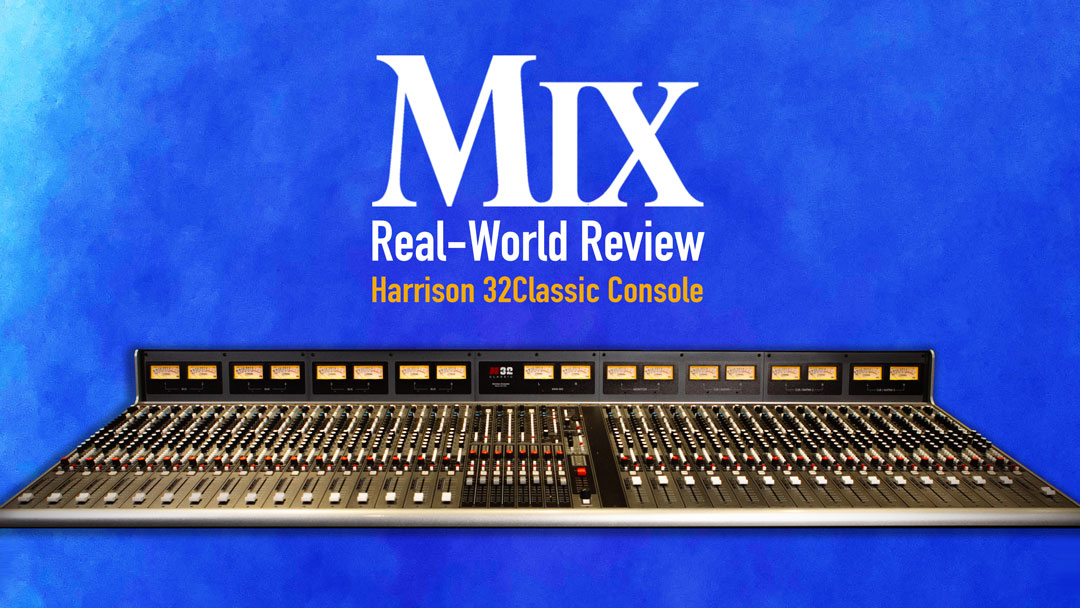
Also, the meter bridge houses 18 large, LEDilluminated, analog VU meters. They are grouped in stereo pairs for buses, cue/matrixes, main mix and monitor. At the top of each input module is a bi-color LED that indicates signal present and clipping. In fact, every button on the console has an LED that lights up when engaged, giving you a visual indication of its status. The digital integration has been meticulously thought out.
Still, the 32Classic is an analog console. Repeat: All the inputs and outputs are analog.
It’s also worth reiterating that the console records and mixes 32 channels seamlessly and effortlessly. You can literally plug in one ethernet cable and make a record. If you need or want more inputs, the 32 Return inputs will get you up to 64. Of course, now you need extra converters and analog patches….but still, you get a heckuva lot per channel.
Discover more great reviews—get a free Mix SmartBrief subscription!
That said, there are a couple of features I would have liked. There are no compressors in the console. It would be convenient if there were, but every channel and every bus has an insert, so patching one in is easy. In the cue/matrix modules, most of the sources have dedicated volume pots, but some don’t. It would be useful if they all did. I like having separate talkbacks to each individual cue, but a separate talkback to studio speaker(s) also would have been a nice addition.
But those are minor quibbles. Consoles are fun to work on, certainly more fun than dragging and clicking a mouse. As a born knob twister, I can tell you that the 32Classic is fun to work on this desk. The user experience and ergonomic considerations speak to the company’s attention to customer feedback, and the high-quality components speak to its commitment to intelligent design. The sound is clean and modern, with a bit of a vintage vibe, and its digital integration makes a lot of sense in today’s DAW-centric world. The Harrison 32Classic would surely be a beautiful, functional and high-quality centerpiece to any studio—small, medium or large.