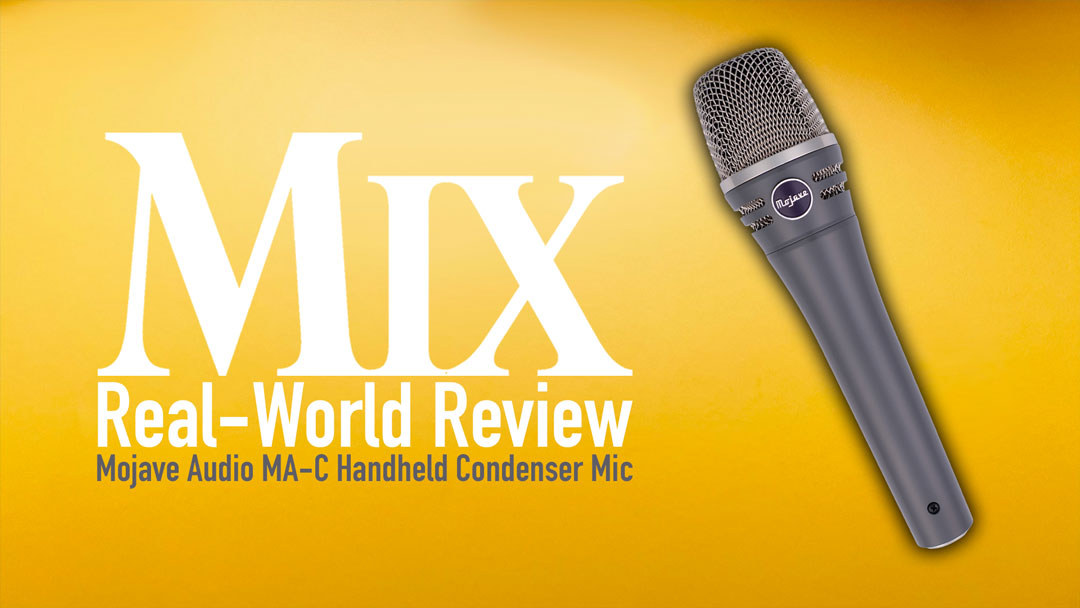
| MIX VERDICT: MOJAVE AUDIO MA-C MICROPHONE |
| THE TAKEAWAY: “Mojave Audio’s newest model answers the need for a more sensitive handheld stage microphone that is rugged, sounds good and is interchangeable with a MA-D dynamic already in place.” |
| COMPANY: Mojave Audio • www.mojaveaudio.com PRICE: $699 MAP PROS: • A good-sounding SDC live mic that can be interchanged with a dynamic. CONS: • Didn’t like the included clip. |
New York, NY (September 24, 2026)—Back in the mid-1990s. David Royer saw the need for a modern ribbon microphone—an updated and more reliable model than was then available—and in 1997 began his first design. The following year, he and Rick Perotta co-founded Royer Labs with the release of the R-121, a side-address ribbon microphone that was an instant success. Today, the Royer line includes nine different models.
However, Royer had been designing microphones for more than a decade before launching the company that bears his name. In 1985, working out of his Fullerton, Calif., garage, he operated a pro audio electronics shop, building custom outboard gear for local engineers. He also hand-built large-diaphragm condenser mics under the Mojave Audio name.
Twenty years later, in 2005, Royer and engineer/producer Dusty Wakeman revived the brand and officially co-founded Mojave Audio, a separate condenser mic company that has since grown to include seven models that use either tubes or FET electronics.
THE SPECS
The company’s newest release is the MA-C, a small-diaphragm condenser mic designed for both live sound and studio use, and it matches the physical shape and look of the company’s MA-D dynamic model. In fact, the MA-D and MA-C are interchangeable, with a predictable and calibrated change in mic gain required. Both mics are made of metal and measure 8 x 2 inches; both weigh about 8 ounces.
The MA-C includes a 17 mm, 3-micron-thick, edge-terminated diaphragm and requires phantom powering. Unscrewing the foam-lined pop screen from the body reveals an internal shock-mounting system with the capsule assembly encased in a flexible, molded plastic mount. This means that the MA-C has minimal handling noise and may be “cupped,” as many singers tend to do onstage.
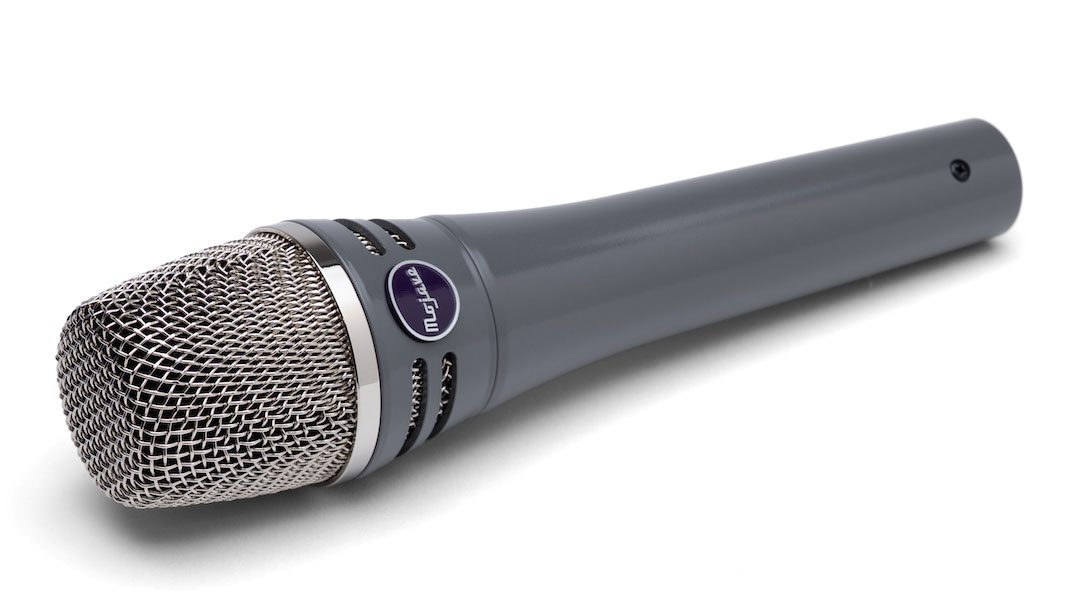
The capsule itself is positioned on a metal plinth that has a pair of built-in toggle switches for the -15 dB attenuator pad and the 200 Hz (6 dB/octave) high-pass filter. Being able to access these switches inside the mic’s body while positioned is brilliant; the switches are both hidden and protected from accidental operation.
With the HPF engaged, the mic has a frequency response of ±3 dB, 20 Hz to 20 kHz, with a bell-shaped 6 dB presence boost centered at 8 kHz. Designed for super-close singing, the microphone is flat down to 100 Hz and said to correct for proximity and low-frequency leakage.
Sensitivity is measured at 5.6 mV, self-noise is 14 dB (A-weighted), and distortion is specified at <1% at 120 dB (pad off), or with the pad on, <1% at 135 dB. There is a FET impedance converter stage to drive an output transformer. Output impedance is 140 ohms.
STAGE AND STUDIO
My first test was in my studio while recording a female artist for a song demo. On a single mic stand, I placed the MA-C right next to a small-diaphragm studio condenser mic I used for reference—they both cost about the same. I placed the two mics as close together as possible without touching, so that she could focus on her performance and sing as if there were only one mic.
For a live microphone in the studio, the MA-C was impressive in how well it worked with my singer. No pad or high-pass filter was used. We both preferred MA-C over the studio mic because it produced a balanced and present sound.
• 2026 Emmy-Winning Audio Teams Set for Mix Sound For Film & TV!
Singing close, as if on stage, the proximity effect was there, but (apart from plosives) was tolerable without too much of the nasality when a singer “eats” the mic. The low-frequency boost was just right; if more was needed, switching in the HPF helped, although very subtly.
Backing away two or three inches made it sound like a studio mic as long as she stayed aimed directly at the mic. The foam-lined metal windscreen is thinner at the live end and allows the diaphragm to be closer to the source. The tight cardioid pattern is excellent for a hand-held condenser mic; it rejected boomy leakage well, and there was minimal handling noise when my singer wanted to hold it and move around.
My next use was tracking a large-bodied Fender acoustic with the artist playing both quiet finger-picking and louder rhythm parts. With no pad and HPF switched in, I placed the mic 8 inches over the sound hole and it was a bit (as expected) boomy-sounding. Moving the MA-C around while listening on headphones, I ended up about 14 inches out in front. For live sound, however, the best results came when the mic was 8 inches away and aimed at the instrument’s bridge, with the HPF on.
• Discover more pro audio news—get a free Mix SmartBrief subscription!
Close in on a snare drum sounded great. No pad, no HPF and no clip on the Trident 80B’s preamp. Compared to my usual dynamic mic, there was a definite, pleasant treble boost. That high-frequency lift could also be heard in the “bleed” leakage of the hi-hat. I tried using the MA-C’s pad and increasing the mic gain to record the same drum. This produced a closer and drier sound, with less low-frequency leakage coming from the kick drum.
Mojave Audio’s newest model answers the need for a more sensitive handheld stage microphone that is rugged, sounds good and is interchangeable with a MA-D dynamic already in place. When exchanging a MA-D for the MA-C, don’t forget, the MA-D has about 8 dB less output than the MA-C with its pad off, or about 7 dB more output with the MA-C’s pad switched in. Works well both ways.