| MIX VERDICT: NORDIC AUDIO LABS NU-100K MICROPHONE |
| THE TAKEAWAY: “I found that the NU-100K would be a refreshing addition to any mic locker.” |
| COMPANY: Nordic Audio Labs • www.nordicaudiolabs.com PRICE: $2,875 MSRP PROS: • A completely new, fresh condenser mic sound. CONS: • A completely new, fresh condenser mic sound. |
New York, NY (October 20, 2026)—Nordic Audio Labs is a small company based in Finland, founded 30 years ago by Martin Kantola, now head designer and CEO. First enamored and inspired by his single 1953 Neumann U47, Kantola went on to have a long career of building conventional tube microphones. By 2017, he started developing his own capsules, not based on any previous or preexisting design. Today, six craftspeople work in the small village of Karperö to produce all the capsules and microphones from in-house parts.
The NU-100K is a dual-capsule, side-address, multi-pattern condenser microphone. It is an updated version of the original NU-100K and uses the same new FloFET preamp as all other Nordic Audio models. It’s also one of four large-diaphragm condenser microphones in the company’s line. The other three condensers are the new NU- 24K cardioid-only; NU-314K single-capsule omni model; and the dual-capsule NU-880K for multichannel in horizontal, native B-format with three outputs (WXY, no Z).
• Discover more great stories—get a free Mix SmartBrief subscription!
All Nordic mics use Kantola’s proprietary D100K 30mm edge-terminated capsule with a six-micron-thick, gold-sputtered mylar diaphragm. Frequency response is listed at 20 Hz – 20 kHz, sensitivity measured at 14.8mV/ Pa, self-noise of 17 dBA, and max SPL is 137 dBA.
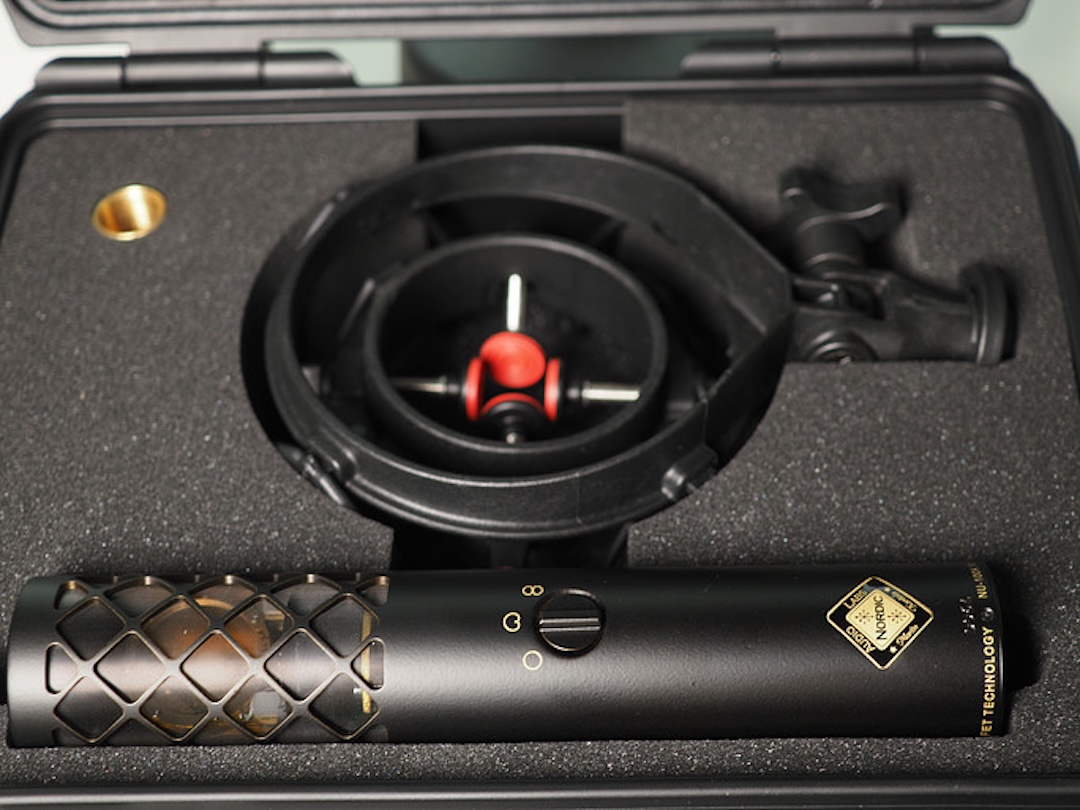
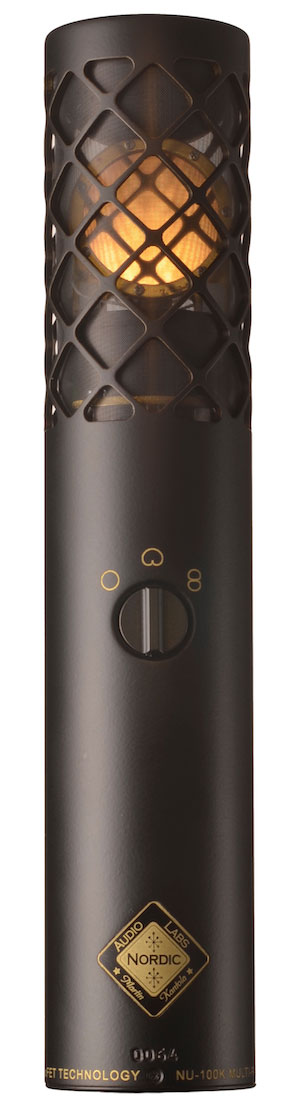
The NU-100K’s overall construction is excellent; the body is a seamless, one-piece brass tube measuring 192.5 mm long and 38 mm in diameter. It’s a striking look, with a distinctive, crisscrossed, basket-weaved grille machined into the top of the mic, just above the pattern switch. Inside, surrounding the capsule assembly, is a very fine screen mesh to further protect the capsule.
The FloFET preamplifier circuit board is made using surface-mounted construction and partially located inside the capsule itself. This permits the wires, connecting the capsule to the rest of the microphone’s electronics, to be only a few millimeters long. The company says that “the FloFET amplifier unloads the capsule so as to capture as much detail as possible and impart a smooth, tube-like sound.”
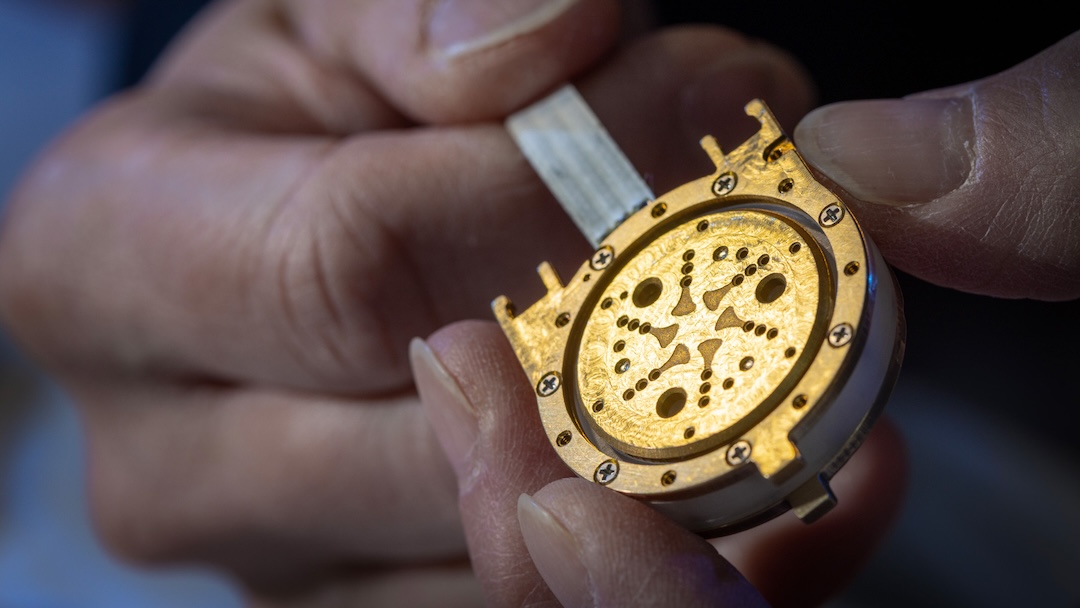
The capsule’s backplates have an unusual look, with a proprietary, geometric pattern of shapes and holes machined into them. Unlike a center-terminated capsule, the company says their edge-terminated capsule is less prone to humidity buildup, which can happen when singers get up-close.
IN THE STUDIO
I recorded a lead vocal with the NU-100K in cardioid mode set up next to one of my usual, go-to vocal mics so that the singer hit both at the same time. This was purely for my own edification; I captured the same performances at the same time so I could quickly A/B the recording in Pro Tools. For this comparison, it worked out well that my cardioid (only) reference LDC also uses a FET amp.
I used a set of matching Sunset Sound “Tutti” preamps for both mics, patched into a two-channel Retro Instruments Revolver compressor. The Revolver is a dual-channel version of the single-channel, British-modified Altec 436 compressor. No EQ or high-pass filters were used. I liked the sound a lot with this chain and the NU-100K. There was plenty of output and low self-noise.
It’s worth studying the frequency response chart supplied with the microphone. It looks a lot like a “smile curve,” with boosts in both the bass and treble regions. A bell-shaped curve shows it boosting almost 5 dB centered at 10 kHz. The midrange between 1 and 2 kHz is flat by comparison, and the chart confirmed what I was hearing.
The NU-100K’s scooped midrange proved to be ideal for my female singer, who has a tendency to sound harsh when singing loudly and at the top of her range. She typically sings close to the mic, and I got the attendant proximity effect; the sibilance was smooth, not necessarily requiring a de-esser. I did set up a windscreen for plosives.
• Mixing John Mellencamp Live: Hits So Good
Although there was no overloading, the extra low frequencies made her sound a little boomy within the 200 to 400 Hz area. It sounded more natural when I moved her about 1 meter from the NU-100K; I still got a full, warm sound.
I found that the key in using the NU-100K is the “reach”—its ability to pick up sound clearly from a distance. At this distance, her vocal sounded more balanced without proximity; she sounded fine even a little further away in a good-sounding room. For a textural effect on backing vocal double-track, I switched to omni and positioned her even further away—a good trick that’s possible with this mic.
The “dip” in the midrange might not be right for all singers. Compared to my more forward-sounding condenser, the overall character tends to be soft, smooth and easy-going; it’s very much like an old, vintage ribbon mic. Between the three polar patterns and the unique frequency response, you’ll have a large range of vocal sounds possible.
LET THERE BE DRUMS!
In another studio, both my go-to reference and the NU-100K were on a stereo bar positioned about 1.5 meters over the snare on a maple drum kit. I used the studio’s Trident 80B console with no EQ or compression. My drummer plays very consistently, and I liked the smooth sound of the cymbals, while the boost in the 200-500 Hz range produced a rounder kick drum sound. Close mics would be needed if you’re looking for more attack.
For a mono overhead, I liked figure-of-8 best to capture some of the bounce off the ceiling. For a room mic 6.1 meters away, again with both mics on a stereo bar in cardioid, the NU-100K was ideal for a big round sound for the kick and toms, and the cymbals were balanced. Being cardioid-only, my reference was good, but with more forward midrange typical of transistorized condenser mics.
ACOUSTIC GUITAR
The NU-100K’s reach and pattern choices played a key role in getting a good acoustic guitar sound. I had the mic out front about 1 meter away, and all three patterns showed how they affect the captured sound—I got what I would expect to hear.
In cardioid and close-in, where the neck meets the body, I found the mic directional and bright and thick. The figure-of-eight pattern sounded better further away. Omni sounded the most natural—the guitar sounded like it did when standing in front of a musician playing in the room.
When up close for this big-bodied acoustic, I used a subtle 50 Hz high-pass filter whenever my musician played big, loud chords. Without the HPF, quieter finger-picking sounded awesome with this mic. This is a setup to remember!
I found that the NU-100K would be a refreshing addition to any mic locker. It does not have the typical presence peak of most condenser mics and works best at a distance rather than close in. I enjoyed the qualities of the instruments and vocals it brought out, making it great for other sources besides vocals, drums and acoustic guitar.