| MIX VERDICT: VIENNA MIR PRO 3D |
| THE TAKEAWAY: “For me, MIR Pro 3D isn’t just another reverb. It’s a tool that changes how I think about mixing. Instead of adding space as an effect, I’m building the mix inside a space from the start.” |
| COMPANY: Vienna Symphonic Library • vsl.co.at PRICE: $812.20 (full) / $398.00 (24-instrument version) PROS: • Superior immersive reverberation with control over placements CONS: • Pricey if you don’t need all that flexibility. |
New York, NY (May 27, 2026)—It’s no secret that I’ve been a fan of convolution reverb for a long time. The idea of capturing a real space and placing your sounds inside it just makes sense to me. There’s a realism and depth in actual rooms that’s very hard to fake, no matter how good the algorithm gets. Over the years, I’ve used just about every convolution reverb out there, in everything from fast-turn television mixes to surround and immersive projects.
But Vienna MIR Pro 3D takes that idea quite a bit further.
BEYOND IMPULSE RESPONSE
This isn’t just about loading an impulse response and sending signal to it. MIR is more like placing instruments on a virtual stage and mixing from that perspective. Instead of asking, “How much reverb does this need?” you start asking, “Where should this live in the room?” That shift in thinking is what makes it so powerful.
As Vienna MIR’s creator and project leader Dietz Tinhof puts it, “MIR isn’t really about reverb. It’s about the relationship between sources inside a space.” That one sentence pretty much sums up why the system feels different the moment you start using it.
For those unfamiliar, MIR Pro 3D was developed by Vienna Symphonic Library, the Austrian company known for its orchestral sampling tools. The system is built around a convolution-based spatial engine and a series of add-on Room Packs.
You start with the MIR engine itself, then add the venues you want—concert halls, scoring stages, churches and other acoustic spaces—each captured in extreme detail. (Note: You can buy additional spaces later by adding Vienna MIR Pro Room Packs.) Once installed, those rooms become virtual environments where you can place instruments, adjust microphone positions and mix from inside the space.
It’s a simple concept, but the results end up being very different than simply applying a traditional reverb.
NO PLACE TO HIDE
I work across a lot of formats—stereo television mixes, 5.1, Dolby Atmos, and inside the Sony 360VME environment—where every detail of the mix is exposed. In a setup like that, you can’t hide behind effects. The space either feels real, or it doesn’t.
Recently, I’ve been composing and mixing for the Liberty Science Center planetarium in New Jersey—the largest planetarium in the Western Hemisphere—where everything is presented in a large-scale 5.1 dome. A space like that will expose every weakness in a mix, but it’s also where MIR Pro genuinely earns its place, because what you build inside a real acoustic environment translates to that environment. When the room is believable at the source, it holds together across every speaker in the dome. You’re not chasing the reverb around the room after the fact; you’re building the environment first, and the mix follows.
HYBRID SCORING
I use MIR Pro 3D the most when I’m doing what I call “hybrid scoring.” Like many composers today, I’ll combine live recordings, virtual instruments, synths and sound design in the same piece. The ability to put things such as sampled choirs, individual string sections, or brass into MIR Pro 3D, then move them around and add depth and height, is eye- and ear-opening. I’ve even dropped real choir recordings in there just to give them a little extra width and spread inside the space.
Another of my favorite tricks is putting synths or pads into a concert hall. It sounds counterintuitive, but when you hear a big analog pad sitting naturally inside a real acoustic space, it can be stunning. It gives electronic elements a sense of scale that feels very cinematic.
A HYBRID FOR IMAX
For an upcoming IMAX immersive space project, I wrote a few tracks using Vienna Strings in my Pro Tools rig, but since this was full, big-screen immersive, we recorded the strings at the Vienna Synchron Stage in Austria to go full hybrid.
So why add a reverb to a real string recording in a great room? Because we have a lot of depth to work with across all those speakers, and it actually helped to create an even greater sense of controlled space. I decided to just add the stereo string mix and use a touch of the 3D environment in one of my favorite rooms.
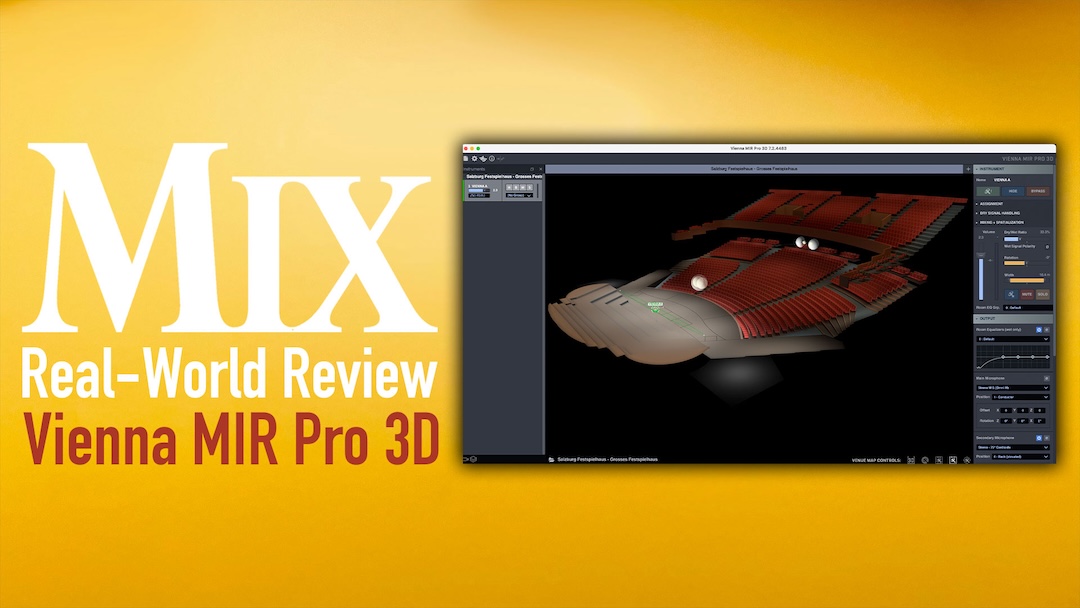
That room is the Salzburg Festspielhaus-Grosses Festspielhaus, found in Room Pack 7. It was captured with 6,400 impulse responses using four Ambisonics microphones. Those spaced layers—front and front-elevated, back and back-elevated—give you a true 3D rendition of the space.
CONTROLS THAT MATTER
My approach inside MIR Pro 3D is pretty simple. I’m not trying to use every feature; I rely on a few core controls that make a big difference.
The first is instrument positioning, the heart of the system. I’m constantly moving sources around the stage to create depth and separation. It’s a much more intuitive way to mix than just turning up a reverb send.
You can also adjust the width of the source as you place it, which I use quite a bit. Sometimes I want a part to feel tighter and more focused, other times, I’ll open it up so it feels larger and more enveloping. It’s a simple control, but it makes a big difference in how the mix breathes.
• Mix Review: AEA KU5A Microphone
In addition to the Main Microphone, you can enable the Secondary Microphone, placed further back in the space. I use it on virtually every session for added height and ambience.
Then there’s the room EQ. I tend to keep the low end of reverbs under control, especially when working with synths or bass-heavy material. MIR’s room EQ lets me shape the space quickly without destroying its character. Interestingly, some MIR Pro 3D rooms have such controlled low end that I’ll actually use the room to enhance a synth or bass element instead of cutting it.
SPACE AS COMPOSITION
Mixing today is becoming more spatial by default. Between Atmos, immersive music releases, planetariums and large-format venues—especially with more and more IMAX screens popping up at local cineplexes—we’re moving into a world where space is part of the composition itself.
For me, MIR Pro 3D isn’t just another reverb. It’s a tool that changes how I think about mixing. Instead of adding space as an effect, I’m building the mix inside a space from the start.
At the end of the day, I’m not using MIR Pro 3D because it sounds impressive in a demo. I’m using it because when the lights go down and that room hits those speakers, it works. Every time.