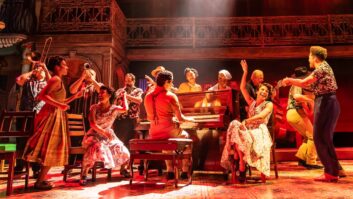
New York, NY (May 20, 2026)—Bringing an over-the-top 1980s action movie to the stage sounds like an exercise in scaling things down—reducing scope, reducing action and, most of all, reducing expectations—but Broadway’s latest hit, The Lost Boys, does none of that. If anything, the show takes “over the top” and uses it as a launch pad.
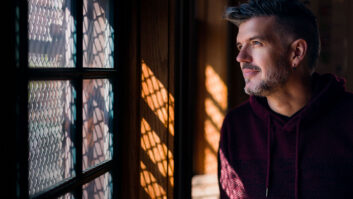
The new musical, based on the 1987 movie about two brothers and their mom battling evil teenaged vampires, merrily piles on the spectacle while simultaneously pulling the crowd deep into the drama unfolding onstage. Much of that is accomplished via the work of sound designer Adam Fisher, who now has received a “Best Sound Design of a Musical” Tony Award nomination for the show.
Staged at the Palace Theatre, a massive venue with 1,648 seats, The Lost Boys has a Sound Associates-provided audio system that is equally ambitious, with 278 speakers in play.
“I’ve been told by the general managers that there’s far too many speakers,” Fisher says with a chuckle, “but for me, that’s what theater is. You’re not trying to blast from the front; you’re trying to deliver sound as closely to the audience as possible, so it is about making the level even throughout the auditorium.”
Central to the system are Meyer Sound Panther large-format line array hangs on either side of the stage, which Fisher says are “a bit of overkill for this show, but I thought that for the ‘rock’ aspect of it, you want to have a big speaker that you’re not driving too hard.”
The massive hangs do more than cover the orchestra and mezzanine, however. “They’re also a visual statement,” says Fisher. “The audience comes in and sees two huge line arrays left and right, which gives the anticipated feel of ‘It’s not going to be quiet—this is going to be a rock show!’”
The 20 Panther elements are among 140 Meyer Sound speakers used in the system. Meanwhile, surround and foldback are handed with passive boxes from U.K. manufacturer EM Acoustics.
• Ethan Popp on the Immersive Vibe of Broadway’s The Lost Boys
Immersive atmospherics, ranging from unsettling drones to things that go bump in the night, are a huge part of the show, but Fisher also uses the show’s spatial audio to make the cast’s performances feel up-close and personal.
“Ideally, you want the audience to believe that it’s coming from the performer, not from the speaker that’s nearest them,” he says. “I try to make sure that everyone is in at least two or three zones, so that we can then create an image to where they are…. Some places, we achieve that better than others, but it’s an endless balancing act. Do you go for pristine-like vocal clarity, or do you image more?”
To support that imaging, Fisher has speakers onstage, hidden in set pieces, to help localize some sounds. When the teenaged vampires’ rock trio performs, two Meyer UPQ speakers hidden in the back wall are employed to image the drummer and guitars onto the stage.
“We were trying to find ways to localize the drums,” Fisher adds. “It was a long process because we tried to find other places to hide speakers, too, and it never landed. We were in rehearsals and Ray Wetmore, who’s our prop supervisor, went, ‘Well, could you put a speaker in the kick drum?’ The actor playing drums is hitting V-Drums, so they’re just pads. We found an in-car entertainment driver—a 15-inch driver with a coaxial horn on it—that we mounted in the kick drum, and it works quite well.”
Discover more great stories—get a free Mix SmartBrief subscription!
In other corners of the stage is a comprehensive foldback system for the cast, with sidefills on the rear of the proscenium, nine speakers in the deck and a grid of boxes flown overhead. The giant system is necessary as the show sports a three-story set and the vampires can fly, so the actors need to hear themselves whether they’re on the deck or 20 feet above it. Additionally, in the pit where the orchestra would traditionally be, there’s instead an apron lift used for several scenes; since it’s so far downstage from the rest of the foldback system, the lift, too, has its own set of wedge-like speakers for the cast.
Despite all the foldback speakers, when the vampire band performs, the actors hear themselves via in-ear monitors on Shure Axient wireless packs. For miking, however, RF is tackled with Sennheiser EM 6000 wireless systems, and all the cast wears DPA Core 4066 headset mics. “I think they’re the best in the realm of what they do,” says Fisher. “They sound like a studio mic, but they also have this uncanny ability to isolate.”
Strings and guitars in the orchestra are also captured via DPA mics. Most of the 16-piece ensemble is in a room three floors below the stage, while drums and percussion are one floor up. All the musicians use Roland M48 live personal mixers to hear themselves, getting sound derived from a DiGiCo SD10 mixing console used for both the orchestra and onstage band monitoring.
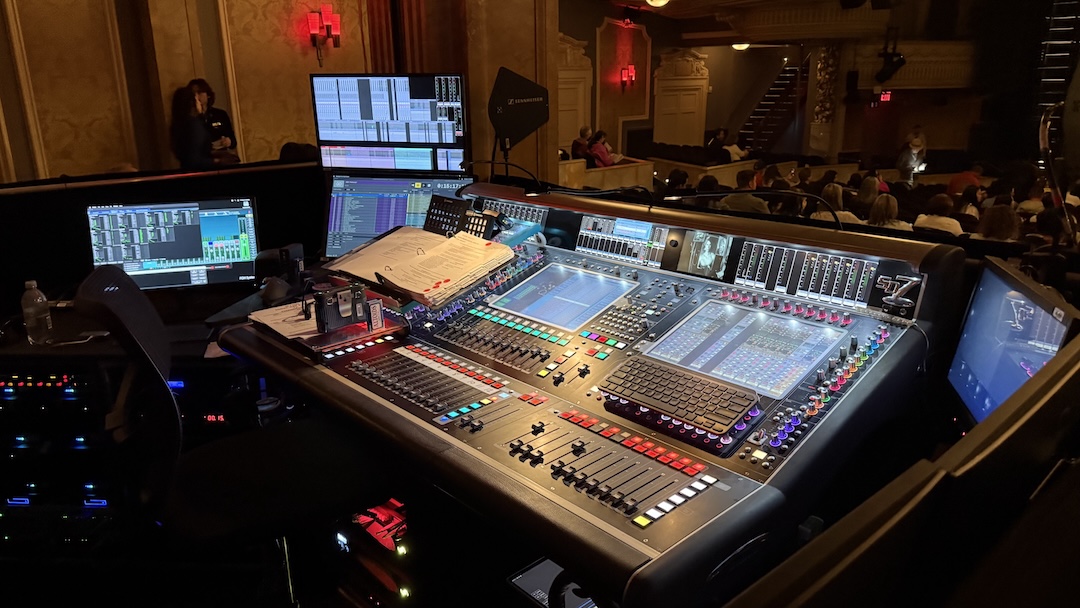
Out at front of house, another DiGiCo desk is put to use—a Quantum7 with theatre extensions, and a pair of Fourier Audio transform.engines handling outboard processing. Vocal processing is handled within the console to keep latency as low as possible, but the Fourier systems are used for reverb effects—and there’s a lot of them, often Seventh Heaven or Soundtoys plug-ins.
“There’s a lot of reverbs on this show,” says Fisher. “Every moment, it’s either atmospheric because it’s a horror section—they’re in a lair or a cave—or we’re trying to do an Eighties number where you’ve got some gated snare plates on drums.”
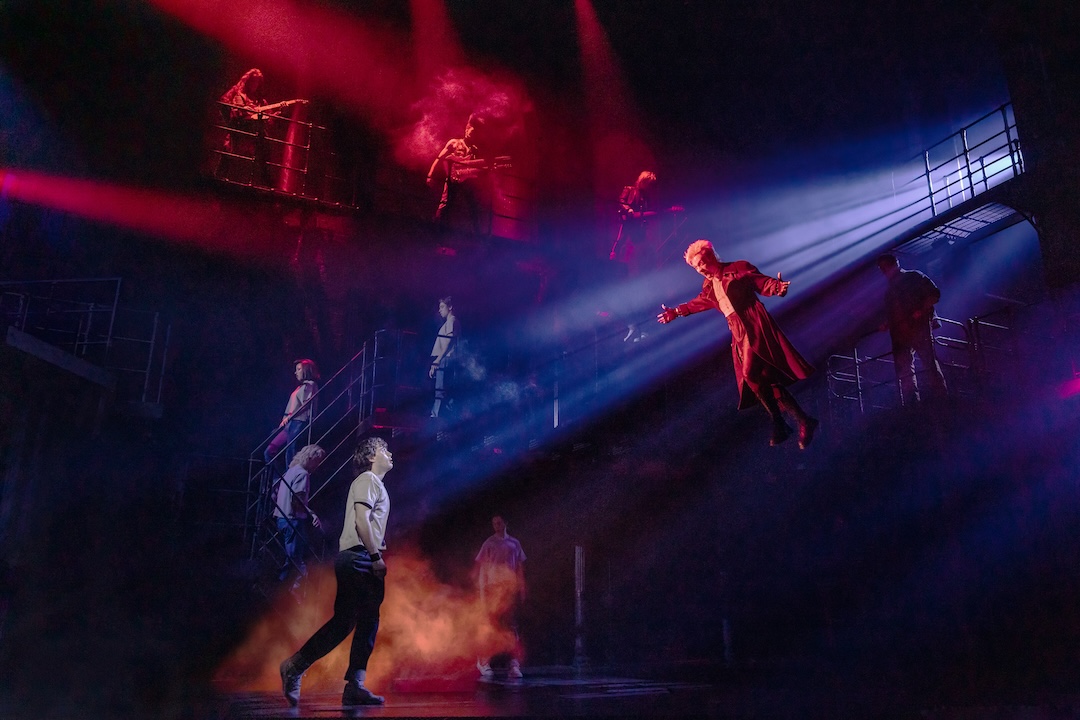
All that equipment and effort is meant to go unnoticed, of course. It’s there to support the show’s storytelling—key for a production that is equal parts musical, emotional drama and breakneck thrill ride—and Fisher’s sound design delivers it all with thoughtful nuance. With the show playing nightly to packed houses, that attention to detail has paid off.
“It was quite long, probably one of the longest processes that I’ve ever been in,” Fisher admits, “but it’s also been one of the most rewarding.”