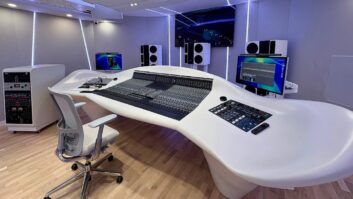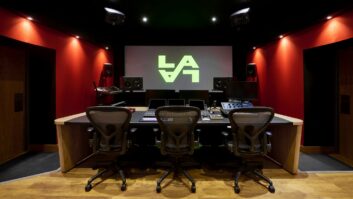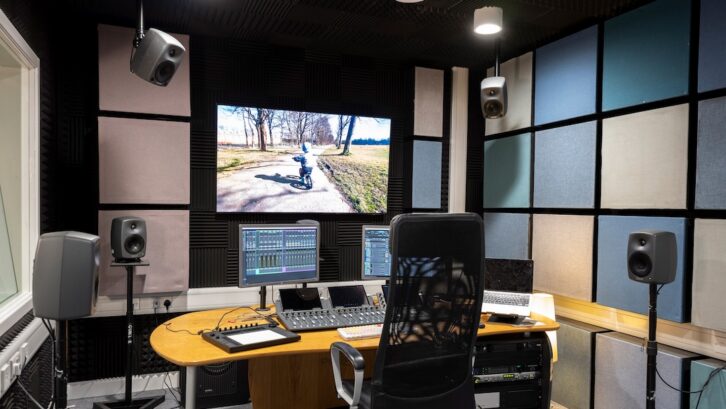
Natick, MA—Scotland’s Glasgow School of Art has relocated its School of Information and Technology closer to the main campus—a project that required recreating three Genelec-powered sound studios.
Previously based at the GSA’s Pacific Quay Campus in Glasgow’s Digital Media Quarter, the relocation has brought SIT much closer to the main campus but involved recreating Pacific Quay’s Dolby Atmos Room, Surround Sound Room and the spatial audio Soundlab in a brand-new space. To help execute the project, the GSA enlisted local reseller and integrator Mediaspec.
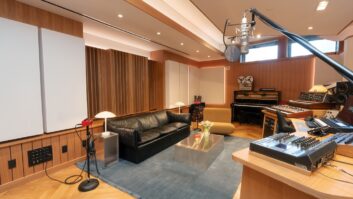
The principal aim of the new SIT facility was to create a flexible, future-facing teaching and production environment capable of supporting industry-standard Dolby Atmos workflows, traditional 5.1 surround mixing and third-order Ambisonics mixing, with support for voiceover and Foley recording too. Designed to provide students with access to industry-standard monitoring environments across multiple spatial audio formats, the decision was made for all studios to be integrated via a Dante network, which represented a major technical step forward from the previous campus location.
To deliver on the vision for the new campus, new spaces—including a 7.1.4 Dolby Atmos studio and a 16-speaker Ambisonics Soundlab—were commissioned and integrated by Mediaspec, with network infrastructure provided by the GSA’s internal IT team.
A total of 11 Genelec 8030 two-way nearfield monitors were transferred across from the Pacific Quay campus to equip the Atmos room, complemented by a 7060 subwoofer, while 16 of the super-compact 8010 two-way near-fields were purchased for the Ambisonics room, supported by a 7050 subwoofer.
The campus’ 5.1 surround sound studio utilizes the GSA’s existing 1029 two-way nearfield monitors, and a separate voiceover booth and Foley studio are also accessible via the Dante network.
• Discover more great stories—get a free Mix SmartBrief subscription!
As with all major projects, there were some technical challenges to overcome, as Ronan Breslin, the GSA’s program leader, MDes Sound for Moving Image, noted: “Since Ambisonic sound does not have a low-frequency enhancement channel as part of its defined characteristics, we found that initial playback testing with the 8010 monitor array in the Soundlab revealed very good immersion and localization characteristics, but the low end required reinforcement. Therefore, Mediaspec suggested that we deploy a 7050 subwoofer in the room—which we fed with summed 100 Hz LPF audio—and this did indeed remedy the issue, following some experimentation with positioning.”