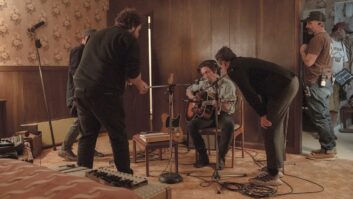
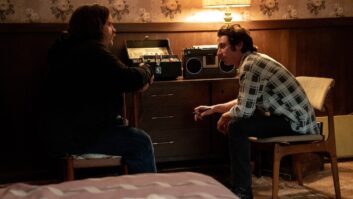
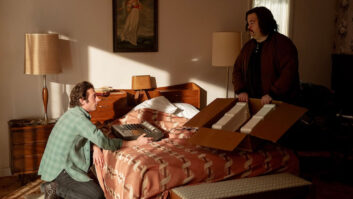
The Bruce Springsteen biopic Springsteen: Deliver Me From Nowhere focuses on The Boss recording both at home and in the studio in 1981 as he struggles to create the songs that will become his stark landmark album Nebraska. Painstakingly recreating the sound of those situations required an army of audio professionals, and over the course of this unprecedented, five-part, 11,000-plus word article, they all weigh in on how they made that happen. Don’t pass up Part 1!
MAKING PRE-RECORDS
Making pre-records for music-based films is commonplace, says Oscar-nominated veteran production sound mixer Tod A. Maitland, CAS. Maitland performed similar duties on last year’s hit rock biopic, A Complete Unknown. “You do pre-records for everything,” he explains. “You need to have them, because you may want to jump in and out of them, if the scene carries on beyond the scene where the music is being performed live to camera, as is the case here. You need to be able to match to them and carry the performance through across those edits.”
They also serve another purpose. “The pre-records are really the vibe,” especially for the Colts Neck recordings, producer Dave Cobb explains. “That’s where we figured everything out. Bruce’s demos are what became the record, so it’s really hard to get back in that head space he was in at the time—and you even see that in the film, as he struggles to recreate that in the studio with his band. So it’s the place for us to help Jeremy recapture the heart of that, and it was where we tried to break down that magic and recreate that sound as well.”
The bulk of the Colts Neck pre-records were tracked at RCA Studio A in Nashville, with some additional recordings made in mid-October at Power Station in New York. Sometimes, pickups might be tracked at places like Hobo Sound in Hoboken during filming, when a particular inflection might be noticed and desired to be replaced for authenticity’s sake. “They would be filming and find something they might wish to change or correct, and just say, ‘Hey, can we get him in to do a couple of these words?’” Koller explains.
Similarly, in January 2025, after filming was wrapped, other spots were picked up at Village Recorders in West Los Angeles. In each case, the identical signal chain was always used, including a 545 mic, tracked to Pro Tools, edited by Caudieux and sent off to Koller to complete his process at his studio in Burbank (see below).
A very important resource the team had available was digital transfers of Springsteen’s original 4-track cassette recordings—the actual raw recordings made on the real TEAC at Colts Neck.
“Bruce was kind enough to open his vault for the 4-track material for our use,” explains veteran music editor Jason Ruder, himself a previous Oscar nominee for his work on Bradley Cooper’s A Star Is Born and Maestro.
The tapes had been digitized a few years ago, along with other recordings for, among other things, creation of the recently released Nebraska ’82 box set. That set features additional recordings and other materials not appearing on the original album, according to Springsteen’s studio engineer and archivist, Rob Lebret, who worked on that set and supplied the materials to Ruder for use in the film. The engineer has worked for Springsteen for almost 20 years, and for the last 15 years, at the artist’s spacious—20’ x 60’—Stone Hill Studio, on Springsteen’s property—in Colts Neck, of course.
MIKE BATLAN ON RECORDING THE ORIGINAL TRACKS
According to assistant/guitar tech Mike Batlan, Springsteen, like most songwriters, would typically record a “work tape” of a song, as he was writing it, which he would later present to the band, to begin working out an arrangement for recording. Those songs were, at that time, recorded onto a 1980 Panasonic RX-5100 boom box, according to Joshua Lutz. Though the story commonly heard is that the Panasonic had become damaged in a flooded basement, Batlan notes, “Bruce had taken it out in a canoe, and it became waterlogged, and it stopped working. And then, one day, it had dried out—and it started working again!” Unfortunately, it worked but not quite as it had before it went for a swim, so its speed often varied and was not fully at 3 3/4 ips.
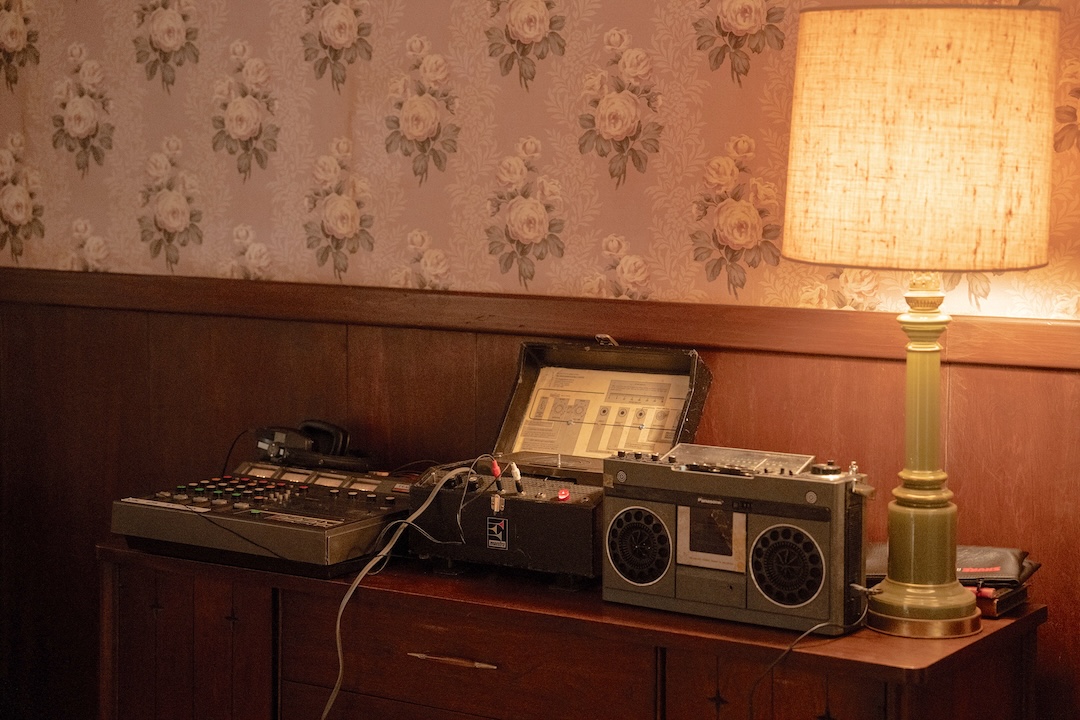
When it came time to begin writing new songs at Colts Neck, Springsteen decided he wanted to make a little more elaborate recordings, so he called Batlan to see what else might be available. “He said he wanted to be able to add a few extra tracks. I asked him, ‘Well, how involved do you want to get with this?’ He said, ‘We just need a couple extra tracks, for a couple of overdubs,’ like a glockenspiel, harmonica or an additional vocal. I said, ‘So, like, 8 tracks? 16?’ And he goes, ‘Oh, no, no, no. We’re gonna do this at the house, probably in the bedroom. Nothing that complicated.’ ‘Well, 4 tracks?’ ‘Yeah, that should do it. See if you can find something we can use. Nothing complicated. It’s just work tapes. That’s all we’re doing here,’” he recalls The Boss telling him. “We weren’t making an album.”
Batlan was visiting with a sound mixer friend from The Stone Pony and described his predicament. “He held up a full-page ad for the TEAC 144 in an audio magazine, and said, ‘How about this? You take a cassette and use all four tracks in one direction—and you’ve got a 4-track recording.’” So Batlan went to nearby Red Bank Music, a local music store where he often bought guitars and other gear for the band, and had them order one (for, though he doesn’t remember, likely the $900 TEAC charged, upon the machine’s release two years earlier). Upon its arrival, he picked it up and brought it home, studying the manual to learn how to use it. “That was my job; Bruce just wanted to play.”
At the bedroom at Colts Neck—which he points out was much smaller than appears in the film, perhaps just 12’ x 14’—Batlan notes, “There wasn’t even room for a second chair, so I sat on the edge of the bed and cleared off a night table, turned it sideways and put the machine on it.”
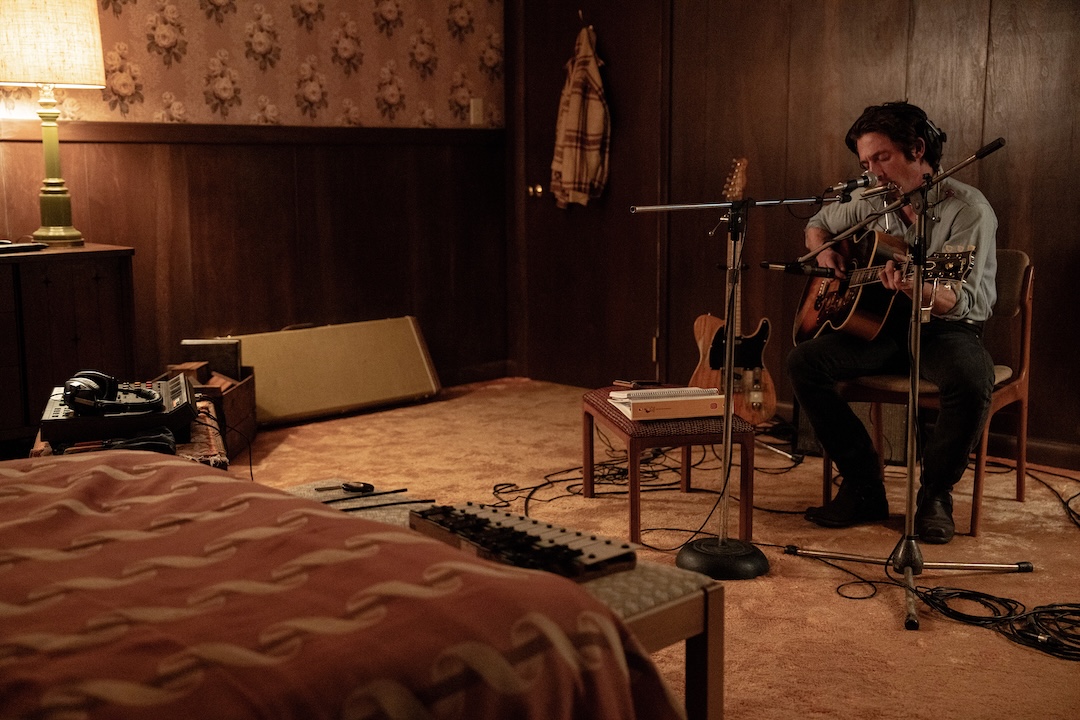
The two worked for two to three weeks at the end of December in 1981. “We worked five days a week, usually starting around 12 noon or 1pm, and finishing around 6 or 7.” Batlan had ordered plenty of high-quality C-60 cassette tapes—the brand long forgotten—which, with the machine operating at 2x speed, offered just 15 minutes per tape of recording. “He might do six or seven takes of a song, and I would record one take of one song on each tape. One thing I never wanted to find myself doing was telling Bruce Springsteen, ‘Uh, Bruce, we lost that one. I ran out of tape.’ That wouldn’t have gone over too well! When Bruce starts playing a song, that’s serious business.” Mixes were made upon completion of each song, later compiled onto a single cassette, he says.
Batlan also brought a popular piece of gear Springsteen loved: an Maestro Echoplex EP-3: “He’d use it all the time on guitar, so I made sure to bring it.” When you hear reverb on the finished recordings, Batlan explains that it was the Echoplex that produced that effect. “They had ‘Echo Sustain’ dial and a repeat delay slider, which set the length of the delay. If you turned up just the Echo Sustain setting, and set the delay to zero, you got an echo that sounded almost like reverb.” The device was likely patched into the 144 via its effects send/return.
For the recordings, Springsteen used a beautiful 1957-era Gibson J-200, one which Batlan and lighting designer Mark Brickman had given him for his 30th birthday, two years earlier. “I got that for him at Manny’s Music in New York. It was $600—Mark and I split it.”
Upon beginning work on the Nebraska ’82 set, Rob Lebret had a listen to the digital transfers of Batlan’s original raw 4-track recordings, which, he notes, as nothing short of astonishing. “It was really exciting to dig back into those recordings,” he relates. The engineer found himself playing the entire set of recordings at first,simply with Springsteen’s voice soloed with no effects.
“It was mesmerizing,” says Lebret. “I could hear Bruce’s vocal in such a clear way. Bruce’s guitar playing is quite soft, and because he’s in a bedroom, there were minimal reflections. The tracks were really clear—direct and intimate. I could hear so much detail of the guitar and voice, with just a little of the room’s natural ambience. It really gave me a sense of that space he was in. It was so captivating, listening to it raw—I just couldn’t stop.”
Springsteen and Batlan appeared to have mastered the use of the simple recording device quickly, Lebret notes. “Judging by the final product, they quickly knew how to use it well enough to capture the magic that we hear, even recording with such a basic setup, with just a few tools.”
The differences in pitch and other specifics to the sound of the original boom box mix were certainly undeniable to Springsteen, his engineer states. “It just came together in such a magical way, and he knew it. That’s the genius of Bruce; he knows when something is right and when it’s not. He generally won’t rest until it’s right, and he knows when it is—and this was it.”
The original recordings were also a valuable resource for White, who was able to study Springsteen’s actual performances in the room—instead of the released versions—which he was required to replicate for the camera.
As one might imagine, a simple recording with two mics in a bedroom, of Springsteen singing into one and playing guitar into the other, resulted in significant bleed across the two channels on the recordings, which needed to be remedied, to provide clean tracks of both the guitar and the vocal for future mixing. “They arrived with his vocal and acoustic baked together; t here would be vocal on the guitar track and guitar on the vocal track,” Ruder explains.
ADAPTING THE ORIGINALS FOR THE PRE-RECORDS
It was decided early on, Ruder says, for Dave Cobb’s use on the pre-records, “Let’s try to keep as many of Bruce’s original instruments as possible,” though still desiring to maintain the lo fi quality of the 4-track recordings. “Even though Jeremy would be performing those songs live on set, being able to strip out Bruce’s voice and provide those clean tracks to him and Dave allowed Jeremy to start workshopping and get himself into the headspace Bruce was in.”
To clean up the bleed, Ruder and his team, he says, “We leaned into non-generative A.I. tools,” such as iZotope RX and AudioShake, a favorite of Ruder’s: “I feel like AudioShake is the best for audio cleanup work. I had just gotten off a pretty large project that I’d leaned on AudioShake for, and it just became an obvious choice as a good cleaning tool. We used it constantly here.”
Ruder was always conscious, however, of not using those tools to make the recordings too clean. “If you go through and A.I.-separate some of that material, sometimes you lose a little bit of the effect in that process. We’d get a sequence the way we want, and I would actually process it a little bit through the same signal chain—through the TEAC—to put a little bit more of that same sound back into it. If the scene was clearly Jeremy’s vocal being played through the TEAC, I would run it through the same signal chain, to recreate that sound, so that it was authentic.”
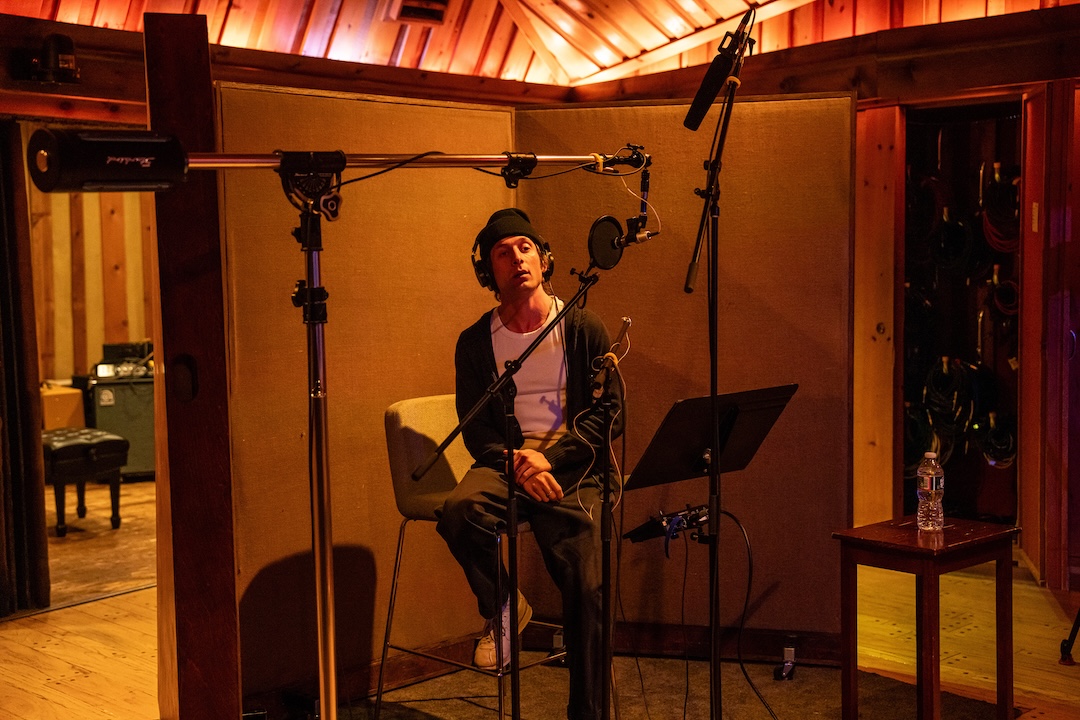
The process of recording White’s vocals was a very specific one, as Cobb details: “We would listen really closely to each line, and then do that line until we got as close as we could. I mean, even breaths. We’d get to a point where, after we’d done a bunch, Jeremy would say, ‘Play Bruce, and I’m gonna sing along with it,’ and then, we really started locking in. We were getting every inflection we could possibly get—every run, every falloff; it was very, very technical and Jeremy was relentless. He was killing himself to be as authentic as he possibly could.”
The actor wouldn’t stop there. “He didn’t want to give up. We would get something, and I’d say, ‘Oh, man, that’s great.’ And he would say, ‘But is it. . . is it it?’ What an unbelievable talent.”
It helped, of course, that this was an actor, used to doing ADR in post-production. “We actually talked about that a little bit. He was definitely able to take advantage of his experience doing ADR, using that part of himself as an actor.”
While White was matching Springsteen’s specific, historical delivery, Cooper notes, it was not mimicry or imitation. “Few people know Bruce better than Steve Van Zandt or [longtime Springsteen producer/manager] Jon Landau, and they felt Jeremy not only captured Bruce, but they felt like they were in the room with him, ’cause they remember him from this period. When you hear or see a Bruce Springsteen performance, it’s almost spiritual. That’s what we were going for—stripping away the mythology and seeing a man who is dealing with a reckoning. He’s singing that reckoning.”
MAITLAND ON THE MICS
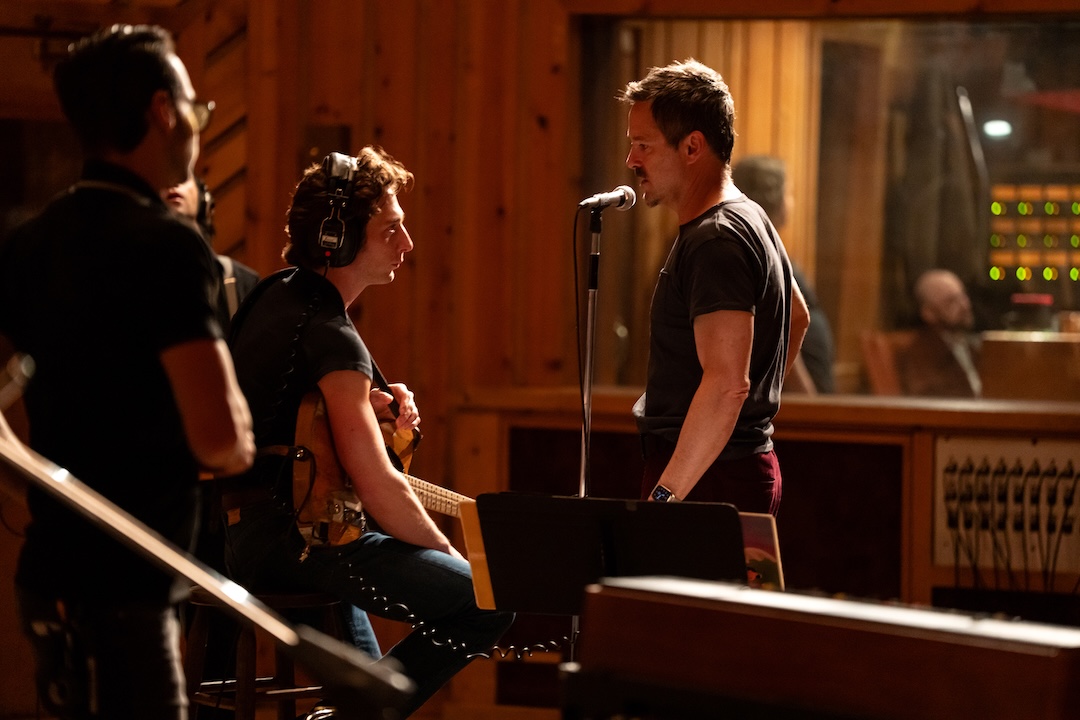
Koller was not the only person recording White at pre-record sessions. With White set up in a makeshift vocal booth at Power Station, in their smaller room, Studio B, Tod Maitland would do a test to determine the best lavalier to use later on set, where needed. “I’ll take a grip arm and attach six different lavaliers to it,” Maitland explains. “I’ll also have my regular boom mic—a Sennheiser 416—mounted a foot or so above his head. The idea is to find the lav that makes the best match to my boom mic. Then, while Jeremy’s recording his pre-record vocal, he’s being tracked by three mics: the studio microphone, my boom, and the selected lav mic.”
In post, then, as a scene, say, progresses from watching White sitting in the Colts Neck bedroom set, singing live to the mic on set, it can transition from that mic to a lav to Maitland’s boom, then to White’s pre-record vocal, and eventually, if needed, to Springsteen’s own original vocal recording, all seamlessly. “If we’re singing live on set and he’s wired, if you transition to a big studio microphone right from a wireless lav, it’s a big change. You’re going from a tiny little diaphragm to a big fat diaphragm, and a big fat, nice, beautiful, rich voice. [This way,] they’ll go from the live track on the wireless, to the pre-record on the wireless lav, and then can transition to the studio mic—and you don’t hear it. The audience never hears the transition.”
Besides the Colts Neck material, pre-records were also made in Studio B at Power Station for three other locations/scenes: two replicated Springsteen with The E Street Band, recorded at the studio in mid-October, and the remainder with another group of musicians.
• Classic Tracks: Bruce Springsteen’s “The River”
The film opens with Springsteen and the band playing the final show of his lengthy The River tour, at Riverfront Coliseum in Cincinnati on September 14, 1981, closing the show with “Born to Run.” For that performance, the actors portraying the band mimed to a previously unreleased recording made during that tour, taken from the Brendan Byrne Arena in East Rutherford, NJ, on July 5, 1981 (one of six shows they played there). “That tour was recorded on 24-track, so we had great material to work with,” reports Ruder. For that performance, White recorded a vocal, matching Springsteen’s.
The E Streeters are also seen recording an early take of what would be another classic, “Born in the U.S.A.,” in the studio. Once again, White was asked only to record a vocal, which we see him sing in the scene, recorded to an existing backing track, provided by The Boss himself: Take 2, recorded May 3, 1982, which was also the released take.
For that recording, Cobb and respected session guitarist J.D. Simo—whom the producer also hired to coach White, as he studied Springsteen’s guitar playing—met at RCA Studio A in Nashville and added some important guitar parts. “There are actually two versions of ‘Born in the U.S.A.’ in the film. J.D., who is a great guitar player, did a new acoustic Colts Neck version, because we didn’t get a good transfer of the original recording, but he and I also added some parts to the studio outtake.”
On the released version, the guitars don’t come in until later in the first verse, when the drums arrive. “But I could imagine, the first time he was running the band through the song, trying to show it to them, so he would likely have been playing the guitar at the start, as well as at the end, because they hadn’t fully figured out the arrangement yet. J.D. and I added those.”
Discover more great stories—get a free Mix SmartBrief subscription!
More challenging, though, was White’s vocal overdub, tracked at Power Station. Notes Cooper, “Bruce has always said it’s the hardest song for him to sing. There were many times where Bruce would be performing live, and see that song on the set list, and turn to [drummer] Max Weinberg and say, ‘Not tonight,’ because that song is too hard to sing.”
White gave it his all, to a point beyond exhaustion. “I would find him on the floor, holding his head—he got a migraine doing it,” the director recalls, “but it was spine tingling to see him sing that track.” Notes Koller, “He was laying on the floor, almost hyperventilating, and he lost his voice for several days after that. He blew us away—we couldn’t believe it.” The final performance heard in the mix is a blend of both his and Springsteen’s voices, delivering the perfect match to what’s seen onscreen.