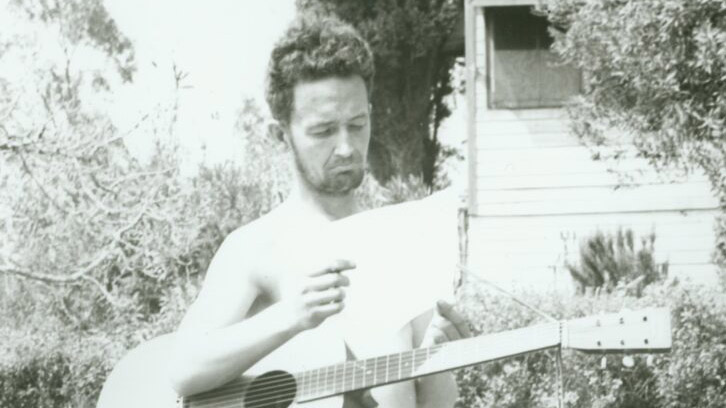
I’m sure that more than a few readers will skip right past this month’s feature story on the making of Woody At Home—Volumes 1 & 2, asking themselves why in the world, with all the new music coming out today, Mix would take the time and space to talk about a man who died nearly 60 years ago. Well… I could go on for hours if we were sitting in a pub, believe me, all while putting aside the fact that one day history will judge him to be one of the most important figures in 20th century America. And not just for his music.
As for why we asked senior writer Steve Harvey to dig into the story behind the making of a two-volume set of previously unreleased recordings, from a simple one-mic-and-a-recorder setup at his New Jersey home in 1951 and 1952, there are a few compelling reasons. The first, and most important, is that he wrote thousands and thousands of great songs—many of them still being covered and recorded in 2025. And now, thanks to technology and a bit of passion, as Steve tells us in his excellent feature article, we get a chance to go back to the raw originals and hear them in an entirely new light.
“It all starts with the song.” In my 35-plus years at Mix, I can’t tell you how many times a producer or engineer has prefaced their answer to a question by saying that no matter what they might do—EQ moves, adding effects, employing every mix trick or technique they might dream up— none of it matters if there isn’t a great song to start with. Strip everything else away, and it’s pretty simple: A great artist with a great band and a great song make for a great record.
Woody Guthrie wrote more than 3,000 songs in his lifetime, many of them for publishers, many for album recordings, many just lyrics on paper that are still being discovered. My own children grew up to Woody’s 20 Grow Big Songs; he wrote hundreds of songs for kids. He wrote Dust Bowl Ballads based on his own experience. He wrote “This Land Is Your Land,” for goodness sakes. In an alternate universe, it could be our National Anthem. And yet, he never considered his masterwork finished—as he says on the disc in “Howie, I’d Like to Talk to Yuh”:
“I have never yet put a song on tape or a record, or wrote it down or printed it down or typed it up, or anything else that I really thought was a through and a finished and a done song, and it couldn’t be improved on, couldn’t be changed around, couldn’t be made better.”
That made me think of all the mix engineers I’ve interviewed over the years who say some kind of variation on the same theme: “A mix is never really finished; at some point, it’s just abandoned.”
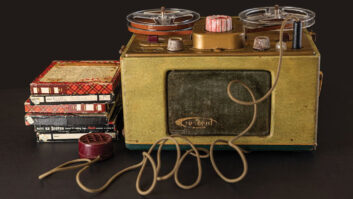
Which brings me to the second reason there’s a story about Woody in this month’s issue: technology. These recordings were made on a consumer tape deck in 1951 and 1952, his first time recording to tape. TRO Music set him up with a mic and a Revere T-100 Crescent recorder, and now, 73 years later, as Grammy-winning Woody At Home producer Steve Rosenthal says in the story, “One of my favorite things is that Woody’s going to get All Music and Discogs credits as a recording engineer. Isn’t that amazing?”
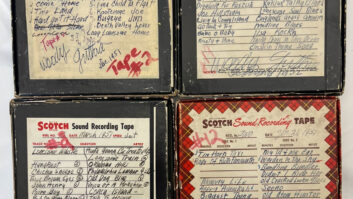
From that point on, there’s a great story of meticulous tape transfers by Sean McClowry at The Attic Studio in New Jersey, then the use of demixing and source separation software by mix/mastering engineer Jessica Thompson, in order to separate the guitar and vocal from the mono recording, then remix them so that it would sound like Woody “was sitting right next to you on the couch.” Audio technology in 2025 is an amazing thing, and it can bring us treasures like they were meant to be heard. Woody was a pioneer. No question.
And the final reason that we are writing about Woody: his humanity.
There’s a long history of musicians coming together to unite the world, or regions of the world, in times of crisis. Live Aid, Farm Aid, “We Are the World,” Playing for Change. Music unites people, and Woody knew of its power.
Woody was the original. He represented the downtrodden and the forgotten, the hobos and the poor, the refugees and the laborers. It’s no coincidence that the first single from the project, released by his family on July 14, his birthday, was his only known recording of one of his greatest works, “Deportee.”
Discover more great stories—get a free Mix SmartBrief subscription!
I’ve read about Woody since I first discovered Bob Dylan long ago, and in doing some background research this month, I came across the following Woody quote on Wikipedia, from a December 1944 radio show. It’s as good a summary of a good man as you’ll find, and it’s in his own words:
“I hate a song that makes you think that you are not any good. I hate a song that makes you think that you are just born to lose. Bound to lose. No good to nobody. No good for nothing. Because you are too old or too young or too fat or too slim, too ugly or too this or too that. Songs that run you down or poke fun at you on account of your bad luck or hard traveling. I am out to fight those songs to my very last breath of air and my last drop of blood. I am out to sing songs that will prove to you that this is your world and that if it’s hit you pretty hard and knocked you for a dozen loops, no matter what color, what size you are, how you are built, I am out to sing the songs that make you take pride in yourself and in your work.”
—Tom Kenny, Co-Editor