Don’t Pass Up Part One!
STOCKING THE STUDIO
Andrew Watt’s personal studio might be where his breakthrough with Ozzy Osbourne began (see Part One), but as his career has blossomed, so has the facility where he creates with engineers Paul LaMalfa and Marco Sonzini. “I love working at my studio,” he admits. “I’ve set up a vibe that I really enjoy creating in, and it morphs around whatever artist we’re working with.”
Upgrading the studio over time has allowed Watt to get better equipment while also indulging his inner rock fan. For instance, his Moog Minimoog Model D analog synth isn’t just a vintage original—it used to be David Bowie’s and was played nightly on the 1972 Ziggy Stardust tour.

Elsewhere, there’s classic guitars and basses, and the iso booth is outfitted with a sturdy drumkit, but the focal point of the facility is a vintage, 32-channel Cadac console originally built for London’s Wessex Sound Studios—which means it has rock ‘n’ roll pedigree to die for.
“It’s the Cadac that belonged to [producer/engineers] Chris Thomas and Bill Price when they did the Sex Pistols’ Never Mind the Bollocks,” Watt explains. “‘London Calling’ by The Clash, News of the World by Queen, and the first two Pretenders albums were all recorded on it—then it found its way to Nigel Godrich, who used it for Radiohead, and Alan Moulder used it extensively, too. It was made for the late-70s music coming out of London, which is probably my favorite period of music.

“Besides that, we use a ton of gear that we love,” he adds. “There’s a bunch of Helios Type 69 channel strips that our drums are always running through; a bevy of compressors and EQs, like Neves and APIs; tons of Neumann 67s on the drums; and all kinds of indulgent stuff!”
While the studio was built up to make his work life easier, Watt readily admits that recording in different environments can bring out different sides of musicians: “It’s always fun to go with an artist to a city that means something to them, or which has a vibe.” Much of his work in recent times has taken him far from Los Angeles—the Stones record was made in London, while McCartney’s album was recorded everywhere from Watt’s place to Abbey Road to McCartney’s own private UK facility in Sussex.
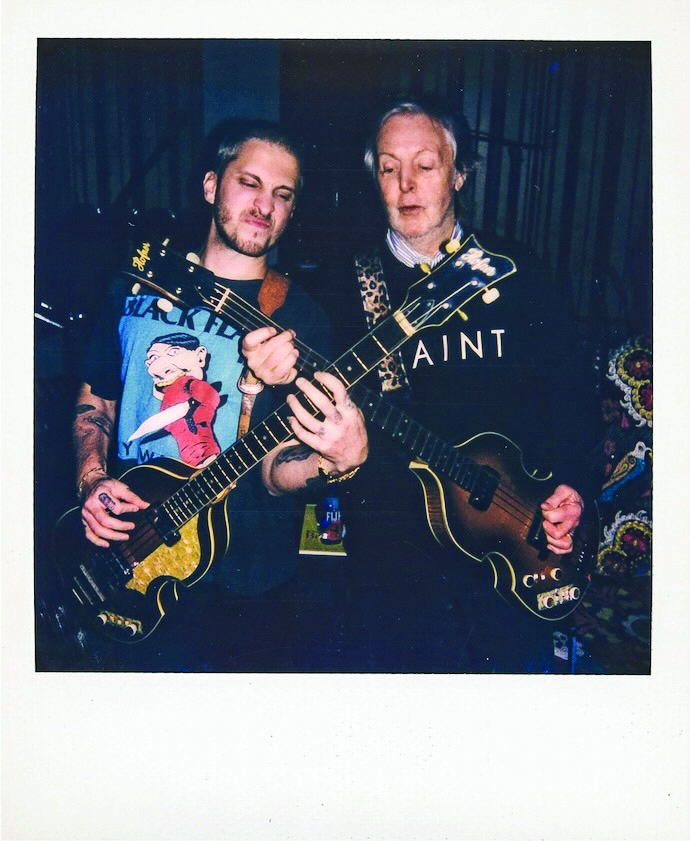
MAKING MUSIC WITH MCCARTNEY
Of all the projects Watt’s been involved with, easily the longest gestating was The Boys of Dungeon Lane—a process that began so quietly that even he and McCartney weren’t aware of it.
“We were working together for four years before we even said, ‘Hey, let’s make this an album,’” says Watt. “We just worked together because we wanted to, we had fun when we were together, and it felt very innocent and all about the music. We never talked about when we should release this music or what it was.”
• Discover more great stories—get a free Mix SmartBrief subscription!
Lest that sound disingenuous, it goes right back to Watt’s credo of supporting the artist—and in the case of McCartney, that meant recognizing their work together was one of many irons in the former Beatle’s fire.
“Paul is making music every day; I mean, that’s just what he does,” says Watt. “He does it because he loves it. There is no ‘commercial’ thought in his head; he goes into the studio because he enjoys creating…. What I’ve seen over the last five years is he’s got a lot of stuff going on in his life—the way he’s living and his tours and stuff—and making work and creating is very much an important part of his life, some of which he does on his own. Over the last couple of years, he’s chosen me as one of the people that he likes to do that with. So, multiple times a year, we just would talk a couple months before and say, ‘Hey, do you want to get together at this time during this thing?’ ‘Yeah!’ Anytime he asks me to do anything, forever, I’m there, right?”