| MIX VERDICT: PRESONUS STUDIOLIVE SE SERIES |
| THE TAKEAWAY: “The possible applications for the StudioLive series extend far beyond basic FOH and monitor duties…the studio-grade quality of the components and USB connectivity make these units compelling options for mobile and fixed-location recording and production chores.” |
| COMPANY: PreSonus • www.PreSonus.com PRICE: $999.99 (SE 16R), $1,299.99 (SE 24R), $1,599.99 (SE 32R) PROS: • Excellent, transparent, fully recallable XMAX-R preamps with combo XLR/¼-inch inputs. • Multiple customizable ¼-inch balanced outputs across Flex mixes as well as DCAs. • “Stupid-easy” virtual mixing software that works on Mac, PC and mobile. CONS: • Minor software bugginess on macOS when linking stereo aux outputs. |
New York, NY (August 19, 2026)—A decade after its launch, the PreSonus StudioLive remains the linchpin of countless live sound rigs, serving as a standalone mixer and a networked stage box interface, and is increasingly used to run IEM setups for touring musicians. Refreshed for 2026 with numerous under-the-hood improvements, this product line continues to prove its value across all facets of live sound environments as a fully capable audio interface platform.
The StudioLive line stands apart from competitors in the space, such as the Soundcraft Ui24R or the Midas MR18. While those units focus on a shallow-but-wide layout in which essential connectivity is spread across a larger rack footprint, the StudioLive designers opted to pack similar functionality into deep 1U and 2U units.
The tradeoff is an interesting one, and it ultimately comes down to a user’s individual needs. In a rushed live sound environment, having all essential connections on the front is very convenient and appealing. On the other hand, condensing similar functionality into a 1U or 2U space opens the possibility of either touring with a smaller rack, or being able to add a few more essential items, like a mic splitter or wireless gear, in the same enclosure.
The three SE rack mixers share the same core StudioLive workflow, but they scale significantly in channel count, USB I/O, mix buses, DCAs and physical preamp count.
WHAT YOU GET
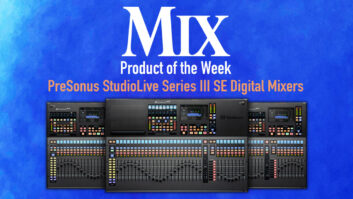
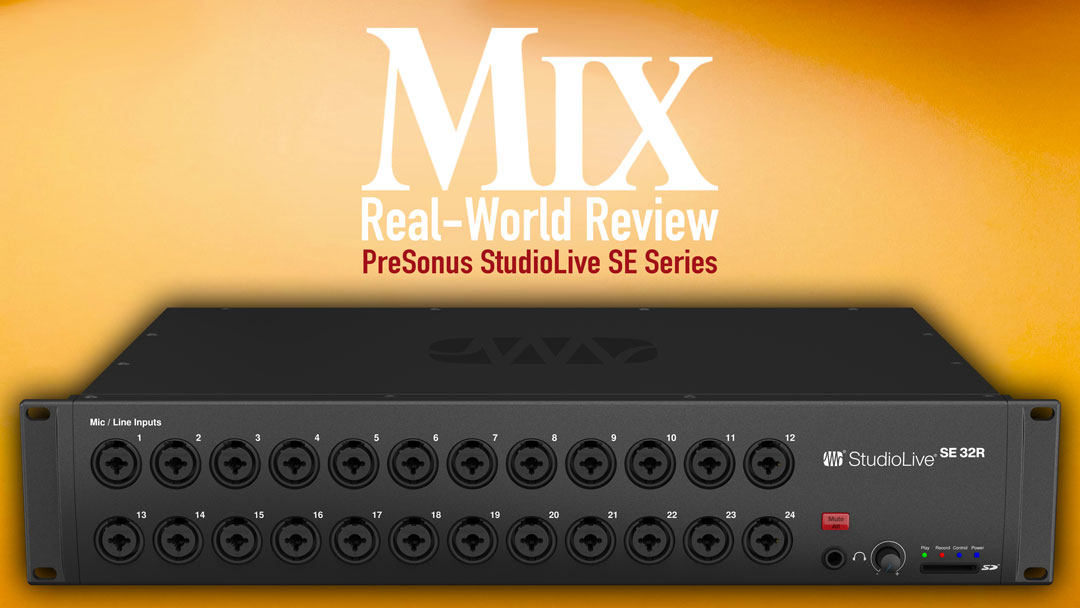
The SE 16R fits into a 1U rack, featuring 16 recallable XMAX-R mic preamps, FLEX DSP Fat Channel processing, six FlexMixes, two dedicated FX mixes, six DCAs, 18×18 USB recording and onboard stereo SD recording. The SE 24R expands this setup over two rack spaces, providing 40 channels, 24 XMAX-R preamps, 16 FlexMixes, four subgroups, four FX mixes, 24 DCAs and 64×64 USB recording. The flagship SE 32R keeps the same 40-channel architecture while adding 32 onboard XMAX-R preamps, along with the same 16 FlexMixes, four subgroups, four FX mixes, 24 DCAs, 64×64 USB recording and stereo SD recording.
In addition to the I/O options, each unit includes RCA stereo inputs, one pair of XLR main outputs, Ethernet/network connectivity, USB, a ¼-inch headphone output, an SD card slot for recording and a front-panel “Mute All” button.
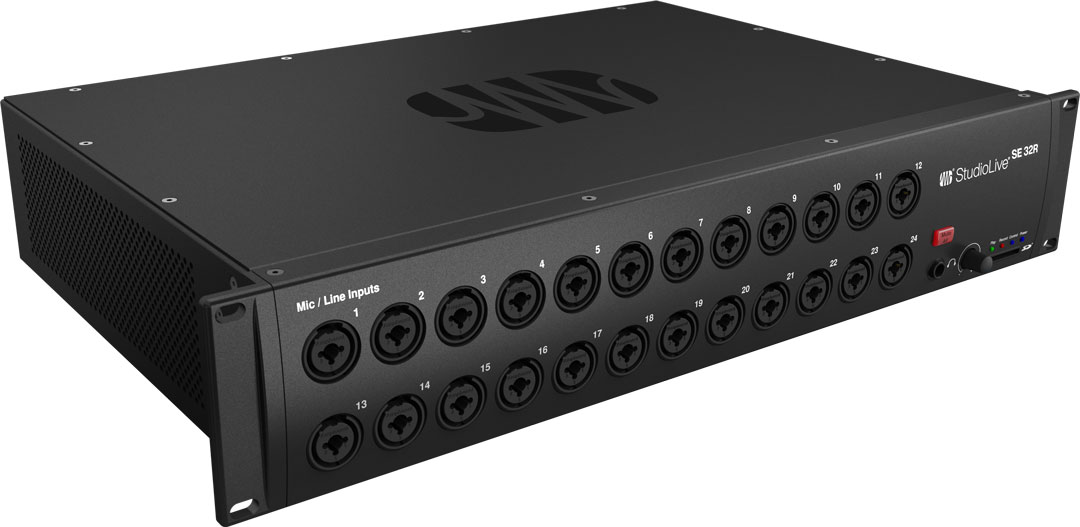
Unlike most competitors in this space, StudioLive lacks integrated Wi-Fi. In use, those built-in networks are essentially the default way to access competing units right out of the box, though virtually all serious users supplement them with a dedicated Wi-Fi router for improved range and reliability. The product team at PreSonus appears to have long ago decided to save space in these already tightly packed units for more important components.
For 2026, PreSonus has refreshed the StudioLive Series III rack mixers under the SE banner, though this is less a ground-up redesign than a modernization of an already mature platform. The headliner updates include Milan-certified AVB networking, expanded Fat Channel processing, improved Digital Reverb XL controls, variable limiter release and a more complete software bundle built around Universal Control, Capture, QMix-UC and the broader PreSonus/Fender software ecosystem. Some of these improvements are firmware-based, also benefiting existing Series III users, so the SE line should be viewed as a current-generation refinement rather than a hard reset.
RACK IT UP AND GO
Getting up to speed with the StudioLive Series is a breeze. The most direct way to access the unit’s mixer controls is via a standard USB connection. Users will need to download the Universal Control software, now transitioning under the Fender Universal Control name, from the PreSonus support site to a Mac or PC. Once installed, users just need to connect the unit via USB and fire up the software. From there, the software will detect the connected unit, and users can begin to access the virtual mixing console.
[Note: It bears mentioning that these units are dense, heavy and deep, each measuring a full 12 inches from front to back. When adding these to a rack mount, you will need to take some care in how you “negotiate” your placements with other, lighter, less forgiving pieces of gear.]
On the mobile side, users will need to supply and configure a dedicated Wi-Fi router with a network name and password, then connect it to the StudioLive via Ethernet. From there, it’s possible to access and control the unit via the Universal Control mobile app, which is best suited to a tablet-sized interface. Phone users are not completely left out, however: QMix-UC remains the more practical option for musicians who simply need personal monitor-mix control from a smartphone.
For the portable IEM crowd, that distinction matters. Everyone in a touring band situation already has a mobile phone, and it’s ultra-convenient to let individuals control their dedicated mixes. For deeper mixer operation, however, Universal Control is dense, feature-packed and better suited to a larger touchscreen interface. In practice, using it on an iPad Mini felt pretty tight.
Aside from the screen-size considerations, the Universal Control software and corresponding mobile experience are straightforward and easy to use. One of the great out-of-the-box features is the ability to assign multiple mobile devices to the unit with varying levels of access. This way, for example, an individual device can have complete control over the unit, while performers remain limited to their own monitor mixes.
From there, working with individual channels is very straightforward. Clicking on a channel lets you set the input source (analog, USB, network or SD card), adjust gain and more. Each channel features a sensible channel strip with gate/expander, compression, EQ and limiter processing. Within those sections, users can select from the original stock options or additional modeled EQ and compressor choices, including vintage-style dynamics processors that bring a warmer, more studio-like vibe.
Additionally, individual channels and aux mixes can be linked in stereo. On the macOS app, there was some notable bugginess when linking aux channels to work in stereo. When attempting to link a pair of auxes, the app would completely crash. However, upon reboot, those changes would be saved and nothing else would be negatively affected.
VERSATILE AND DEEP
From an overall sound-quality perspective, there is nothing to dislike about these units. The hardware preamps and outputs are pristine and transparent. The included mixer software, gates, EQs, compressors and spatial effects enable users to dial in mixes with DAW-level precision. The mix software also includes a deep library of source-specific presets that work as a great jumping-off point for crafting an initial mix. Beyond mixing chores, the software supports user-defined mix presets or scenes, making it simple for FOH or monitor engineers to jump from one band to the next, or even between individual songs.
The possible applications for the StudioLive series extend far beyond basic FOH and monitor duties. Thanks to AVB networking, these mixers can function as stage boxes for the company’s full-format digital mixers. Additionally, the studio-grade quality of the components and USB connectivity make these units compelling options for mobile and fixed-location recording and production chores.