New York, NY (December 1, 2025)—Since it opened in 2023, Sphere in Las Vegas has become one of the most famous venues in the world, and it’s also home to the biggest spatial audio system in existence, Sphere Immersive Sound. What’s even bigger, however, are the ambitious plans that parent company Sphere Entertainment has for the burgeoning audio technology.
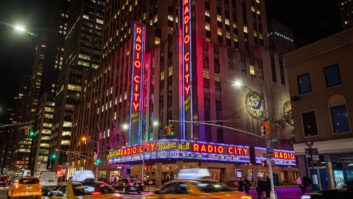
Speaking inside New York City’s Radio City Music Hall, which has just installed its own Sphere Immersive Sound system, David Dibble, Special Advisor to the Executive Chairman and CEO of Sphere Entertainment, told Mix that the near future will likely see the company launch a touring version of the system, able to bring spatial sound to indoor and outdoor venues.
“The next turn in the product, the next crank, which is on paper, designed, engineered and waiting to get the blessing…that is the game changer,” he said. “That is a touring product. Put it in the truck, rack it, stack it. [Use it for] music festivals, outdoor stage isolation, existing venues. These systems are substantial, but these are much lighter weight than what we have in Las Vegas.”
ROLLING INTO RADIO CITY
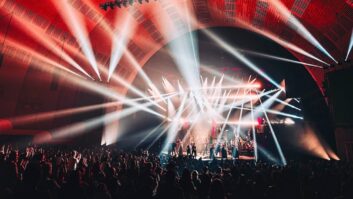
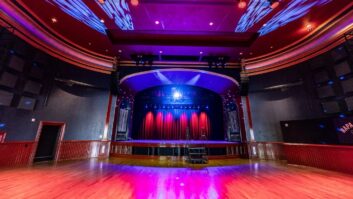
Thousands will experience Sphere Immersive Sound for the first time over the holiday season inside Radio City Music Hall, where the technology is adding spatial audio to the current 92nd annual Christmas Spectacular Starring the Radio City Rockettes holiday show.
The Radio City system may be the latest iteration of Sphere Immersive Sound, but it’s not the first time the technology has been deployed outside of Las Vegas. Jointly developed by Sphere Entertainment and Berlin, Germany-based audio manufacturer Holoplot (which has since become a Sphere Entertainment subsidiary), the system was created with the massive Las Vegas venue in mind, but made its debut a year earlier. In 2022, the spatial audio P.A. was installed at New York City’s Beacon Theatre, turning the venue into a real-world proving ground for the technology as audio pros and tours came through. The new Radio City system, however, builds substantially on that earlier version.
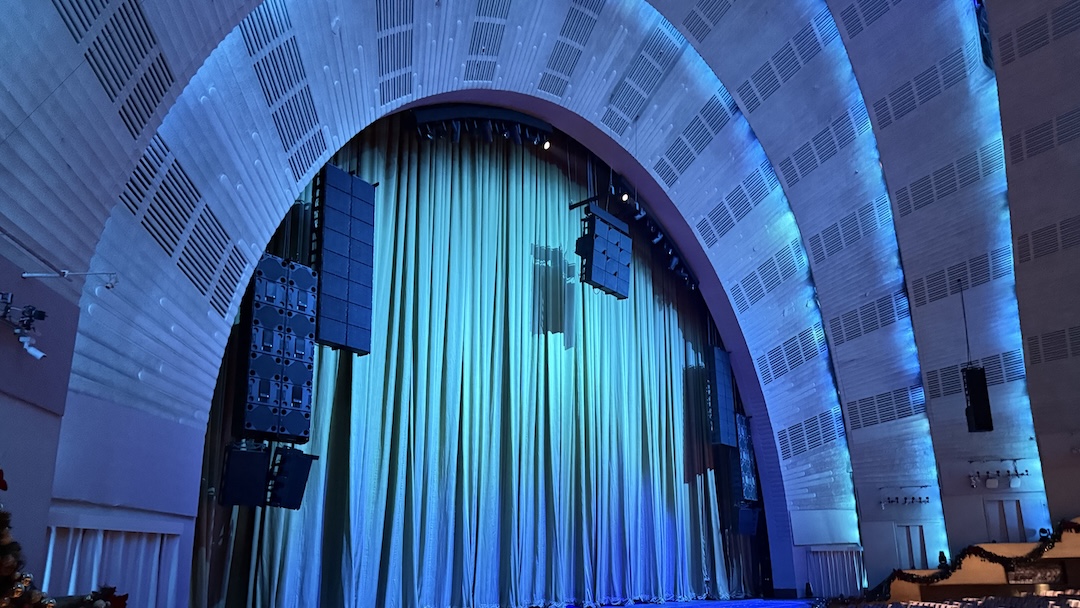
Inside Radio City Music Hall, the new system comprises more than 7,000 individually amplified loudspeaker drivers, and like the other Sphere systems, those drivers are all guided by custom software that allows artists and engineers to mix as usual on their own consoles and outboard gear, while also allowing productions to spatialize audio, sending different instruments or sounds to specific parts of a venue.
Conversely, for tours that want to stick with the typical stereo-style sound they have at any other venue, that’s entirely possible as well. The overall goal of the system is to uniformly cover the venue’s 5,960 seats so that all ticketholders have the same audio experience, regardless of whether they’re upfront in the orchestra or in the last row of the top balcony.
Inside the Audio Sphere
However, that use only scratches the surface of what the technology can do, because due to its tight beamforming, the system can provide tightly defined localization of sounds. As a result, audio content—say a speech given before an international audience—can be custom-tailored to different parts of a venue, so the speaker’s voice might be presented to the center of the audience while alternative translations are provided simultaneously to other sections of the room.
HIT THE ROAD
While the Beacon Theater system was proof that Sphere Immersive Sound worked, the new Radio City Music Hall system advances beyond previous iterations by introducing what Holoplot calls Intelligent Audio System Synthesis. The new feature allows non-Holoplot speakers to be used in conjunction with a Sphere Immersive Sound system, and that helps pave the way for the technology to be used across a variety of venues in the future. Case in point: The Sphere Immersive Sound arrangement at Radio City makes use of L-Acoustics loudspeakers for surround hangs and underbalcony fills.
Does that set the stage for the immersive technology to be used without Holoplot loudspeakers? Unsurprisingly, no. It does, however, mean that a Holoplot system can tie into parts of a pre-existing house system, making the emergence of touring Sphere Immersive Sound systems in the future far more likely.
Dibble sees outdoor usage as a perfect application for the technology, citing its use of beamforming as a good fit for outdoor events in heavily populated areas where show volume needs to be contained. “There’s an outdoor music festival market begging for stage isolation, or even musical instrument isolation,” he said. The next iteration of Sphere Immersive Sound could provide that: “Why wouldn’t we get it ready for outdoor? Seriously, that’s not a heavy lift; this is UL rating and IP certifications.”
Discover more great stories—get a free Mix SmartBrief subscription!
There’s plenty of other possibilities for Sphere Immersive Sound’s future beyond touring, of course. With its installation in two major venues owned by Sphere Entertainment’s sister company MSG Entertainment, it may only be a matter of time before the technology lands at other related venues, like Chicago’s eponymous Chicago Theatre, or the namesake itself, Madison Square Garden.
Whether any of that will happen is unknown, but some things are certain. As the new audio system of the Christmas Spectacular, Sphere Immersive Sound will bring the Rockettes’ tap shoes into the ears of 217 different audiences by the turn of the year—and starting in January, all concerts and events held at Radio City Music Hall will use the technology going forward.