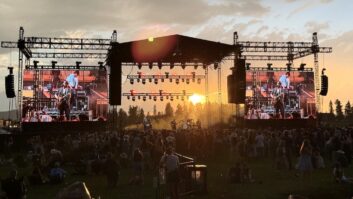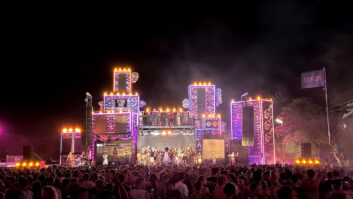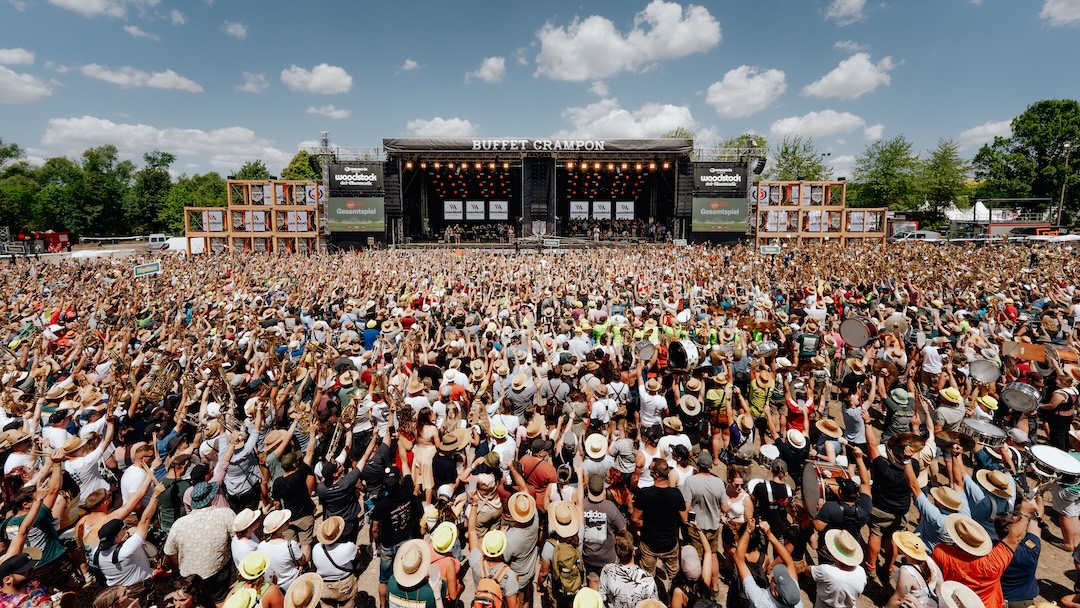
Ort im Innkreis, Austria (November 2, 2026)—There’s a lot of festivals out there, but few are more unique than Woodstock der Blasmusik—a.k.a Woodstock of Brass Music. Every year more than 110,000 music lovers descend on Ort im Innkreis in Austria to hear 150-plus bands on two main stages. Bringing every triplet on a tuba to the crowd is German production company Session Pro GmbH, which has provided sound and lighting technology for the event since 2012.
• Discover more great stories—get a free Mix SmartBrief subscription!
This year, Session Pro outfitted the mix positions with Allen & Heath dLive desks, including DM64 MixRacks, two S7000 surfaces at FOH and two S3000 surfaces at monitors, alongside an SQ-Rack for announcements. While the two stages had separate FOH and monitor positions, the audio team also needed to be able to share channels and wireless systems between both locations. Fortunately, dLive allowed channels to be shared between the two stages digitally, allowing wireless channels from one stage to be reassigned to the other without any physical rewiring.
The system’s flexibility was also put to the test when integrating the festival’s OB truck. “My slots were already full and I still had to connect the OB truck,” said Alexander Schad of Session Pro, “so I split the MADI card: one connection for the OB truck and one for FOH. At FOH I was running at 96 kHz, while the OB truck wanted 48 kHz; with dLive, that was no problem at all.”
• Steve Vai on Power, The ‘SatchVai’ Album and More
Another area where the desks provided an advantage was monitoring, as brass-based genres often require split-second timing. “Especially with sensitive musicians in jazz or classical music, it often comes down to one thing: latency,” said Schad. “That’s one of the areas where consoles truly differ. Sound quality is subjective, but latency is something musicians clearly notice because it changes a lot of what they hear in their ears.”