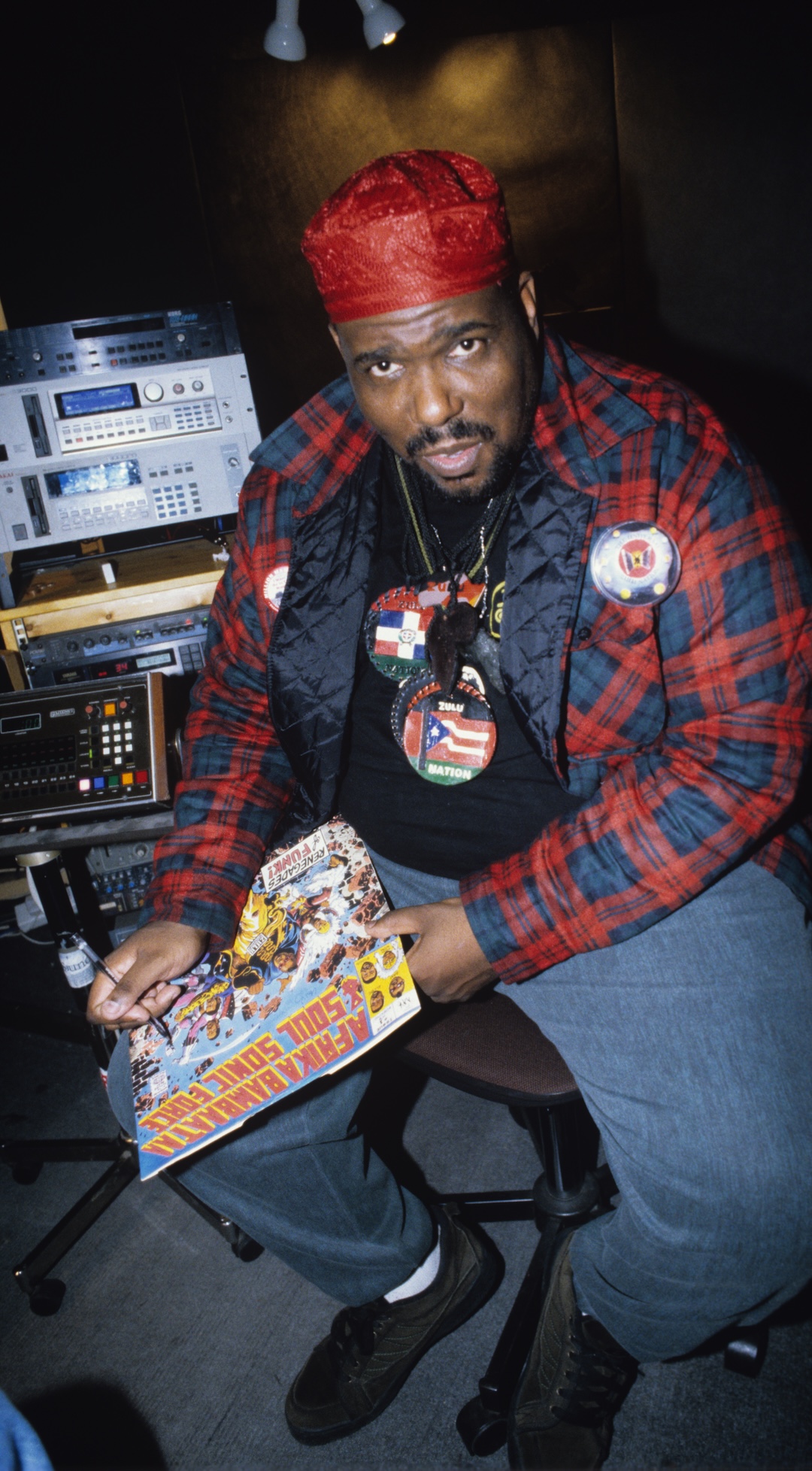
Pennsylvania (April 10, 2026)—Pioneering hip-hop producer Afrika Bambaataa—né Lance Taylor—died in his sleep Thursday, April 9, 2026, ending a battle with prostate cancer. One of the leading lights of hip-hop during the genre’s formative years, Bambaataa’s reputation was overtaken in recent times by accusations of sexual abuse during the 1980s.
Born April 17, 1957 in the Bronx, Taylor fell into gang life as a young teenager, but his direction changed radically when he entered an essay contest and won a trip to Africa. Inspired by what he had seen overseas, upon his return to the Bronx, he changed his name to Afrika Bambaataa Aasim, began DJ-ing and formed the Universal Zulu Nation, a youth-centric organization focused on cultural events that combined local music and dance elements to foster positive change in the community.
Bambaataa began hosting and DJ-ing large-scale block parties where he developed his hip-hop sound, incorporating break beats and an array of funk and electro tracks into his sets. As the events’ popularity spread, he co-founded multiple early rap crews, including the Jazzy 5 and SoulSonic Force.
Making inroads into the Greenwich Village post-punk dance music scene of the early 80s, Bambaataa moved into producing records and teamed with legendary dance producer Arthur Baker to create the breakout hit, “Planet Rock,” which married the propulsive sound of hip-hop to the burgeoning EDM/new wave sounds emanating from overseas. Drawing inspiration from sources as disparate as Germany’s Kraftwerk and Japan’s Yellow Magic Orchestra, Bambaataa interwove those sounds with hip-hop, classic 808 beats and primordial sampling.
• Van Halen / Doobie Brothers Engineer Donn Landee Passes at 79
Many of Bambaataa’s best-known productions of the era were collaborations, as he worked with the likes of James Brown on “Unity” and created Time Zone, an ad-hoc supergroup with bassist/producer Bill Laswell and ex-Sex Pistol John Lydon, for the hip-hop/alternative rock crossover hit, “World Destruction.” Bambaataa went on to appear in the film Beat Street (1984) and participated in the 1985 anti-apartheid charity compilation Sun City.
While his career cooled off in the years that followed, in 2012, Cornell University named Bambaataa a visiting scholar; the following year, his archives, including more than 30,000 vinyl records, cassettes and CDs, were donated to the university’s library. The collection is now the foundation of the Cornell Hip Hop Collection, which opened for public research in October, 2019.
In 2016, however, political activist Ronald Savage accused Bambaataa of having molested him in 1980 when Savage was 15. Savage later recanted some of the accusation, recontextualizing it that he had used a fake I.D. at the time so that he could work at Bambaataa’s block parties, and thus appeared to be a consenting adult. Savage and Bambaataa made amends in 2024, and Savage told allhiphop.com, “Bambaataa is not a pedophile and, in my eyes, he was doing something that was consensual with someone that he thought was of age.”
Nonetheless, in the wake of the initial 2016 accusation, other individuals came forward with similar claims, and the Universal Zulu Nation soon distanced itself from Bambaataa. In turn, the producer vehemently disavowed the accusations, telling Rolling Stone, “These allegations are baseless and are a cowardly attempt to tarnish my reputation and legacy in hip-hop at this time.”
Discover more recording stories—get a free Mix SmartBrief subscription!
A child sex trafficking lawsuit was filed against Bambaataa in August 2021 by an anonymous man; Bambaataa lost the case last year when he failed to appear in court, resulting in a default judgement.