As the broadcast industry moves toward more flexible production platforms, Calrec will present its evolving audio ecosystem at IBC 2026, on Stand 8.C47. The demonstration will include previews of enhancements to its ImPulseV DSP software, developed as part of the company’s ongoing commitment to the EBU’s Dynamic Media Facility project. To support the DMF Project, Calrec is also committed to adding support for the Media eXchange Layer (MXL) to ImPulseV.
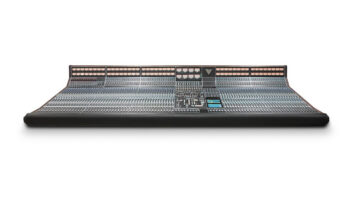
Throughout the show, Calrec will explain how its Argo ecosystem delivers at scale, combining physical and virtualised user interfaces as part of its software-defined ImPulseV engine, giving broadcasters freedom of choice in how they build and evolve their infrastructure. Handling up to 256 processing paths and supporting all immersive audio formats, ImPulseV can be deployed on-prem on a standard COTS server, on public cloud infrastructure, or across a hybrid. It can be accessed from any Calrec Argo surface, or via the browser-based Calrec Assist interface, giving broadcasters the freedom to scale depending on the size of the project.
New, smaller DSP pack sizes of 96 and 140 processing paths join the existing 256-path configuration, tailored for smaller systems that still demand uncompromising, broadcast-grade audio performance. Calrec has also introduced short-term, flexible licensing options, including 1-year, 12-week and 4-week subscriptions. This lowers the barrier to entry for ImPulseV, giving broadcasters production capacity exactly when they need it, without long-term commitments or high upfront costs, making it ideal for temporary, variable or one-off productions.
Introducing ImPulseV v1.5
As part of Calrec’s ongoing work with Grass Valley’s AMPP ecosystem, ImPulseV will support the AMPP control SDK, giving applications running on AMPP direct control over console parameters, including fader control. This is supported by ImPulseV 1.5 update demonstrated at the show.
Calrec’s new AMPP Bridge control application installed as a workload on an AMPP node, will provide bidirectional control between an ImPulse core and the AMPP environment. Calrec-Bridge carries control data with AMPP handling audio through Dante, NDI and ST-2110 interfaces.
ImPulseV will also be available on the NEP Platform, a service offering orchestrated, rapid deployment of leading production applications like ImPulseV on server-based hardware, unifying multi-vendor applications into a single interface for end-to-end production workflows.
Support for COTS hardware reduces reliance on niche equipment, with Calrec currently benchmarking ImPulseV’s performance on standard server hardware. ImPulseV will also include NDI connectivity as an alternative to Dante for routing audio into and out, supporting up to 256 mono-equivalent channels across a maximum of 16 streams, with up to 64 channels per stream.
ImPulseV will also add support for automated deployment using Cloud-Init and Terraform, tools that let broadcasters set up and configure new systems automatically rather than manually. Cloud-Init modules can configure surface layout, system and core names, manage licences, and DSP engine addressing. New ‘Online’ licences handled through an online licensing server, allow licenses to be added via key rather than file, and work with automated deployment. Terraform support is provided via example scripts from Calrec, which can be edited for individual deployments.
Henry Goodman, Director of Product Management at Calrec says, “The ImPulseV DSP software enhancements previewed at the show align with the EBU’s Dynamic Media Facility (DMF) project. The idea of a shared server stack that can host all the production software a facility needs, with users spinning up whichever tools a given job requires, is a powerful driver for broadcasters focused on reducing costs and maximising their investment to deliver a broader range of content.
“The DMF project and the associated Media eXchange Layer (MXL) development aim to solve many of the real-time challenges of moving to software-defined workflows. It vastly reduces compute by enabling containerised software functions from multiple vendors to use shared memory to transfer video, audio, and metadata on the same server.
“It gives broadcasters the ability to take advantage of best-of-breed technology within the same flexible software stack, while retaining the tried-and-trusted feature set they’ve come to expect from Calrec, without committing to a one-off investment in processing hardware up front.”
Calrec will also give visitors to IBC 2026 a first look at its Argo v1.5 software release, part of its ongoing commitment to continually developing and enhancing the Argo ecosystem.
Key enhancements to Argo v1.5
The new update will allow Offline Assist users to access the Argo Assist UI to configure shows, memories and presets without an ImPulse core or Argo surface, including importing a ‘Desk Package’ to configure against a specific physical surface. Also included are new True Peak Limiters, keeping audio in line with broadcast loudness standards, with 64 channels available in Assist, assigned per leg.
I/O patching has been streamlined: Desk Outputs and Desk Inputs have been renamed, and fader inputs now sit in their own discrete category, delivering faster switching when patching.
A new Bulk Advanced Configuration option lets users save advanced device settings across multiple devices in one action, specifying which options to save, and which devices to save them to. Calrec Connect will also display richer stream information for third-party transmitters, including channel count, packet time, sample rate, codec, media clock offset and payload type.
“Ultimately, these updates are about giving broadcasters greater freedom by delivering an infrastructure that fits today’s production requirements and adapts to tomorrow’s,” says Goodman.
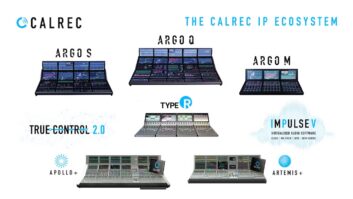
That freedom extends across the whole Calrec IP-native ecosystem, with the award-winning Argo console range at its centre. It’s a platform that supports a broad range of production workflows, giving broadcasters the flexibility to deploy resources where they’re needed most while driving greater operational efficiency and cost savings.