— Custom House’s Davey Rieley works closely with Full Sail University and Genelec to transform existing production rooms into identical Dolby Atmos® learning environments —
Nashville, TN — Custom House at Guitar Center, the premier destination for customized professional audio solutions, recently worked with Winter Park, Florida-based Full Sail University to support the school’s expansion in immersive audio education, collaborating to equip ten identical on-campus Dolby Atmos® studios designed to give Recording Arts students hands-on experience with the technologies and workflows they will encounter upon graduation in today’s professional production environments.
The project represents the latest chapter in an ongoing relationship between Full Sail University and Custom House at Guitar Center, with Davey Rieley, Custom House Executive Account Manager, working closely with Full Sail’s audio team throughout the transition. Building on Full Sail’s existing relationship with Genelec and its experience using the company’s monitoring systems, Genelec became the natural loudspeaker choice as the university upgraded a group of existing 5.1 post-production rooms into 7.1.4 fully immersive Dolby Atmos environments.
The studios are part of Full Sail’s “Mix Palace,” a facility originally designed around individual production rooms that allowed students to work independently rather than sharing a single large-format studio environment. The facility previously included twelve stereo rooms and twelve 5.1 post-production rooms. As immersive audio became increasingly important to professional music and post-production workflows, Full Sail saw an opportunity to evolve the existing spaces and provide students with practical experience working in Dolby Atmos.
“The move to Atmos was really a necessity,” says Darren Schneider, Course Director for Advanced Session Recording at Full Sail University. “Students need to leave here understanding the basics of Atmos. There are ways to introduce immersive audio through binaural monitoring, but we already had these rooms and Genelec monitoring in place, so it made sense to build on that foundation and give students the opportunity to actually hear and work with Atmos on speakers.”
Full Sail’s emphasis on real-world technology was a major factor in the system design. Rather than choosing equipment specifically for an educational environment, the university strives to expose students to the same tools and workflows they are likely to encounter after graduation.
“The gear that’s in a room is there because it is what the industry is using,” Schneider explains. “Our goal is always to ask: What are students going to leave here and see in the real world? Increasingly, they’re going to see Atmos rooms. We want them to understand the concepts, the signal flow and the I/O, and, most importantly, have the experience of actually hearing immersive audio on speakers.”
Each of the ten rooms features a 7.1.4 Genelec monitoring system, with 8340A Smart Active Monitors serving as the L-C-R channels, 8330A Smart Active Monitors deployed for the surround and overhead positions, and dual 7360A Smart Active Subwoofers. Working collaboratively, Custom House, Genelec, Dolby and Full Sail’s Darren Schneider refined the system configuration, selecting the larger 8340A monitors for the front L-C-R positions while utilizing the existing 8330A monitors for the remaining surround and overhead channels.
Consistency from room to room was another key objective. Full Sail created identical mounting structures within each studio, allowing speaker placement and distances to remain consistent despite minor architectural differences between rooms. The approach also provides flexibility should the university need to reposition or change monitors in the future. All ten rooms are configured and tuned to provide students with a consistent listening environment, allowing them to move a session from one studio to another with confidence.
Beyond monitoring, the rooms were designed to accommodate students at different stages of the Recording Arts program. Students can connect their MacBook computers via USB-C through an Apogee Symphony interface and work directly with the internal Dolby Atmos Renderer. As they advance, they can move to Full Sail’s house systems and external Dolby rendering workflows, with DADman control software providing routing to the monitoring system. This allows the rooms to support everything from a student’s first introduction to immersive audio through advanced music and post-production projects.
For Rieley and Custom House, the project extended beyond supplying equipment. His longstanding relationship with Full Sail provided an additional resource as the university evaluated its immersive workflow, monitoring requirements and future direction.
“Full Sail has always been very focused on giving its students access to the tools and technologies that are shaping the professional world,” says Davey Rieley. “With immersive audio becoming such an important part of music, post-production and entertainment, the goal was to collaborate with them to create rooms that wouldn’t simply teach Atmos in theory but would allow students to experience it the way professionals do. Genelec was a natural fit because Full Sail already utilized the platform, and the consistency we were able to achieve across all ten rooms gives students a tremendous environment in which to learn.”
Rieley’s involvement with Full Sail extends beyond equipment acquisition. He has participated in immersive-audio panels and educational activities at the university and has facilitated opportunities for students to experience emerging technologies, including Sony immersive-audio profiling. Schneider says that kind of continuing engagement is an important part of Full Sail’s relationship with Custom House.
The results, Schneider says, have exceeded expectations, particularly in the response from students. “We’re already seeing students asking for additional time in the Atmos rooms and choosing to create immersive deliverables. Hearing Atmos on speakers takes the experience to an entirely different level.”
Immersive audio is now being progressively integrated throughout Full Sail’s Recording Arts curriculum, beginning with introductory exposure and continuing through post-production, advanced Pro Tools and final-project coursework. The objective is not necessarily for every graduate to become an Atmos specialist, but for students to enter the professional world able to understand and communicate effectively within immersive production environments.
“Immersive audio is not going away,” Schneider concludes. “I don’t think every student needs to leave as an Atmos operator, but they need to be able to walk into the industry and operate intelligently with somebody working in Atmos or immersive audio. This is where the industry is going, and we want our students prepared for it.”
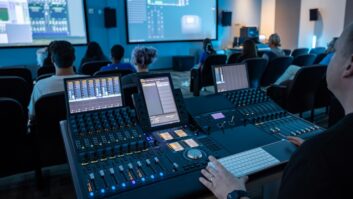
Photo caption: Full Sail’s “Mix Palace,” a suite of ten identical on-campus Dolby Atmos® studios, each featuring a 7.1.4 Genelec monitoring system composed of 8340A Smart Active Monitors serving as the L-C-R channels, 8330A Smart Active Monitors deployed for the surround and overhead positions, and dual 7360A Smart Active Subwoofers — the systems were recently outfitted by Custom House at Guitar Center.