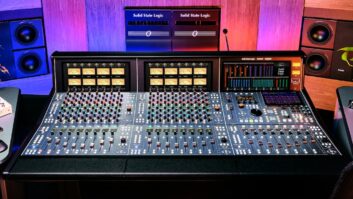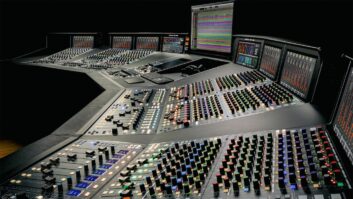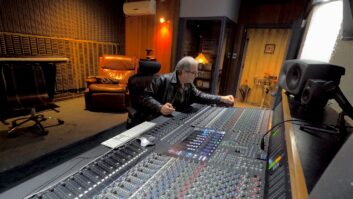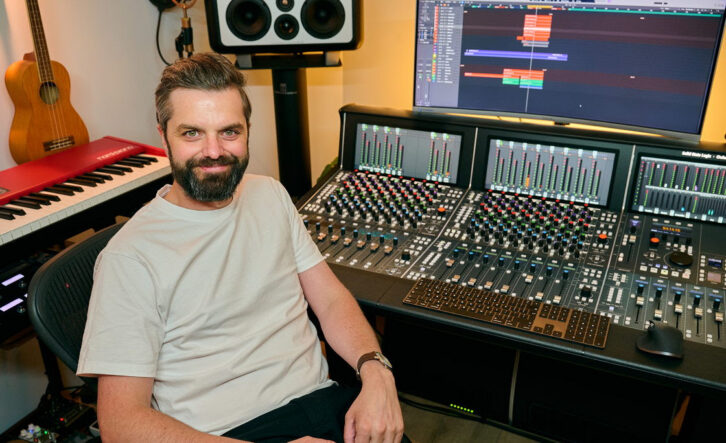
Milton Keynes, UK, August 17, 2026 — Songwriter, producer and musician Adam Argyle installed a Solid State Logic Oracle 24-channel mixing console at his home-based Vapour Trails Productions studio in Milton Keynes, England, at the beginning of 2026. The digitally controlled “Future Analogue” console has significantly improved the speed and efficiency in his room, says Argyle, who has collaborated with Dua Lipa, James Arthur, Five Seconds of Summer, James Bay, Olly Murs and many others.
Argyle explains that the upgrades to his workflow centre around one of the console’s core capabilities. “The biggest thing is the Instant Recall,” he says — Oracle’s ability to fully recall and reset every single function across the board. His previous console had only partial recall, which meant that he could never bring back a mix with the accuracy that he needed. “It was just a headache.” With Oracle, Argyle can jump between projects, for example, switching sessions to send someone an updated mix in response to their emailed notes before returning to his previous project quickly, efficiently and with 100% accuracy. That is the same as a DAW workflow, he points out, only — uniquely — with a fully analogue signal path.
Argyle started out in his teens as an artist and signed with a major label but shied away from the spotlight as a performer and came to focus on songwriting instead. “I infinitely enjoy being in the studio more and I love getting into somebody else’s head,” he says. “I can express a feeling or emotion more clearly when it’s somebody else that I’m writing for than when it’s myself.”

All wired in
The artists that Argyle writes with typically collaborate at his studio, but he invariably produces alone, recording drums, keyboards, guitars or whatever the song needs by himself. Oracle’s inline design means that his 24-channel console offers 48 simultaneous inputs, and he can introduce a further 16 lines through the stereo subgroup faders if he needs more inputs. That input capacity enables him to leave every instrument in his room permanently wired and ready to record.
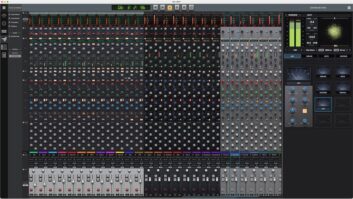
“I’ve got the drum kit in one corner, and the piano miked up. I don’t want to be constantly plugging and unplugging stuff,” he says. “I don’t have an engineer, so I want it to be quick and have everything miked up all the time and the levels set. The SSL console really makes a difference with that. It’s super-efficient on time.” He has set up a console template that streamlines the production process, regardless of which instrument he is tracking. “Once you’ve got the template set up in the O Control software it’s a breeze. I don’t even have to think about it. The only time I have to set any levels is when I have somebody come in and record a vocal,” he reports. “Then, when it comes to mixing, I can just switch to my mix template.”
.jpg)
“Everything just sounds so great.”
Argyle read up on the information about Oracle on SSL’s website, just as he was becoming frustrated with the limitations of his previous console. “I’d worked at a studio with SSL’s UF8 controllers and thought they were infinitely better.” Oracle’s fader panels are ergonomically similar to the UF8 but offer a significantly more premium experience when interacting with control and faders, plus the new console offered more inputs in the same footprint as his old board. Visiting SSL’s headquarters for an Oracle demo, he says, “Within about 20 minutes I was ready to buy it.”
He had assumed that Oracle would perform similarly to his previous console, but once it was installed, he says, “I really noticed the difference. Recording stuff through it instantly sounded better. And I’m not a mix engineer, I’m more of a producer, but mixing demos for people is so quick and everything just sounds so great.”
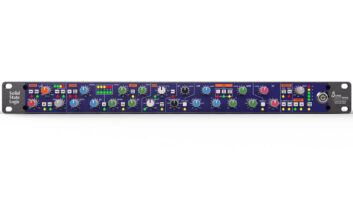
Argyle confesses that he rarely used SSL’s famed bus compressor before installing his Oracle. “It had never really excited me,” he admits. He’s changed his opinion now that he’s had some time to use the Oracle, which incorporates a fully recallable version of SSL’s award-winning THE BUS+ compressor. “The very first time I engaged that mix bus compressor, I could not believe how amazing it sounded, and the meter was hardly moving. That’s still how I use it. It provides the last 10 or 15% on a mix. Now it sounds like a record! So, for some reason, it took me by surprise, at the age of 45, how good a piece of equipment it is.”
.jpg)
Oracle’s ‘muscle memory’
As someone who records a lot of instruments, Argyle appreciates being able to rearrange Oracle’s input channel layout. “I’ve been doing that more and more recently,” he reports, and, again, it’s a feature that brings greater efficiency to sessions. “It means you can always have the same things in the same spots. You can lay it out the way that you want to see the channels, or the way that you’re used to doing things, and you begin to feel the muscle memory.”
With so many people working in a DAW these days, Argyle also appreciates being able to follow a similar workflow on the Oracle, switching the console surface to control the DAW. “The DAW control is fantastic, especially when I’m tracking,” Argyle says. “It’s really quick, and I can assign the soft keys to the functions I use all the time.” But while Oracle fits naturally into a modern DAW workflow, its analogue circuitry gives him something he says no computer can quite mimic. “I might only be using the SSL EQ on five or six channels, but it gets me to the sound I imagined at the beginning of the production much faster. Before I know it, it just sounds like a record. It’s a weird thing you can’t quite put your finger on — but you know it when you hear it.”
Argyle says he used to dream about sitting in front of a mixing console and making music when he was a youngster, but sometimes the production process can feel like hard work. “As lucky as I feel — and I really do — to be able to do this job, there are definitely days, if not weeks, where it feels like a real slog. But I’m excited every time I come into the studio and sit down at the Oracle. I look forward to getting to the end of a production so that I can mix on it again. And I look forward to getting to the end of a mix so that I can record on it again. To have something that makes you excited to come into the studio for another 10 or 12 hours every day is invaluable. It gives you the motivation to keep going.”
About Solid State Logic
Solid State Logic is the world’s leading manufacturer of analogue and digital audio consoles and provider of creative tools for music, broadcast, live and post production professionals. For more information about our award-winning products, please visit: www.solidstatelogic.com.