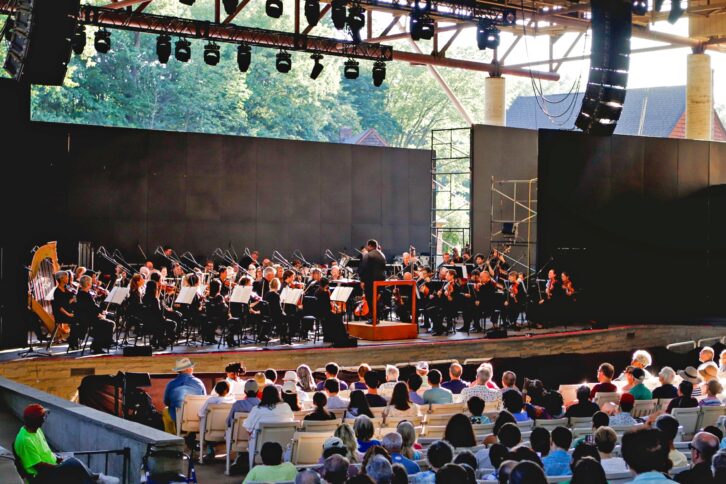
Cleveland Heights, Ohio—Evans Amphitheater at Cain Park in Ohio, one of the country’s oldest municipally owned arts parks, has replaced its 30-year-old sound system with a new Meyer Sound rig designed and installed by Tone Proper AV.
The upgrade centers on 16 Panther large-format linear line array loudspeakers and six 2100-LFC low-frequency control elements, delivering even coverage from the pavilion to the lawn while minimizing spill into the surrounding neighborhood.
Opened in 1938 as a Works Progress Administration project, the amphitheater has long been a cultural anchor for Cleveland Heights, but its aging sound system had served far beyond its expected lifespan. Cain Park production manager Scott Stanley explored numerous systems before purchasing the Panther system.
Stanley, who has three decades of experience in live sound, had first encountered Panther through a trusted colleague. “One of the guys I worked with told me, ‘You need to hear the system, it’s absolutely the most incredible system you’ve ever heard,’” he says. “For the dollar amount for the system that we got, it was the smartest path forward for us. For us, it was like jumping 40 years into the future.”
Tone Proper AV CEO Nick Moon says the choice of Panther over smaller line arrays was made with long-term flexibility in mind. “You want to have more than you think you need, because you never want to be in a situation where you’re wishing for more gas in the tank,” he explains. “With this system, that’s never going to be an issue.”
The partially covered, 3,000-capacity amphitheater sits in the middle of a residential neighborhood, a point of pride—and a constraint. “Right behind the lawn are houses,” Stanley says.
Discover more great stories—get a free Mix SmartBrief subscription!
Moon and team modeled the venue in Meyer Sound’s MAPP 3D system design and prediction tool, building arrays that keep energy in the listening area and out of the neighborhood. “We spent the time to make sure that the coverage was right on the audience, and nowhere else,” Moon says. “The subs are in a cardioid configuration…we were able to keep everything kind of right where we needed to keep it.”
That precision translates into a consistent listening experience across the venue. “When we got the system dialed into our space, you could walk from the front to the back and it doesn’t change at all,” Stanley says. “It was even more impressive than I was expecting.”